
We’re trialing a new kind of post: summaries of Fort Collins City Council meetings. Strong Towns has long argued that local government is the highest level of collaboration among people who actually live in a place together – the closest, most accountable layer of decision-making most of us will ever interact with. Council Work Sessions and Regular Meetings are where the work of that collaboration happens: where street designs, surveillance policy, housing rules, and budgets get shaped. Most residents don’t have time to watch three hours of Council a week, so we’ll try to give you the gist of what was discussed and where you can weigh in.
Meeting agenda, details, and video recordings available on Fort Collin’s Municode website. The next city council meeting is on May 19th and will be a regular meeting, that includes opportunities for public comment.
Flock Cameras and License Plate Readers
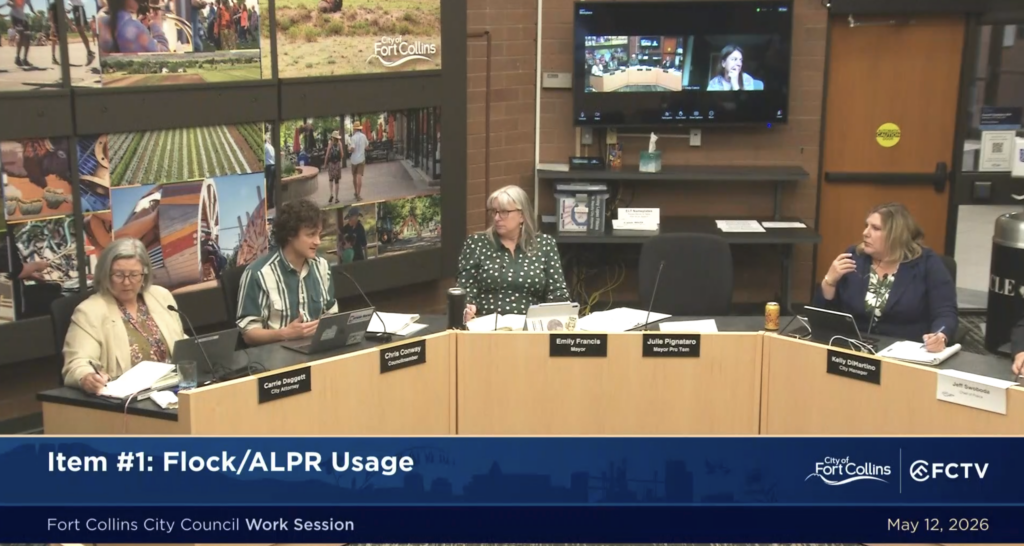
Fort Collins Police Services returned to Council for a follow-up discussion on the Flock automated license plate reader (ALPR) system, after a February work session and significant community feedback – including 33 residents who spoke against the system at a Council meeting.
Chief Jeff Swoboda opened by emphasizing that Flock has only been fully deployed in Fort Collins for about a year, that ALPR technology more broadly has been in the city for over a decade (it’s part of red-light and speed cameras too), and that the District Attorney has called the loss of ALPRs a “huge setback to community safety.” Several Council members had visited Police Services since February to see the system in operation.
Four options were presented by the Fort Collins Police Services:
- Continue current deployment while Council develops a technology use policy. The Flock contract runs through April 2027.
- Keep Flock but add controls. Specifically: reduce data retention from 30 to 23 days, add city-preferred contract language for misuse remedies, and post monthly audits publicly with an oversight body (potentially the Citizen Review Board) reviewing them.
- Discontinue Flock now and begin a competitive procurement process. The $48,000 already paid for the current year would not be recoverable, and there would be an investigative gap until a new vendor was selected.
- Eliminate ALPRs entirely – which could also affect red-light cameras, speed cameras, and other systems that use the technology.
Council members who had visited the Flock demo described what they saw. Chris Conway walked through the interface: officers log in with two-factor authentication, must enter a case or incident number, and can search up to 30 days of history. He noted that the system’s default network options make it easy to search broadly – Fort Collins shares with 67 Colorado agencies, and audit logs show roughly 40,000 monthly external searches of Fort Collins’s data. Melanie Potyondy noted that Flock contains no direct link to a driver’s identity; matching a plate to a person requires a separate database. Amy Hoeven described Flock as a “pointer system” that depends on existing federal and state crime databases – the National Crime Information Center (NCIC), run by the FBI, and the Colorado Crime Information Center (CCIC), the state equivalent – which is where stolen vehicle reports, warrants, and similar records actually live. Flock cross-checks plates it sees against those existing databases. She emphasized that Fort Collins shares Flock data only with Colorado agencies because they operate under the same state laws. Anne Nelsen drew a comparison to a recent local case in which a resident in her district was arrested on a weapons charge and was found to have been systematically logging vehicles passing his home – recording make, model, color, and timing. Her point was that the underlying act of recording who passes a fixed point is the same thing a Flock camera does, even though the legal and institutional context (a municipal contract with public safety purposes and oversight) is very different from an individual’s project.
Sergeant Bob Younger, who runs the department’s audits, explained the monthly process: internal audits show full information about Fort Collins officers’ searches; external audits show redacted information from other Colorado agencies (names and case numbers withheld to protect ongoing investigations), but each search carries a unique identifier so the department can contact the originating agency about anything suspicious. Younger acknowledged that an officer at another agency misusing the system using their own credentials would not show up in audits – the deterrent is criminal liability, since unauthorized database searches violate state law and can cost an agency its NCIC access.
Council discussed several specific concerns: an incident in which Loveland Police Department had granted federal authorities access to its Flock data during a Tesla arson investigation, and that access was subsequently used for an unrelated immigration-related investigation; whether private businesses with their own Flock cameras (currently about 50 in the city, compared to 15 owned by the city) raises broader surveillance questions; and whether the company itself could be trusted to operate within contract terms.
Where Council landed: Anne Nelsen indicated support for Option 2 (keep with controls). Amy Hoeven supported the Citizen Review Board as an oversight body. Emily Francis favored shortening retention to 7–14 days unless tied to an active investigation, restricting automatic sharing with communities whose values diverge from Fort Collins on issues like immigration and reproductive access, and adopting a broader surveillance ordinance. Melanie Potyondy was uncertain on which option but emphasized the need for stronger interagency agreements. Josh Fudge leaned toward Option 3, citing distrust of the vendor specifically. Julie Pignataro also supported Option 3 for similar reasons. Chris Conway supported a 7-day retention period and broader surveillance policy.
City Manager Kelly DiMartino summarized that staff would proceed with expanding Citizen Review Board oversight, bring back a proposal for a broader surveillance governance policy in the coming weeks, and that if Council wanted short-term contract changes (like retention reduction) before the full policy was developed, they could bring it up at the following Tuesday’s regular meeting.
Vision Zero
Vision Zero is the city’s adopted plan to eliminate serious injury and fatal traffic crashes by 2032. Council named it a priority during its retreat earlier this year, and staff presented an accelerated work plan.
Deputy Director Drew Brooks opened with the stakes: from 2021 through 2025, 40 families lost loved ones and 358 people experienced life-changing injuries in Fort Collins traffic crashes. The estimated annual societal cost of crashes – including medical care, lost productivity, and future insurance costs – is approximately $211 million. Brooks was direct that accelerating Vision Zero will require trade-offs: slower speeds, longer travel times, road diets, and parking removal that won’t be universally popular.
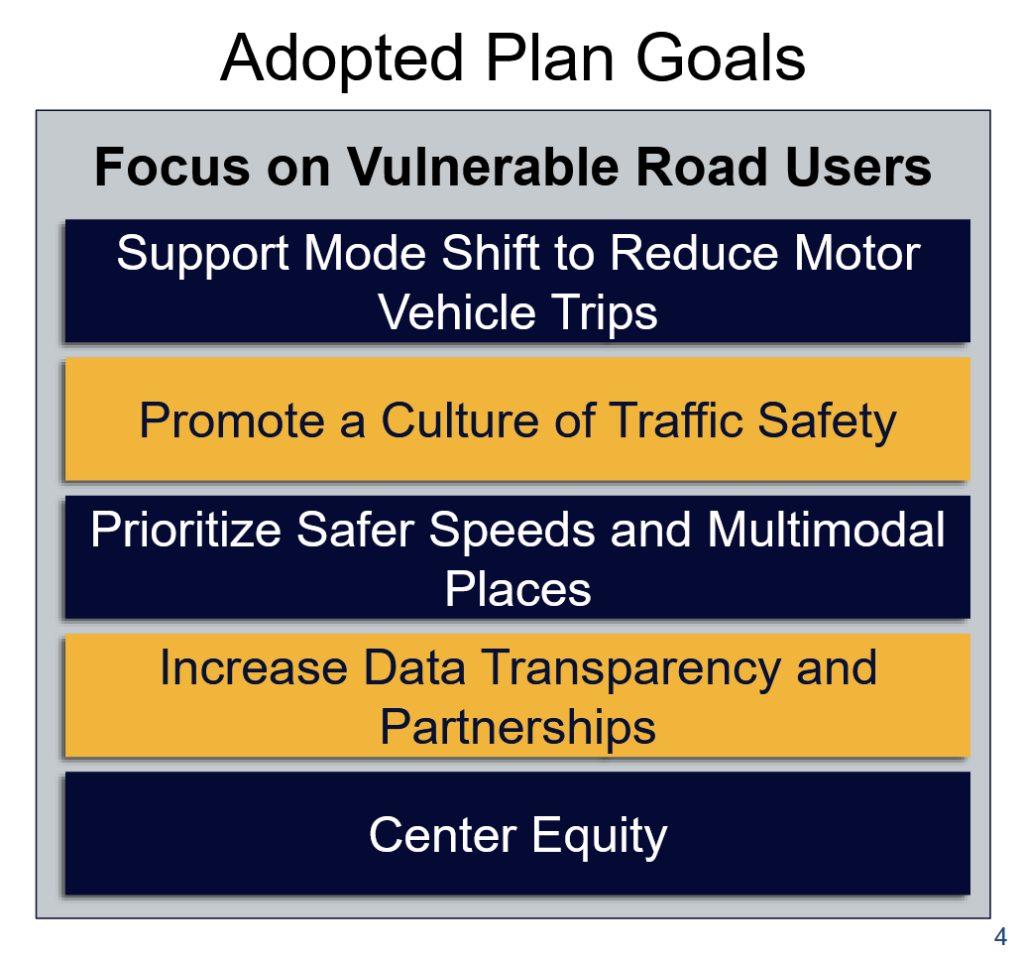
City Traffic Engineer Tyler Stamey shared key data: vulnerable road users (people walking, biking, or on motorcycles) represent about 7% of total crashes but 50% of serious injury and fatal crashes. The High Injury Network – the 8% of roadway miles where 60% of severe crashes occur – overlaps closely with the automated speed enforcement corridors. 2025 saw a 20% reduction in serious injury and fatal crashes compared to 2024.
Assistant Chief Kristy Volesky reported that the Traffic Unit has been fully staffed since 2023 and the camera-radar operator team expanded from 8 to 12 last year. The transportable speed cameras (the “R2D2”-shaped units) were deployed last July and are rotated through high-injury locations monthly. The current vendor contract expires in December, and the upcoming Request for Proposals (RFP) – the formal competitive bidding process the city uses to select a new vendor – will seek more flexibility, particularly the ability to redeploy units faster into construction zones, school zones, and emerging hotspots. Notably, Volesky reported that as of the meeting Fort Collins had recorded zero traffic fatalities in 2026; last year had six total.
FC Moves Manager Aaron Iverson covered the rest of the work plan: a federal Safe Streets for All grant application is being prepared, school safety assessments are being accelerated (12 completed so far, with funding sought to finish the rest in two years rather than ten), and a grant-funded review of the Larimer County Urban Area Street Standards (LCUASS), traffic code, and development code will begin in the coming weeks.
Council feedback was substantive. Melanie Potyondy asked about reporting smaller safety concerns and how the city could expand traffic safety education in schools, particularly for high schoolers. Josh Fudge raised specific locations including Twin Silo Park (a known late-night cruising hotspot) and Harmony Road, which is getting a corridor study covering everything from I-25 to JFK Parkway.
Anne Nelsen delivered the most extensive comments, connecting Vision Zero to the Council’s affordable and sustainable growth priority. Her specific requests:
- Explicitly adopt the National Association of City Transportation Officials (NACTO) design guides – including Designing Streets for Kids – as the city’s reference standard in the LCUASS update.
- Add active-modes trip share to the Vision Zero dashboard so it’s tracked alongside crash reduction, since both share the 2032 deadline.
- Make mode-shift consideration a policy commitment rather than just a checklist item before any lane-capacity additions.
- Highlight the cost-effectiveness argument: protected bike lanes and quick-build projects cost a fraction of arterial expansion, active modes don’t wear out roads, and transportation is the second-largest household expense – so genuinely usable active-mode networks are an affordability benefit.
Chris Conway echoed Anne’s framing and named specific Capital Improvement Plan projects he wanted reconsidered, particularly the Taft Hill Road expansion, which he argued contradicts Vision Zero goals despite being labeled as a safety project. He also pushed for a citywide review of speed limits using the city’s updated methodology (which now incorporates pedestrian volume, driveway density, and crash history rather than only the 85th-percentile-speed approach).
Emily Francis asked whether Fort Collins might consider blanket neighborhood speed reductions to 20 mph (as Boulder has done) without requiring engineering studies, as a possibly more cost-effective alternative to physical traffic calming.
Julie Pignataro closed with a request that staff bring forward the human stories behind project locations – examples she gave from past projects included a kindergartener with colorful socks and a recent Air Force Academy graduate. “Knowing that there is a person behind every dot and every data point is so important in this work.”
Community Engagement in Policy Making
The final item was a framework discussion rather than a decision. Chief Communications and Engagement Officer Amanda King and Senior Community Engagement Manager Heather Young walked through how the city defines and approaches community engagement.
Young described the city’s “engagement triangle” – three different things “engagement” can mean: informing decisions, building capacity (education and behavior change, like the “Slow the FOCO Down” campaign), and strengthening relationships. She also revisited the International Association for Public Participation’s spectrum (Inform, Consult, Involve, Collaborate, Empower), which Fort Collins has formally adopted as its framework. The Hughes Stadium Civic Assembly was offered as the local example of “Collaborate.”
A public engagement assessment was completed in 2025, and the centralized engagement effort is meant to be budget-neutral, leveraging existing staff and resources rather than adding new ones.
Julie Pignataro raised a concern she’s brought up before: making sure Council and staff align on what level of engagement is appropriate for a given decision. She offered two examples – a past renaming of “climate change” to “climate emergency” that she said was a pure policy call requiring no engagement, versus the Hughes Stadium process which was extensive collaboration. Amanda King agreed that scoping should explicitly address whether the community has a role in the decision, and pointed to trash contracting as an example where earlier efforts had been misaligned but the most recent round was successful as a robust outreach-and-education plan rather than a feedback-solicitation one.
Chris Conway raised an equity point: when 10 or 20 residents speak at a Council meeting, that is one slice of the community – typically a more privileged slice, statistically – and policy that genuinely serves all of Fort Collins requires reaching residents who don’t know when Council meets, including students, single parents, and historically underrepresented groups. “It’s really easy to hear 15 people say something and think the community has spoken.”
Anne Nelsen built on that thread: the highest-value contribution the engagement office can make to Council is representing the voices of people not in the room.
The session adjourned without announcements.
Work session materials, including the full agenda packet and staff memos, are available on the City of Fort Collins website. Work sessions are open to the public and televised on Channels 14 and 881, and livestreamed at fortcollins.gov/fctv.
Leave a Reply