
Overview
The Fort Collins City Council held its regular meeting on July 21, 2026, its first Tuesday meeting after a summer stretch without one. All seven members were present: Mayor Emily Francis, Mayor Pro Tem Julie Pignataro (District 2), and Council Members Chris Conway (District 1), Josh Fudge (District 3), Melanie Potyondy (District 4), Amy Hoeven (District 5), and Anne Nelsen (District 6). City Manager Kelly DiMartino previewed “a full night”: a 32-item consent calendar, four discussion items, roughly two dozen public speakers, and a closing executive session. Two neighborhood issues – paid parking in Old Town and a proposal to graze pigs on weeds at Rigden Farm – dominated public comment, while the council’s most substantive debate centered on water.
Meeting agenda, details, and video recordings available on Fort Collin’s Municode website. The next city council meeting is on July 28th and will be a work session, that does not include opportunities for public comment, though the public is welcome to attend and watch.
Disability Pride Month proclamation
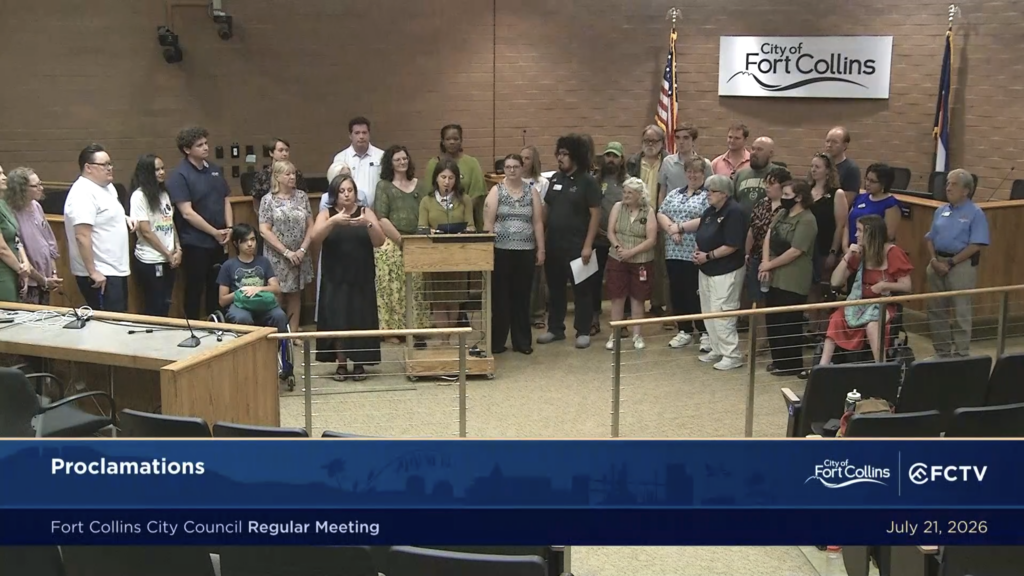
The evening opened at 5 p.m. with a proclamation declaring July 2026 Disability Pride Month, accepted by People First of Larimer County. A group representative described a year of advocacy that included work on a state host-homes safety bill and a trip to Washington, D.C., to advocate for Medicaid. A longtime city employee who accepted the proclamation said she was grateful for the support she has received over 29 years.
Community report: Youth Advisory Board
Four members of the city’s 12-member Youth Advisory Board – students from Fort Collins’ four large high schools, with Parks and Recreation Director LeAnn Williams as staff liaison – reviewed the board’s year. Their projects included integrating CPR, AED, and “Stop the Bleed” training into high schools alongside Poudre Fire Authority; a neuroscience and healthy-habits program piloted for middle schoolers at Blevins Middle School with a local suicide-prevention nonprofit; e-bike and environmental-awareness work, including a letter the board says influenced the city’s negotiations with its e-scooter operator over age restrictions; and an upcoming vaping-education effort. The group also attended the National League of Cities conference in D.C. Council members praised the board, several noting that the students design programs meant to continue after they graduate.
Public comment
Twenty-six people signed up to speak before the 5:30 deadline; about 23 actually spoke, each held to two minutes because of the long agenda. Comments clustered around a few themes.
Paid parking in Old Town
Context: The city has been studying paid on-street parking in Old Town to help cover parking-system and garage-maintenance costs. A council work session on the topic is scheduled for early August, and much of the night’s turnout came to weigh in ahead of it. (We’ve previously covered the issue of paid pakring in a series of articles).
Eight speakers addressed parking, most of them opposed. They included a downtown store owner of 46 years, a credit-union branch manager whose Old Town branch serves quick visits, a tea-shop owner active in a parking-advocacy group, and a downtown employee who read off a list of “unanswered” questions about cost and enforcement. One speaker who said she represents about 120 downtown businesses cited an 11,000-signature change.org petition and argued the city is not ready, asking the council to “keep bringing us to the table.” One resident spoke in favor, framing free parking as a large hidden subsidy, addressing some of the criticisms heard that night and suggesting dynamic pricing as a data-backed solution. A west-side resident who managed the city’s 2017 downtown plan urged the council to weigh downtown’s outsized role in sales-tax revenue before acting.
Pigs at Rigden Farm
Context: A consent-calendar item would let the Rigden Farm Homeowners Association use up to 15 pigs to eat kochia – an invasive weed – on part of a neighborhood park, as a chemical-free alternative to herbicides. The neighborhood converted from bluegrass to native grass years ago and has struggled with weeds since.
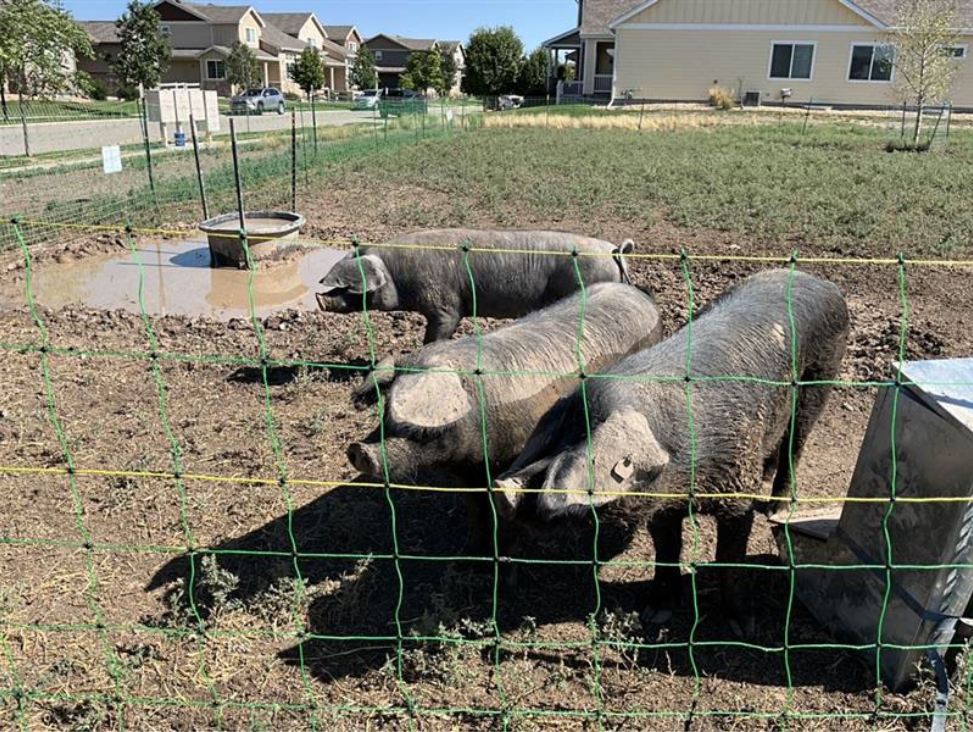
Seven speakers weighed in. Several HOA board members and the association manager supported the pigs as an eco-friendly, expert-recommended method; one speaker, a cancer survivor, contrasted the pigs favorably with herbicides and closed, “Please vote for my pigs.” Two neighbors opposed the plan, citing odor, noise, and the lateness of the season, and questioned whether earlier pig grazing had actually worked. One resident offered qualified support, urging safeguards and pointing to established grazing programs in Boulder and Jefferson counties as models.
Disability rights
Two speakers, including the co-founder of a local disability-advocacy group, said the proclamation needed to be backed by action. They referenced a July 20 U.S. Department of Justice clarification on the Olmstead decision and pressed the council on accessible-housing wait lists and blocked sidewalks: “We don’t want performative gestures. We need real support through the protection of our human rights.”
Other topics
Individual speakers raised several other issues: keeping the Halligan Reservoir project rather than joining the Northern Integrated Supply Project, or NISP (a speaker identifying himself as a PhD ecologist and 32-year utility customer); banning animal testing within the city; support for a building-performance grant on the consent calendar (a Fort Collins Sustainability Group member); and concern about local police cooperating with federal investigations of nonviolent political activity. One commenter flagged what he read as errors in the consent-calendar sentencing item and questioned several other items.
Public comment follow-up
Council Member Nelsen, an architect, responded to the disability comments by explaining that the city’s building code adopts accessibility standards (ANSI A117.1) that closely track the Americans with Disabilities Act, and offered to meet offline about specific requirements and about reporting sidewalks blocked by city vehicles; DiMartino pointed residents to the Access Fort Collins tool. Council Member Potyondy thanked the disability community and acknowledged that federal actions have left many “understandably nervous, scared, and feeling discriminated against.” Mayor Pro Tem Pignataro previewed the August parking work session, asked staff to double-check the sentencing item, and noted the agendas are assembled by people, not AI, so any discrepancy would be human error.
Consent calendar
The consent calendar bundles items expected to pass without controversy – routine first and second readings, resolutions, and administrative actions – into a single vote, and any council member can pull an item for separate discussion. Many of these items are the latest step in multi-year efforts, so the one-line descriptions rarely capture the full backstory.
This calendar held 32 items, including a $72.5 million appropriation for the southeast community recreation center (a LEED Gold building), a $3.8 million Colorado Energy Office grant supporting transportation-safety and building-performance work, the conveyance of a city property at 314 North Howes Street – the current EcoThrift site – to Housing Catalyst for affordable housing, the Rigden Farm pig proposal (recommended 5-1 by the Planning and Zoning Commission), a Cargill water-share exchange, a distributed-energy agreement with Platte River Power Authority, and a $1.8 million clean-fleet grant. Council pulled item 25; the rest passed 7-0. Afterward, Nelsen praised EcoThrift’s waste-diversion role, arguing the city should support the circular-economy businesses its climate goals rely on.
Discussion items
Long-term water rental policy (item 25)
Potyondy pulled this resolution, which would create a framework for water leases longer than the city’s standard one-year agreements. One Water’s Jen Dial (Water Resources Manager) and Nicole Poncelet-Johnson (One Water Director) fielded detailed questions. Staff explained that a neighboring town, Windsor – facing delays to its own reservoir – prompted the change, and that any lease would bar deliveries during declared water restrictions and return to council for approval, with annual fees in the range of $50,000 to $75,000.
Potyondy voted in favor but was candid that she leaned the other way, saying she found “more compelling arguments for keeping what we have.” Fudge said his main concern – keeping water the city needs – was resolved by the restriction provision. Hoeven, reflecting on the drought, said, “Being a fourth-generation Coloradan, I’ve never seen it like this, and it has scared me,” but was reassured by staff. The resolution passed 7-0.
DOLA grant items (items 33–35)
Mayor Francis recused herself from three items tied to the Colorado Department of Local Affairs, citing her role there, and Pignataro chaired. Council gave second-reading approval to a housing action plan (6-0) and to a $792,434 appropriation for infrastructure serving the Switchgrass Crossing affordable-housing development (6-0).
On first reading of an Accessory Dwelling Unit grant – $157,000 from DOLA with an $83,000 match – Clay Frickey (City Planning) and Carisa Clinton (Grants Administration) explained the money would fund pre-approved ADU designs and fee waivers for about four units, with the match drawn from an existing energy-efficiency project. Potyondy voted yes but said she was uncomfortable using climate-tax dollars for the match and would prefer affordable-housing funds; she asked staff to explore reallocating the money and to estimate the emissions benefit before second reading, adding she was “not going to die on this hill.” Nelsen and Fudge spoke in support, and the item passed 6-0.
Orphaned oil and gas wells (item 36)
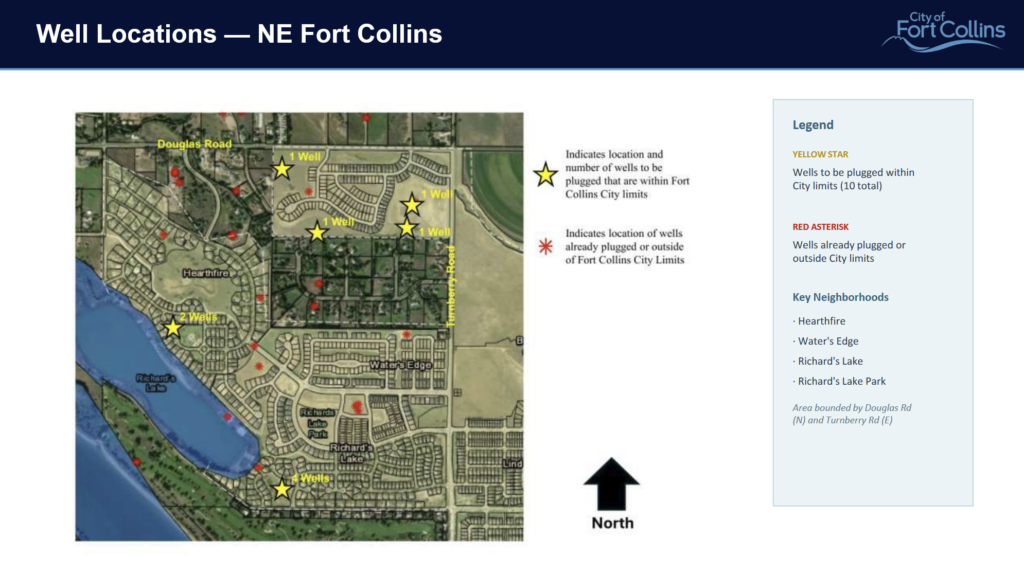
With the mayor back, Senior Environmental Planner Kirk Longstein and Larimer County’s Rebecca Everett presented an ordinance waiving Basic Development Review to speed a county-led cleanup – what Longstein called “a good news story.” The city’s only operator, Prospect Energy, lost its state license in August 2024 after years of violations, leaving 50 orphaned wells in the Fort Collins Field, 10 of them within city limits in the Hearthfire, Richard’s Lake, and Country Club Reserve neighborhoods. A $5.2 million state grant will plug and clean all 50 by 2028. Conway called it a long-sought win for families worried about health and safety, and Nelsen thanked the Air Quality Advisory Board and the county. Fudge, a county employee, noted the item posed no conflict for him. It passed 7-0.
Council reports
Potyondy highlighted a meeting with the Adelante Youth Fellowship and a news story crediting a Poudre River flows plan the city helped build. Fudge reported attending the Front Range Passenger Rail brand launch and reminded residents of the “Kids in the Park” event on July 31 at Twin Silo Park. Mayor Francis thanked the community for the Fourth of July and noted there will be no meeting on August 4 because of Neighborhood Night Out.
Adjournment
In other business, the mayor recognized a departing graduate management assistant leaving to pursue a doctorate. The council then voted 7-0 to enter an executive session on strategy for potential business-incentive negotiations, after which the mayor closed with her customary sign-off: “Good night, Fort Collins.”
Leave a Reply