
The seven-member Fort Collins City Council includes a mayor elected citywide and six members elected by district. Regular meetings are where council takes formal action, voting on ordinances, resolutions, contracts, and appeals. Most ordinances require two votes, called readings, at separate meetings before they take effect. Each regular meeting includes a public comment period where anyone can speak to council on any topic, in person or remotely.
Overview
Council held two meetings on September 15, 2026: a Regular Meeting, followed by a Work Session. The Regular Meeting’s main vote was a Land Use Code change to speed up city review of most housing projects, which council passed on first reading, 5-2. The Work Session was the first of three on the city manager’s recommended 2027–2028 budget and covered Community Services; Community Development, Housing and Sustainability; and Transportation.
All seven members attended both meetings.
Present:
- Mayor Emily Francis
- Chris Conway, District 1
- Julie Pignataro, District 2 (Mayor Pro Tem)
- Josh Fudge, District 3
- Melanie Potyondy, District 4
- Amy Hoeven, District 5
- Anne Nelsen, District 6
Absent: None
Part 1: Regular Meeting
Awards and Proclamations
Mayor Francis read three proclamations. The first declared September 24 Bette Sears Bike Lane Appreciation Day, honoring the resident whose 1970 petition led to the city’s first bike lane; Fort Collins now has more than 185 miles of them. Her husband, Bill Sears, accepted. A Daughters of the American Revolution representative accepted the proclamation for Constitution Week (September 17–23).
Latinx/Hispanic Heritage Month (September 15–October 15) was read in English and Spanish. Grace Moreno of the Colorado Hispanic & Latino Heritage Fund accepted it and described the group’s plans for a museum in Denver. She invited residents to a community session on October 17, 11 a.m.–2 p.m., at Old Town Library.
Public Comment
Sixteen people signed up to speak, 12 for general comment and four for the housing item. Eleven of the 12 general speakers appeared.
Platte River Power Authority’s carbon goal (4 speakers)
Context: Platte River Power Authority (PRPA) is the public utility that supplies wholesale electricity to Fort Collins and three other northern Colorado towns. In 2018, it set a goal of 100% non-carbon electricity by 2030.
Four speakers asked council to oppose any move by PRPA to drop that date. One said doing so would “make a mockery of the original goal” and argued that PRPA’s sale of renewable energy credits undercuts the city’s own climate targets. A retired utility engineer asked that Fort Collins, as a part owner, press PRPA to study a plan that would let the city meet its goal.
Housing review (3 speakers)
Context: The housing ordinance on this agenda would let staff approve most housing projects without a public hearing. It is covered in detail under Discussion Item below.
Two speakers supported the ordinance, one of them asking:
How many years should it take to build a home?
A multifamily architect among them said existing city standards already cover what public hearings typically raise. The third speaker asked that the September 1 minutes be amended regarding comments made about council’s Ad Hoc Committee on Affordable and Sustainable Growth.
Animal testing (2 speakers)
Two speakers asked council to pass a resolution supporting alternatives to animal testing.
Parking permits and Lincoln Center fees (2 speakers)
Context: RP3 is the city’s Residential Parking Permit Program, which limits non-resident parking in some neighborhoods near Colorado State University (CSU). The Lincoln Center is the city-owned performing arts venue.
One resident objected to a new charge for a household’s first RP3 permit. A nonprofit theater leader said rising Lincoln Center fees would cost his company about $4,000 more this season and asked for a cost-recovery policy with a ceiling:
Every additional dollar that [we pay] in facility fees is a dollar that I cannot pay an artist.
Public Comment Follow-Up
Councilmember Hoeven said that at the last meeting she had asked for a pause on the new RP3 rates, and that staff has since put one in place. Mayor Pro Tem Pignataro told the animal-testing speakers that a supportive resolution is on her list, though council’s attention is on the budget for now.
Consent Calendar
The consent calendar bundles items expected to pass without debate, and any council member can pull one for separate discussion. No one did, and council approved all 19 items 7-0. Many are the latest formal step in projects years in the making, which a one-line listing can’t fully capture. The items included $5.5 million from the statewide Extended Producer Responsibility (EPR) recycling program, $103,500 for a Community Arts and Art in Public Places (APP) Master Plan, and a $72,700 state grant for fishing improvements at Arapaho Bend Natural Area. Council also gave the Montava development up to two more years to close its land purchase, created a 90-day residency grace period for board and commission members, and allowed restitution for victims of petty offenses. Resolution 2026-113 sets the budget public hearings for October 6 and October 20. The rest covered federal housing grants, Utilities billing software, a North Mason Stormwater design contract, two historic landmark amendments and year-end budget adjustments.
Discussion Item: Faster Review for Most Housing Projects
Ordinance No. 118 moves most new housing to Basic Development Review (BDR) in zones where that housing is already allowed. Under BDR, staff approve a project without a Planning and Zoning Commission hearing.
The Ad Hoc Committee, made up of Mayor Francis and Councilmembers Conway and Nelsen, had asked for BDR everywhere. Staff’s version is slightly narrower: it keeps lower-density housing at the current review level in commercial and employment districts, where City Plan calls for density. The Planning and Zoning Commission backed staff’s version 5-0. The item was back before council because on September 1 it was pulled from the consent calendar and postponed on a 5-1 vote, with Hoeven voting no and Mayor Francis absent.
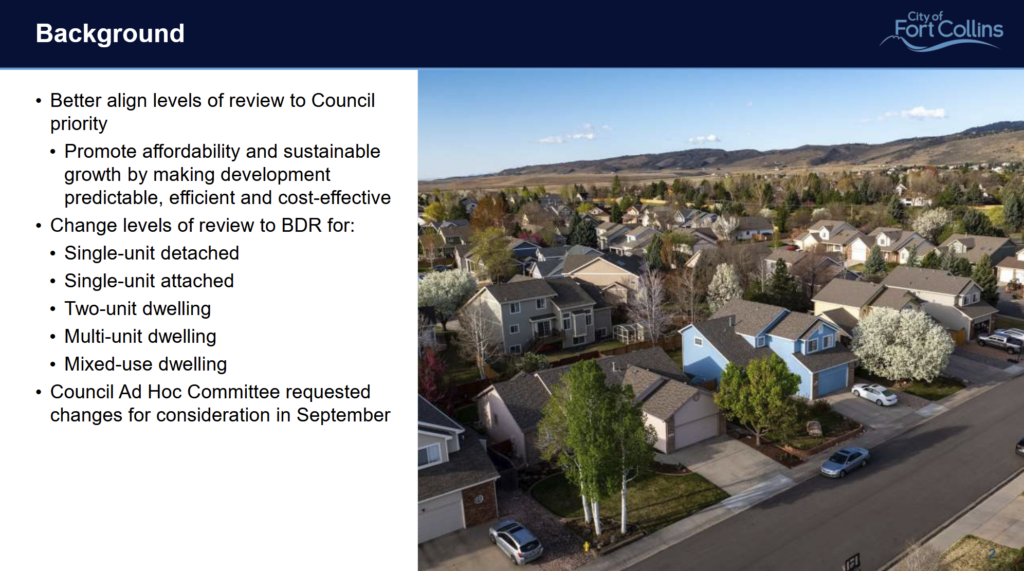
Planning Director Clay Frickey said the change adds no new housing types to any zone, but it does come with tradeoffs. The city would collect less in review fees, up to $32,350 less per project by the staff report’s estimate. Fewer projects would reach the Planning and Zoning Commission, and residents could still comment by email or phone but not at a public hearing. The commission also suggested a size threshold, so that large buildings would still get a hearing.
Three of the four people signed up for the item spoke. A home builder’s vice president said public input works best early in design rather than at a final hearing, a second speaker endorsed staff’s recommendation, and a third suggested a research-based unit count as the trigger for a higher level of review.
Council discussion
Councilmember Potyondy said she supports the housing goals; her concern was how the recommendation was developed.
In my mind, an ad hoc committee should inform judgment of council, not substitute for it.
She said she could not yet justify a yes vote.
Councilmember Hoeven said she is “on the same team,” but that the committee’s meetings are not recorded and have no minutes, which made its work hard to follow. She walked through her own research. Austin, Texas, built 12.5% more housing in two years and saw rents fall about 7%, while Fort Collins permitted about 22,000 units over the past decade. Using The MARC, a new 197-unit Midtown apartment building, as an example, she estimated the change would have saved it about $10,775 in fees, less than a tenth of 1% of its cost and unlikely to lower rents. She also questioned giving up fee revenue during a tight budget.
Mayor Francis responded:
The ordinance in front of us is not about a fee reduction. It’s about fulfilling the committee’s charge of making development more predictable and efficient and cost effective.
She said the committee’s focus is housing supply and cited an estimate that the city needs nearly 7,000 more units over the next decade. As chair, she said the committee will begin keeping minutes, share a six-month calendar and report during council reports.
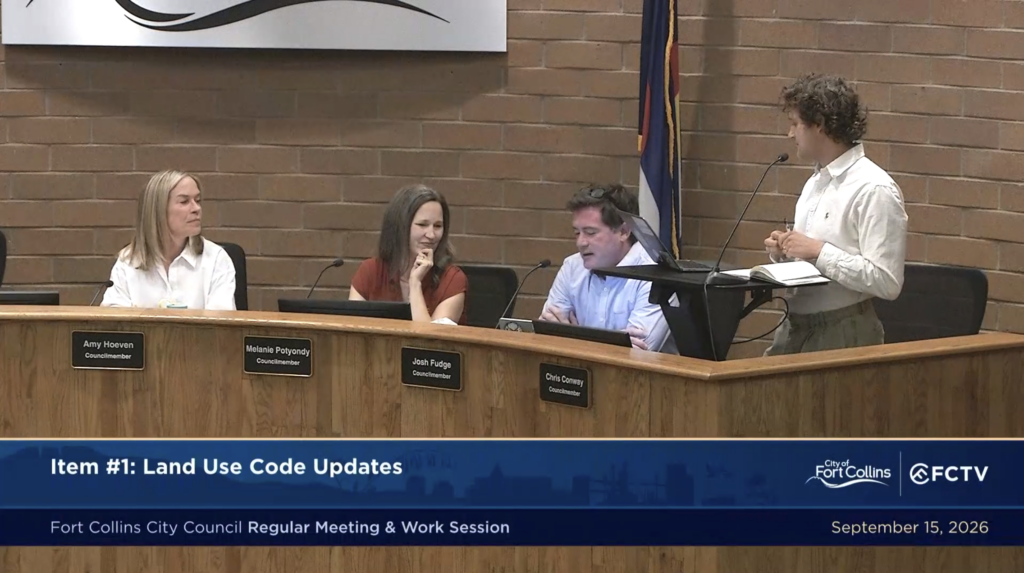
Councilmember Fudge said he had been undecided on September 1 and had considered proposing a size threshold. He described the city’s accumulated rules as “death by a thousand cuts” and said the ordinance would “help get already allowable projects done quicker.”
[Editor’s note: Fudge noted from the dais that Strong Towns Fort Collins September 1 meeting recap had noted his stance as “Fudge on the fence.” He said that sounded like a kids’ toy; we think it’s more like an old-timey schoolyard game, part candy, part running and jumping over a fence. Either way, the game is over: Fudge, off the fence – votes yes.]
Councilmember Conway said:
This doesn’t change what can be built. It changes how fast it can be built.
He added that project-by-project hearings tend to favor people with more time and money. Mayor Pro Tem Pignataro said her support was unchanged and told Hoeven that housing “is not a petri dish,” so exact answers may not exist. Councilmember Nelsen said “every unit matters” and that public engagement under the change remains appropriate.
Outcome
Council passed the ordinance on first reading, 5-2, with Francis, Pignataro, Conway, Fudge and Nelsen voting yes and Hoeven and Potyondy voting no. A second reading is required before the change takes effect.
Other Business
No council member raised other business.
Council Reports
- Hoeven mentioned the 9/11 memorial stair climb.
- Potyondy said Neighbor to Neighbor raised more than $100,000 for housing support.
- Fudge mentioned a Poudre River Library District fundraiser.
Adjournment
The Regular Meeting adjourned at 7:26 p.m.
Part 2: Work Session – 2027–2028 Budget, Session 1
The seven-member Fort Collins City Council includes a mayor elected citywide and six members elected by district. Work sessions give council time to discuss issues in depth with city staff and community partners before decisions are made. Council takes no votes and does not hear public comment at work sessions. Instead, council members ask questions and give staff direction. Items that need formal action come back to a later regular meeting for a vote, where the public can comment.
The Work Session convened with all seven members present and had one item.
What Staff Brought Forward
City Manager Kelly DiMartino, Chief Financial Officer Caleb Weitz and Budget Director Victoria Shaw presented the recommended budget, which was delivered to council on September 3. The packet asked council two questions: what clarifying questions it had about the three service areas presented, and what follow-up items it wanted on budget issues in those areas.
The Big Picture
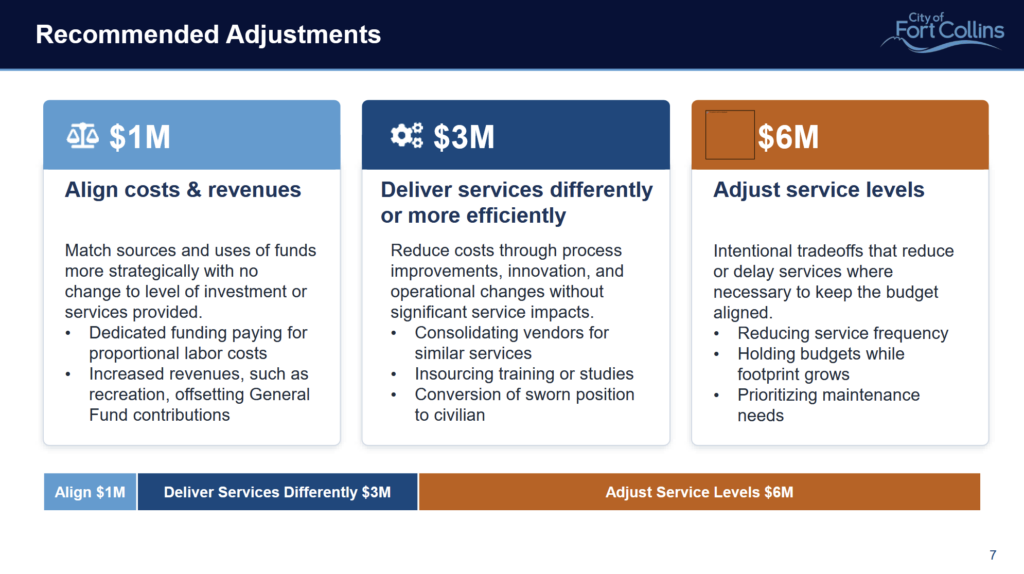
Weitz said revenues are still growing, but many costs are growing faster. A projected $15 million gap in tax-supported funds has narrowed to about $10 million. The recommended budget closes it with about $1 million from better matching funding sources to costs, about $3 million from delivering services more efficiently, and about $6 million from service-level reductions, mostly lower frequency rather than eliminated programs.
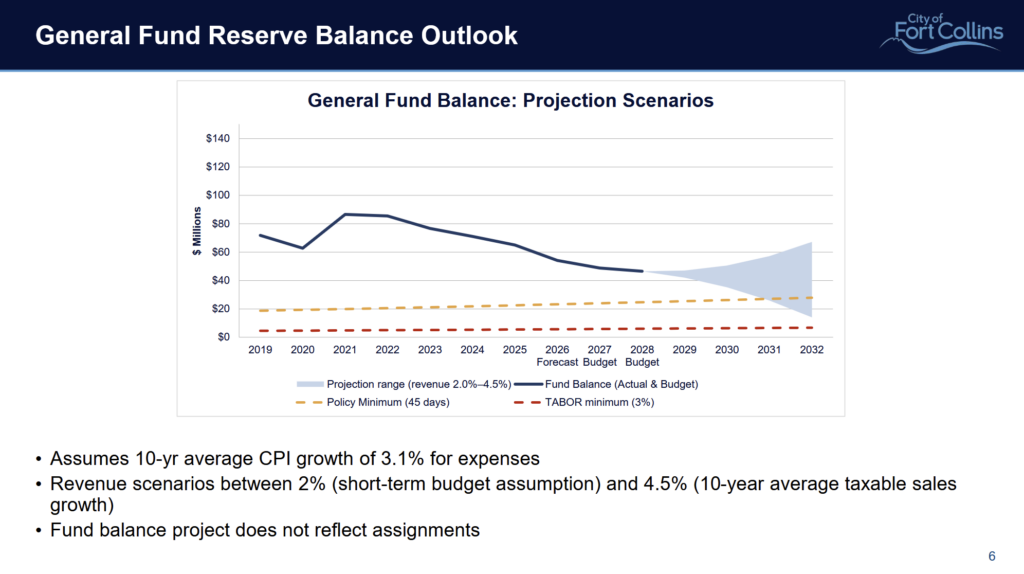
About 31 vacant positions are eliminated, with no layoffs. Wage funding equals 4% of payroll, and Weitz said health insurance costs are rising about twice as fast as revenue. The budget assumes 2% sales tax growth, and Weitz called the planned drawdown of general fund reserves “no cause for alarm,” since reserves stay above council’s minimum. Staff also listed about $8.5 million in 2027 requests the budget couldn’t fund, such as facility roofs and HVAC, which Weitz suggested council consider if year-end reserves allow.
In response to Mayor Francis, Weitz said the vacancy savings assumption drops from 6.5% to 4% after the last one proved too high. Fudge called the reserve trend “a green ski run” and asked what happens if sales tax weakens; Weitz said the city has enough tools to respond.
Community Services
Parks will absorb new acreage without matching budget growth, which Shaw said could mean fewer portable toilets, smaller flower beds or less frequent trash pickup. Forestry eliminates a long-vacant manager position and reduces tree planting, the Community Services Director position is eliminated, and Arts & Culture trims about $100,000 in artist fees. On the investment side, Natural Areas has a one-time $10 million land purchase paid from reserves, and the budget covers startup costs for the Southeast Community Center.
Fudge asked about the Lincoln Center fees raised in public comment. Arts and Culture Director Eileen May said fees rose about 2.5% and that staff will propose a clearer fee approach next year so user groups can plan ahead. Conway asked whether park construction plans account for upkeep. LeAnn Williams of Parks and Recreation said the master plan update will put maintenance costs first, which could mean fewer or smaller neighborhood parks where natural areas or school parks are nearby.
Community Development, Housing and Sustainability
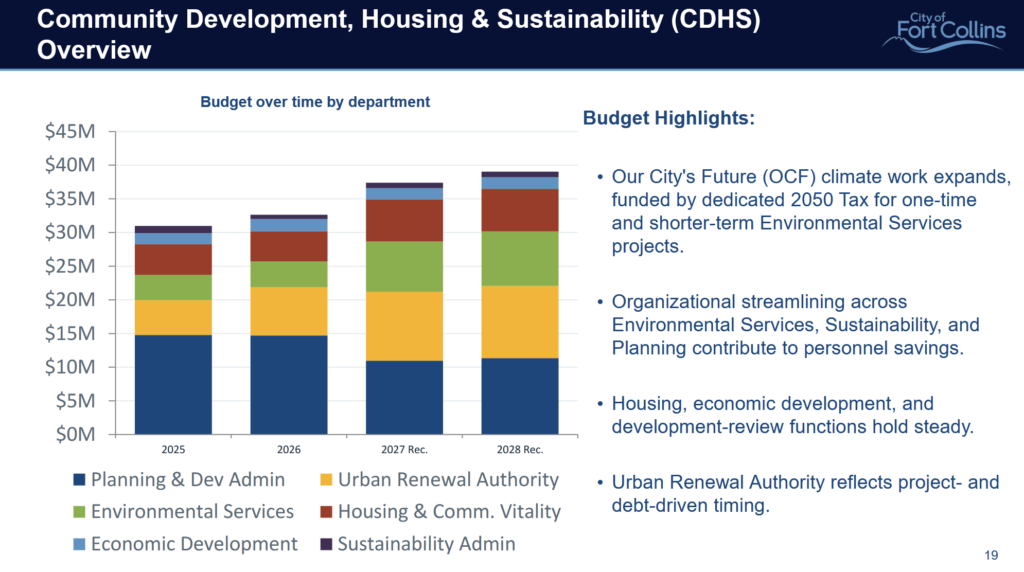
This area eliminates two vacant positions, renegotiates the Humane Society contract (which could slow responses to barking-dog calls and dead-animal pickup), and redesigns the grocery tax rebate and human services grants. New spending includes about $3.1 million from the dedicated 2050 climate tax, a new Development Services Navigator position, and $1.3 million in capital tax money for affordable housing.
Grocery rebate and human services
Nelsen asked how much affordable housing money is available. Weitz said about $8 million now, plus the $1.3 million in this budget and about $6.3 million more over the capital tax’s remaining years.
Nelsen also asked about the grocery rebate. Staff said enrollment rose after the application was simplified, and the budget would cut funding by $200,000, to $550,000, which staff said is still above historical levels. Options include reducing or capping rebates for larger households, though the final design isn’t set. Nelsen said she wanted to be sure the savings are worth it in a program that meets basic needs, and another council member said they would prefer a design that doesn’t reduce rebates for families with children.
Pignataro said:
I do not feel like this is the right time to be pulling money from this program.
Noting the rebate is about $81 per person, she asked staff to redesign the program without cutting its funding and to protect human services grants as well. In response to Mayor Francis, staff said the $50,000 grant cut equals about one and a half average grants.
Pignataro also asked who would handle dead animals on roads under a new Humane Society contract; staff will follow up with a memo. Mayor Francis asked whether Planning and Development Services has enough staff for council’s housing workload. DiMartino said the budget holds a $2 million placeholder for that work, with a resourcing plan to follow, and Conway voiced support for staffing the department.
Transportation Services
About eight of the 31 eliminated positions are in Transportation, including a new streets crew funded last cycle but never filled. Shaw said material costs have risen faster than inflation while the street network keeps growing. As a result, residential street sweeping drops from four passes a year to three, lower-priority snow routes get a single plowing pass, and equipment replacement slows. Weitz said the budget fully funds Transfort’s newly optimized bus system.
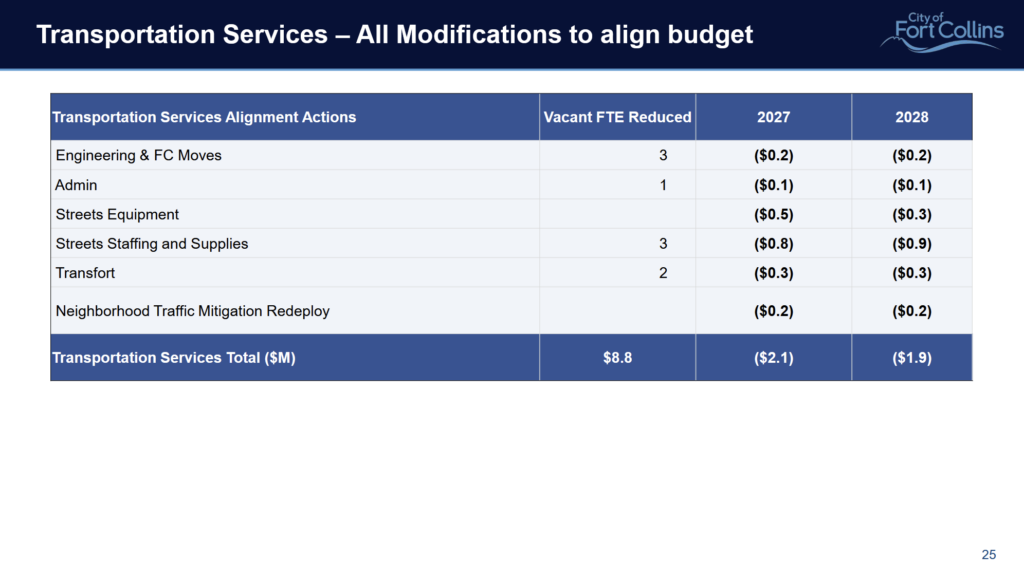
Potyondy asked about a cut adaptive-programming position; staff said that work moved into an existing Safe Routes to School contract. Conway asked where Vision Zero traffic safety and trail priorities show up in the budget, and Transportation Services Director Caryn Champine offered a follow-up memo, including spending by travel mode.
The Direction Given
No formal direction was expected at this first review. Council members asked staff to follow up on reconciled general fund balance figures, affordable housing funding, human services grant totals, the Humane Society service plan, programs started with federal American Rescue Plan Act (ARPA) money, and Vision Zero spending. DiMartino said staff will offer more detail on large funding categories and, on October 13, bring alternatives for areas council flagged, including ways to keep some items funded.
What’s Next
- September 22: Work session on Police, Information & Employee Services, Finance/Executive/Legal/Judicial, and Utilities
- October 6 and October 20: Budget public hearings
- October 13: Work session on follow-ups and alternatives
- November 3 and 17: First and second readings of the budget
The Work Session adjourned with the mayor’s “Good night, Fort Collins.”
Leave a Reply