
In our previous article, we made the case for paid on-street parking in downtown Fort Collins. Since then, the city has reduced the proposed paid zone from roughly 1,300 to 800 spaces based on community feedback, and council discussion is ongoing. But the opposition has organized around a handful of recurring arguments. Here’s the evidence to why those arguments don’t hold up.
“Paid Parking Will Kill Small Businesses”
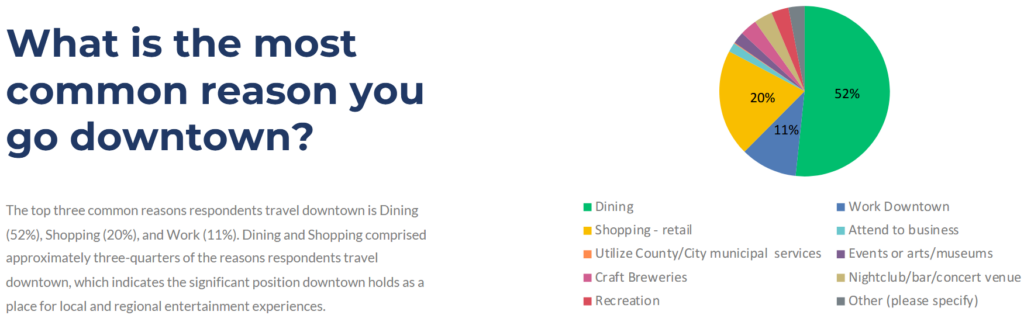
This is the most common fear and the most consistently contradicted by evidence. The worry is that shoppers will flee to Centerra or Foothills Mall, where parking is free. But think about it: if the only thing keeping people in Old Town were abundant free parking, Centerra would already be winning. People come downtown for the restaurants, the walkable streets, the local shops, and the overall experience. The Downtown Development Authority’s (DDA) 2023 survey of 3,140 people confirms it: 52% come for dining, 20% for shopping, 76% combine multiple activities per trip, and 81% stay more than two hours. These are people coming for an experience, not a parking deal.
Research backs this up broadly: a Berlin study found that business owners estimated 21.6% of their customers drove, when the actual figure was 6.6%. Over 90% of weekly revenue came from people who walked, biked, or took transit. Business owners consistently overestimate how much their revenue depends on drivers with cars parked out front.
Old Pasadena saw sales tax revenue quadruple and property tax revenue triple within five years of installing meters, fueled by reinvesting meter revenue into streetscape improvements.
Meanwhile, the actual track record from other cities is clear. Old Pasadena saw sales tax revenue quadruple and property tax revenue triple within five years of installing meters, fueled by reinvesting meter revenue into streetscape improvements. Idaho Springs and Manitou Springs in Colorado reported improved downtown sales after introducing paid parking. Walker Consultants, who conducted Fort Collins’ own Parking Optimization Study, found that communities implementing paid on-street parking consistently see increases in downtown revenue, not declines.
A note on sources: some opposition materials (Facts vs Theory – FOCO Parking) have cited studies from the National League of Cities, the International Downtown Association (IDA), the California Air Resources Board (CARB), and the Texas A&M Transportation Institute that appear to document harm from parking fees. We reviewed every one of these citations against the original publications and found significant problems with how they were presented. Some sources were re-titled to misrepresent their purpose, did not match the data presented by the authors, others had key caveats stripped away, and in several cases the underlying research actually recommends parking pricing as a demand management tool. It is unclear if this was a mistake, AI hallucinations, or intentional action. A more direct point-by-point list is at the bottom of this page.
“We’re Not a Tourist Town, Locals Will Stop Coming”
Critics say that since 73% of downtown visitors are locals, they’ll be uniquely price-sensitive. But this argument undercuts itself. Locals are repeat visitors. The DDA survey shows 61% come downtown at least weekly and 95% at least monthly. Someone who grabs coffee on College Avenue three mornings a week isn’t switching to a Harmony Road drive-through over $2. The habit and experience is worth more than the fee.
In fact, locals are the people most frustrated by the current system. The DDA survey found that 30% of visitors have difficulty finding parking, and another 16% find spots but not near their destination. That’s 46% reporting a suboptimal experience under the “free” system. Paid parking is designed to fix exactly this: keeping one or two spots open on every block so you can actually park where you’re going.
And Fort Collins is one of the few cities its size that still doesn’t charge for on-street parking. Among peer cities (including Boulder, Ann Arbor, and Asheville), 85% already do. Boulder’s Pearl Street Mall has had paid parking for decades and remains one of the most successful pedestrian shopping districts in the region. This isn’t radical. It’s catching up.
“The City Should Fix Its Own Problems First”
There’s a fair point buried here: the city should improve enforcement, update fine structures, and stay on top of garage maintenance. City staff agree, and have laid out immediate action items for 2026 to do exactly that.
But no amount of operational tweaking fixes the structural problem: the most desirable parking downtown (the curb) is free, while the least desirable (the garages) costs money. The DDA survey shows 73% of visitors prefer free on-street spaces, while garages function as a fallback. Why would anyone pay for a garage when the curb is free? That’s the “upside-down” model city staff have described, and enforcement alone can’t fix it.
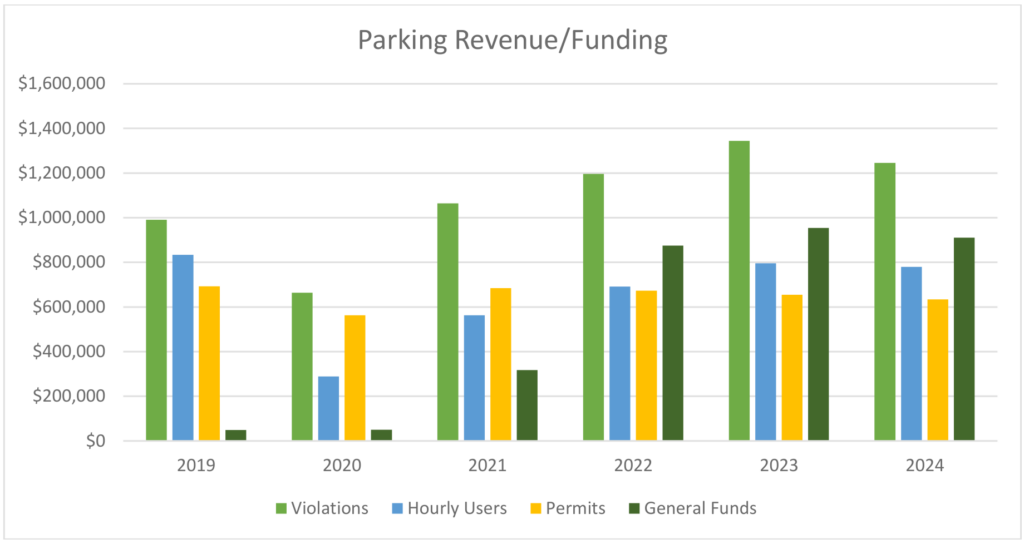
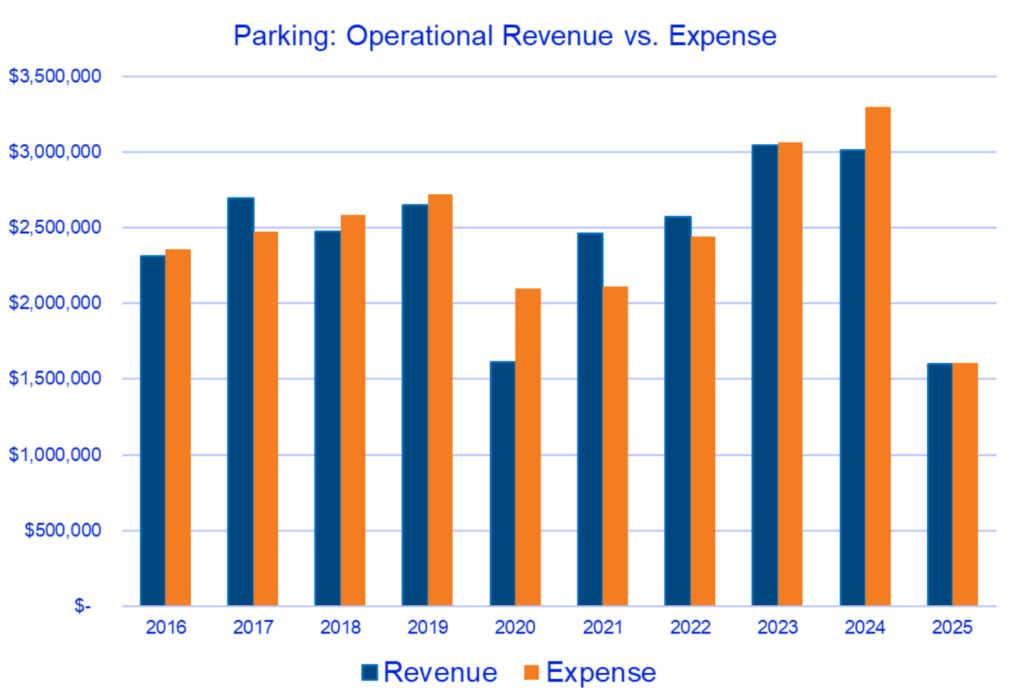
Here’s the part many critics miss: the general fund subsidy that once backstopped Parking Services is going away. The department must now cover its own costs – garage maintenance, technology, enforcement – from its own revenue. The current model can’t do that. Staff estimated the annual parking services deficit at $600,000 to $1 million, depending on the year and maintenance needs. And deferred maintenance has real consequences: a Civic Center parking garage stairwell assessed at roughly $55,000 for repair in 2019 was deferred due to COVID and later required a full replacement costing $1.2 million. The question isn’t whether Fort Collins residents are willing to add a new cost. It’s whether the parking system can survive without one.
“Turnover Is a Myth, It’s Really Just Diversion”
Critics cite a California Air Resources Board (CARB) study to argue that paid parking simply drives people away. But consider what the current system actually produces: a meta-analysis of 16 studies around the world found that an average of 30% of traffic in congested commercial areas consists of drivers circling for parking. That’s not commerce. That’s waste.
The underlying data the opposition cites is real. A meta-analysis of 50 studies found that a 10% parking price increase is associated with a 3.2% reduction in non-commute parking volume. But the opposition’s presentation of this data is misleading in several ways.
What does this mean?
First, the CARB brief explicitly warns that its elasticity data comes mostly from places that already had paid parking, not from cities transitioning from free to paid. It says the data “cannot be directly used” to predict what happens in Fort Collins’ situation.
Second, “reduced parking volume” doesn’t necessarily mean fewer customers. If some of that reduction reflects mode or parking-location shifting, that’s a feature, not a bug. Fort Collins’ own data shows we’ve been moving in the wrong direction: between 2013 and 2023, single-occupancy vehicle trips to downtown rose from 38% to 54% while biking fell from 16% to 4%. A modest shift back toward carpooling, biking, or transit isn’t a side effect of paid parking. It’s one of the goals, and it frees up spaces for people who truly need to drive and helps the city, the community that makes it up, make progress towards broader goals. Third, the opposition cherry-picked the shopper data while ignoring the commute data (a stronger response), which is exactly the mechanism Fort Collins wants: moving employee cars off the curb and into garages to free prime spots for customers.
And a 3.2% response to a 10% price increase is, in economic terms, highly inelastic demand, meaning people barely change their behavior. The real-world evidence from Pasadena, Redwood City, and San Francisco’s SFpark pilot confirms this: paid parking doesn’t reduce downtown visits. It changes who parks where. In fact, under San Francisco’s demand-responsive pricing, average meter rates actually decreased by 4% because prices dropped on underused blocks while rising only where demand was highest. This proposal gets us closer to that possibility.
“Free Parking Is the ‘Front Door’ to Small Business”
The opposition calls free parking the ‘front door’ to small business. But that front door has a two-hour time limit that doesn’t match how people actually use downtown. The DDA survey found 63% of visitors stay two to four hours, yet the prime curb spaces kick them out at two. Meanwhile, employees who know the system park in unregulated curb spaces nearby – 32% choose these as their first option – or shuffle between timed spots to avoid tickets. The result is a ‘front door’ that’s too small for customers and too easy for non-customers to work around.” A 2019 city study found that 10–15% of downtown employees engage in the “two-hour shuffle,” moving their cars to dodge time limits rather than paying for a garage permit. The DDA survey found that 58% of downtown employees prefer free curb spaces over available garage permits, directly competing with customers for the same spots. Nearly 50% of employees have received at least one ticket. They’re not rule-breakers. They’re responding rationally to a system where free curb parking beats a $20–$60/month permit.
A priced curb space is the real front door: always available, always turning over, always ready for the next customer. And the revenue doesn’t disappear. It goes back into downtown through garage maintenance, ADA upgrades, wayfinding, and community amenities. Pasadena’s merchants, who initially feared meters, became enthusiastic supporters once they saw the investment flowing back into their district.
What About Equity and Accessibility?
These concerns are legitimate and worth taking seriously. The proposal includes pay stations that accept cash and cards, garages at $1/hour with the first hour free, a grace period for quick stops, free surrounding street parking, and free Sundays in garages.
But the equity argument also cuts the other way. Every dollar the general fund spends maintaining downtown parking garages is a dollar that doesn’t go to neighborhood sidewalks, Transfort service, parks, or emergency response. Paid parking lets the parking system fund itself, so tax dollars can go where they’re needed most. Boulder, one of Fort Collins’ closest peer cities, already demonstrates what this looks like in practice: it uses meter revenue to buy transit passes for all downtown workers and residents. And free parking is one of the most regressive subsidies a city can offer. The household that drives downtown five days a week captures far more value from “free” parking than the household that takes the bus or bikes. A user-pays system simply asks each driver to cover the cost of the space they’re using.
The Bottom Line
Between 2013 and 2023, single-occupancy vehicle trips to downtown rose from 38% to 54%, biking fell from 16% to 4%, and visits got longer, all while the number of parking spaces stayed the same. The general fund safety net is going away. The garages need maintenance. The current revenue model can’t cover all the costs.
The proposed system – $2/hour on-street, $1.50 in surface lots, $1/hour in garages with the first hour free – is designed to keep downtown accessible, keep the parking system solvent, and reinvest every dollar back into the community. City after city has walked this path, and the pattern is remarkably consistent: controversy when proposed, quiet appreciation after implemented.
Fort Collins deserves a parking system that works: for shoppers, business owners, employees, and every taxpayer. Paid parking isn’t the end of something. It’s the beginning of a stronger downtown.
Fact Check: Paid Parking Opposition Claims
An opposition group has been circulating a list of data points against paid parking in downtown Fort Collins. We reviewed every claim and source. Here’s what we found.
Claim: “A 10% increase in parking price leads to a 3.1% reduction in total parking volume.”
Rating: MISLEADING
The number is close to real research, but the opposition’s source title is fabricated. The actual CARB brief is titled “Parking Pricing,” not “Policy Brief on the Business and Economic Impacts of Paid Parking.” More importantly, the brief explicitly warns that its data comes from cities that already had paid parking and “cannot be directly used” to predict outcomes in cities transitioning from free to paid, which is exactly Fort Collins’ situation. The opposition also omitted that a 3.2% response to a 10% price change is highly inelastic demand, meaning people barely change their behavior. And the CARB brief’s own conclusions support paid parking: it states that commercial activity may be enhanced by pricing strategies that free up spaces otherwise taken by commuters, and specifically cites Pasadena’s experience where meter revenue reinvested in business districts rapidly increased sales tax revenue.
Claim: “Adding friction (apps/kiosks) results in a 10–15% drop in impulse transactions.”
Rating: FALSE
The two sources cited for this claim do not appear to exist. The International Downtown Association’s actual report, “The Value of U.S. Downtowns and Center Cities,” is a benchmarking study that does not study parking friction or impulse shopping. The Texas A&M Transportation Institute (TTI) has no record of a paper called “The Cognitive Load of Urban Parking.” TTI’s actual parking research recommends pricing as a demand management tool. The 10–15% statistic has no verifiable source.
Claim: “Aggressive parking fee implementations correlate with a 12–18% drop in transactions for independent retailers.”
Rating: FALSE
The cited source, the National League of Cities’ “How Cities are Rethinking Fines and Fees,” is a real 2025 publication, but it studies punitive municipal penalties like court fees and unpaid utility bills, not parking meter rates. It contains no data on parking fees and retail transactions. The 12–18% figure has no verifiable origin.
Claim: “In Ventura, CA, downtown sales tax plateaued or dropped following meter expansion, while peripheral free-parking districts grew.”
Rating: UNVERIFIED and the available evidence points the other way
HdL Companies does produce quarterly sales tax reports for Ventura, and these are publicly available on the city’s website. However, the reports break down revenue by business type (restaurants, auto dealers, etc.), not by geographic district. They do not separate “downtown” from “peripheral” areas, so the opposition’s claim that downtown sales dropped while free-parking districts grew cannot be verified from these reports. It’s worth noting that Donald Shoup’s 2024 peer-reviewed analysis identifies Ventura as one of the cities where the Parking Benefit District model has been replicated – meaning parking reform researchers cite it as a success case, not a cautionary tale.
Claim: “The City issued 7,898 courtesy tickets in 2024, a massive failure to capture existing revenue.”
Rating: UNVERIFIED DATA, MISLEADING CONCLUSION
This figure comes from the opposition group’s own website and we could not find it confirmed in any city document or news report. But even if accurate, the conclusion drawn from it actually makes the case for paid parking, not against it. The opposition is simultaneously arguing that enforcement should be tougher and that the city shouldn’t introduce pricing. But stricter enforcement without pricing just means more tickets, more adversarial interactions between officers and visitors, and more revenue from penalizing people – without solving the underlying problem. The city’s own data shows the real issue: 22 of 24 downtown block faces exceed the 80–85% occupancy threshold where drivers perceive no spots are available, while parking structures sit 40–50% occupied. Enforcement can’t fix that. Additionally, the city’s council work session materials confirm that parking violation fines haven’t been raised since approximately 2003 and garage rates haven’t changed since 2009 – context the opposition omits when framing this as a recent “failure.”
Strong Towns Fort Collins is a local advocacy group aligned with the Strong Towns movement, which promotes financially resilient and people-centric approaches to community development. Learn more at strongtownsfoco.org.
Sources:
- Fort Collins Downtown Development Authority, 2023 Downtown Fort Collins Parking & Travel Habits Survey (survey conducted January 20 – February 12, 2023; 3,140 respondents)
- City of Fort Collins, Downtown Parking Optimization Study and Implementation Strategies, December 9, 2025 Council Work Session
- City of Fort Collins, Downtown Parking Management Updates, OurCity.fcgov.com (Q&A and public comments)
- City of Fort Collins, Parking Permits (monthly permit options and pricing for garages and surface lots)
- National League of Cities, Reimagining Parking: An Action Guide on Adaptions, Flexible Uses and Resilient Development, 2022
- National League of Cities, How Cities are Rethinking Fines and Fees to Strengthen Residents’ Economic Stability, 2025
- International Downtown Association, The Value of U.S. Downtowns and Center Cities, ongoing study
- California Air Resources Board, Impacts of Parking Pricing and Parking Management on Passenger Vehicle Use and Greenhouse Gas Emissions: Policy Brief, September 2014
- California Air Resources Board, Parking Pricing: 2025 Policy Brief, April 2025
- Lehner, S. & Peer, S., “The Price Elasticity of Parking: A Meta-Analysis,” Transportation Research Part A 121, 177-191 (2019)
- Donald Shoup, The High Cost of Free Parking (2004, updated 2011)
- Texas A&M Transportation Institute, Parking Management and Finding the Value of Urban Parking, Transportation Policy Research Center
- Parking Reform Network, Parking Benefit Districts: A Guide for Activists
- Parking Reform Network, What is Parking Reform?
- Parking Reform Network, “Local Leaders Know Parking Reform is a Good Idea. What’s Stopping Them?” December 2025
- Parking Reform Network, “Fairness and Equity in Parking Reform,” Part 3
- U.S. Department of Transportation Climate Change Center, Parking Reforms, January 2025
- SFMTA, SFpark Pilot Project Evaluation
- Pierce, G. & Shoup, D., “Getting the Prices Right: An Evaluation of Pricing Parking by Demand in San Francisco,” Journal of the American Planning Association 79(1), 2013
- Kolozsvari, D. & Shoup, D., “Turning Small Change into Big Changes,” Access Magazine, Fall 2003
- Shoup, D., “Parking Benefit Districts,” Journal of Planning Education and Research 44(1), 2024
- Shoup, D., “Cruising for Parking,” Transport Policy 13(6), 2006 (meta-analysis of 16 cruising studies)
- Von Schneidemesser, D. & Betzien, J., “Local Business Perception vs. Mobility Behavior of Shoppers: A Survey from Berlin,” Transport Findings, 2021
- KUNC, “Visitors to downtown Fort Collins could soon be paying for on-street parking,” August 13, 2025
- CBS Colorado, “Paid parking may begin in 2027 for Northern Colorado’s Old Town Fort Collins,” January 5, 2026
- Denver7, “Fort Collins Parking Services adjusts proposed paid parking plan after community input,” December 10, 2025
Leave a Reply