
The seven-member Fort Collins City Council includes a mayor elected citywide and six members elected by district. Regular meetings are where council takes formal action, voting on ordinances, resolutions, contracts, and appeals. Most ordinances require two votes, called readings, at separate meetings before they take effect. Each regular meeting includes a public comment period where anyone can speak to council on any topic, in person or remotely.
Council took three recorded votes on discussion items at its October 6, 2026 meeting. It gave final approval to a change in how housing projects are reviewed, approved a tax rebate agreement with the chipmaker Broadcom, and told staff to bring a temporary moratorium on data centers to the October 20 meeting. Council also held the first of two public hearings on the 2027-28 budget.
Present:
- Mayor Emily Francis
- Julie Pignataro, District 2 (Mayor Pro Tem)
- Josh Fudge, District 3
- Melanie Potyondy, District 4
- Amy Hoeven, District 5
- Anne Nelsen, District 6
Absent:
- Chris Conway, District 1
Proclamations
The mayor read five proclamations before the meeting: Imagine a Day Without Water Day (October 15), Public Power Week and Fire Prevention Week (both October 4-10), Cybersecurity Awareness Month, and Conflict Resolution Month. Staff from the city’s mediation and restorative justice program used their time to recognize a colleague who retired this year after 26 years.
Public Comment
Platte River Power Authority’s 2030 goal
Context: Platte River Power Authority (PRPA) is the wholesale electricity provider jointly owned by Fort Collins and three other cities. It has a goal of 100% non-carbon electricity by 2030. Speakers said the PRPA board will vote October 29 on removing that date. Francis represents Fort Collins on the board.
Eleven speakers addressed the goal. They asked council or the mayor to press PRPA to replace the 2030 target with a new date instead of dropping it. Two named 2040 as the latest acceptable year. Speakers also objected to PRPA’s planned gas turbines and to its sale of renewable energy credits.
“If total non-carbon power generation cannot be obtained by 2030, a firm date should still be set.”
Amendment 81
Context: Amendment 81 is a measure on the November 3 statewide ballot. It would require local police to notify federal immigration authorities about certain people charged with crimes.
Four speakers asked council to pass a resolution opposing it. They said it would reduce crime reporting by immigrant residents and add costs for local police.
The 2027-28 budget
Seven speakers addressed the budget. Four, all from one local theater company, asked council to consider nonprofit arts groups when raising Lincoln Center rental rates. The chair and vice chair of the Human Services and Housing Funding Board asked council to protect human services funding. A member of a North College neighborhood group asked for faster traffic safety work and a police substation in that area.
Other topics
Five others spoke on e-bikes on neighborhood paths, two statewide ballot propositions affecting transgender youth, the Chamber’s support for three agenda items, federal policy, and financial markets.
Public Comment Follow-Up
Francis said officials from PRPA’s four owner cities met last week about the 2030 goal.
“There is currently no technical path forward to reach our goals that maintain our reliability standards and also offer affordable rates.”
She said an average $100 monthly bill will rise to $136 by 2030 under the current plan, and would have reached $186 under the most aggressive option the board considered. She said PRPA expects to reach about 84% non-carbon generation and will stop burning coal in 2030.
Pignataro said council recently held a work session on e-bikes and expects recommendations soon.
Consent Calendar
The consent calendar bundles items expected to pass without debate. Any council member can pull an item for separate discussion.
Consent items are often the latest step in work that spans several years. The list below does not capture that history.
Council approved the consent calendar 6-0. No items were pulled.
- September 15 meeting minutes. Routine approval of the official record.
- Donations through City Give (second reading). Appropriates about $53,000 in charitable gifts to city departments.
- Drug task force grant (second reading). Accepts about $17,600 in federal money for police work with the Northern Colorado Drug Task Force.
- Year-end budget adjustments (second reading). Three ordinances add revenue and reserves to the 2026 budget for unanticipated expenses.
- J.M. Morrison landmark, 718 W. Mountain Ave. (second reading). Removes the carriage house from the historic designation.
- Marsh/Geist landmark, 1006 Laporte Ave. (second reading). Removes the garage from the designation and renames it the Walker/Geist Property.
- Restitution for victims (second reading). Allows restitution for victims of petty offenses and civil infractions, not only misdemeanors.
- Pedestrian intersection improvements (first reading). Moves about $1 million to construction at five locations.
- Lemay and Drake intersection (first reading). Adds about $1.5 million to buy adjacent property and replace the traffic signal.
- Wastewater mapping technology (first reading). Adds $60,000 from reserves for a utility asset management system.
- Strauss Lakes annexation (first reading). Brings about 147 acres at the northeast corner of Ziegler and Horsetooth roads into the city at the owner’s request.
- Strauss Lakes annexation agreement (first reading). Lets the owner leave the city if certain later development approvals are not granted.
- Strauss Lakes zoning (first reading). Zones most of the land for low-density mixed-use neighborhoods and about 8 acres for medium density.
- Housing Catalyst board appointment. Fills one vacancy on the housing authority’s board.
Discussion Items
Budget public hearing
One resident spoke. He asked whether some departments duplicate each other and why Connexion, the city’s broadband service, is budgeted within the electric utility. The second hearing is October 20.
Housing review change in the land use code
Council voted 5-1 to give final approval to an ordinance that moves most new housing to Basic Development Review (BDR) in zones where that housing is already allowed. Hoeven voted no. Under BDR, city staff decide whether to move forward on a project after mailing notice to nearby property owners, with no neighborhood meeting and no Planning and Zoning Commission hearing. Residents can still comment by email or phone.
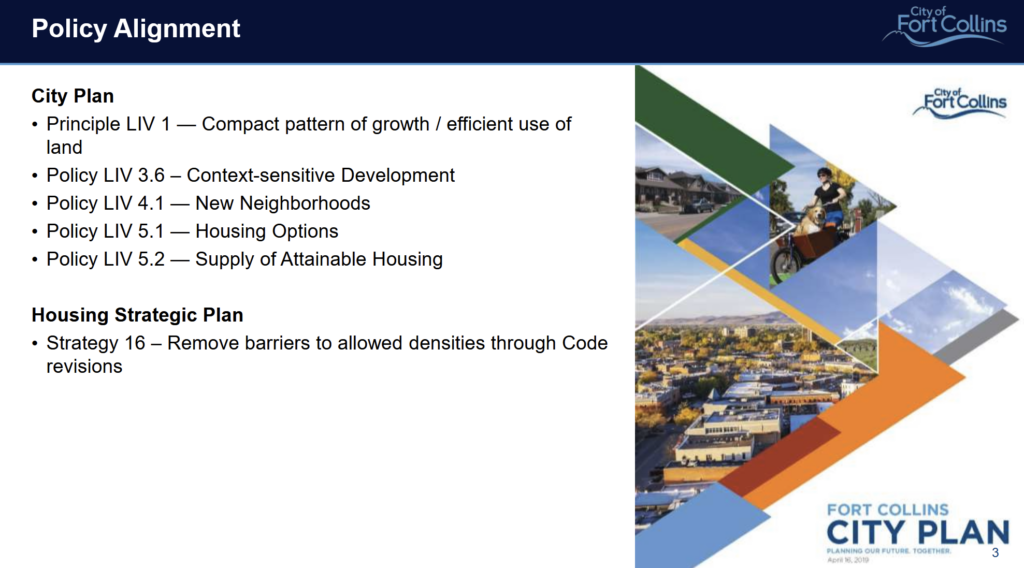
Council postponed the item on September 1 and passed it 5-2 on first reading September 15, with Hoeven and Potyondy opposed. The Planning and Zoning Commission recommended the ordinance 5-0 and suggested a size threshold so that large projects would still get a hearing.
Hoeven asked how staff was addressing that suggestion. Planning Director Clay Frickey said no threshold is in the code or proposed, and that staff could bring one back with other code updates planned for the end of the year if council asks.
Hoeven said she would again vote no. She said her research showed permit times and the pace of market-rate construction in Fort Collins are healthy, and that shortening permitting would do little for affordability in the near term. She said she would prefer that the council’s Ad Hoc Committee on Affordable and Sustainable Growth prioritize direct help for the 6,346 renters she said are cost-burdened.
Potyondy, who voted no on first reading, said she still had concerns about how the proposal reached the full council but had learned more about it since.
“I feel comfortable shifting my vote to yes.”
The mayor asked whether staff was starting work on a threshold. Staff said they would do so only if council requested it. No member made that request.
Broadcom tax rebate agreement
Council voted 6-0 to approve an incentive agreement with Avago Technologies, which does business as Broadcom. Economic Development Director SeonAh Kendall said the company plans to invest about $1.5 billion in its Fort Collins plant and has committed to at least 100 new jobs paying $66,000 to $135,000.
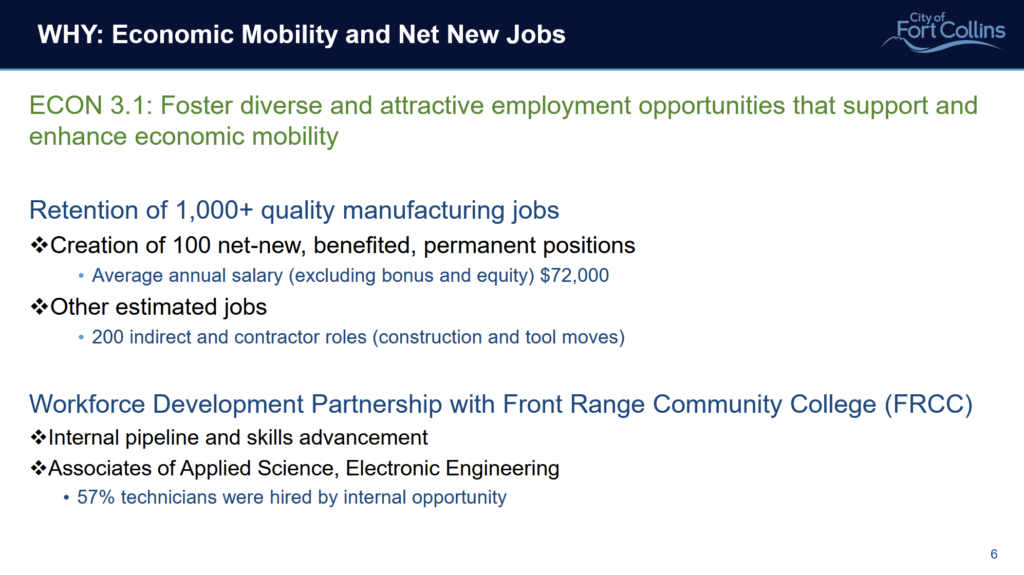
The city will rebate up to $8.9 million in sales and use tax after the company pays it and the city verifies the purchases and jobs. That includes all of the base tax on air pollution control equipment and 25% on construction and manufacturing equipment. Staff estimates $43 million in net new city revenue over 10 years. Kendall said the company must have substantial construction underway by December 31 to qualify for a federal tax credit.
Potyondy asked whether the plant’s emissions would rise after the expansion. Kendall said new equipment comes with pollution controls and that she would send projections.
Data center moratorium
Council voted 5-1 to direct staff to present a six-month moratorium on October 20 and to stop accepting applications for covered data centers in the meantime. Fudge voted no.
The resolution covers data centers that are a property’s main use, plus data centers attached to another use that need more than 10 megawatts of power. The packet says the land use code has no rules for data centers. The moratorium, if adopted, would apply retroactively to October 6.
One resident spoke, asking council to also consider the tax revenue a large customer could bring.
Fudge said he was concerned the 10-megawatt threshold was too low and that including accessory data centers could block projects valuable to the city. He said council had discussed a figure closer to 25 megawatts at its August work session.
“I’m 51-49 on this. And so if this comes around again, I could perhaps be interested in voting for it.”
Potyondy supported the lower figure.
“Six months is a small price to pay and I would rather have a more conservative cutoff because I don’t feel confident that we have appropriate guardrails in place.”
Pignataro said the figure had moved from 100 megawatts to 25 to 10 in earlier conversations and asked whether it would change again. Staff said 10 megawatts is PRPA’s definition of a large-load customer and was used as a starting point. The mayor asked staff to bring information on other thresholds and possible unintended consequences, and said council can change the number on October 20.
Other Business
Hoeven asked staff to prepare a resolution opposing Amendment 81 for October 20. The mayor asked whether other members supported the request, and none did. Francis and Potyondy said they were hesitant to have council take formal positions on ballot measures, and Fudge said he agreed. Francis said she was comfortable with the Colorado Municipal League, which Hoeven said has opposed the measure, taking the lead.
Council voted 6-0 to enter executive session for legal advice on capital expansion fees, which the city charges new development.
Council Reports
- Nelsen spoke about Poudre School District’s school consolidation process. She said two schools recommended for closure are in her district and asked families with more school options to attend the district’s listening sessions.
- Fudge said he toured the Southeast Community Center construction site and that the project is on schedule and on budget.
Adjournment
The mayor said no business would follow the executive session.
Leave a Reply