
On paper, the September 1, 2026 regular meeting looked short: 26 consent calendar items and no discussion items at all. City Manager Kelly DiMartino confirmed as much in her agenda review, noting only a minor amendment to the updated council meeting rules to fix a scrivener’s error. Then one council member pulled an item from consent, and the meeting ran another two hours. The substance came from three places: public comment shaped by a fatal crash in Old Town two days earlier, a debate over how housing projects get reviewed, and a disagreement about how that item reached council at all.
Mayor Emily Francis was absent – Mayor Pro Tem Julie Pignataro, who presided, said Francis was out of town and would return the following week. The other six members were present: Pignataro (District 2), Chris Conway (District 1), Josh Fudge (District 3), Melanie Potyondy (District 4), Amy Hoeven (District 5), and Anne Nelsen (District 6).
Proclamations
The first declared September 2026 Suicide Prevention and Awareness Month. Lawrence Hermance of the Alliance for Suicide Prevention of Larimer County accepted it, saying the work is not something a small nonprofit can do alone.
The second declared September 2026 National Preparedness Month, themed “Preparedness Starts at Home.” Dennis Day, the city’s director of emergency preparedness, security and special events, accepted it and recognized Fort Collins Volunteer Response Team members who attended.
Public Comment
Pedestrian safety after the Mountain Avenue crash
A District 6 resident described an incident the previous Saturday in which a large vehicle struck about five people on Mountain Avenue, killing one. He said a tree in front of an Old Town ice cream shop stopped the vehicle and the outcome could have been worse.
He asked for three things: move forward with downtown paid parking but set aside part of the revenue for physical safety infrastructure such as bollards and raised curbs; restrict diagonal parking in Old Town to compact vehicles, on the reasoning that smaller vehicles cause less severe injuries; and continue the city’s broader work on safety for people not in cars.
“This incident that happened on Saturday is not inevitable.”
Wildlife crossing funding
A second speaker addressed wildlife crossing funding under Senate Bill 26-141, a state measure council has no power to change. He said tying a voluntary $5 fee to vehicle registrations creates a perverse incentive, making the funding depend on growth in the very traffic the crossings address. He offered three alternatives: checkoffs on outdoor recreation purchases, a state income tax checkoff, and a utility bill roundup.
Questions on four consent items
A third speaker asked whether the proposed 90-day allowance for board and commission members to relocate outside the city’s Growth Management Area – the boundary within which Fort Collins plans to grow and provide services – could be renewed repeatedly; who bears the cost of the wastewater bond and grant package, given haulers outside that boundary; why the updated council meeting rules permit recording in chambers; and said the rate request behind the residential waste collection changes would not be detailed until second reading.
Paid parking messaging
A District 5 resident recommended naming the parking project for its intention rather than its means – something built around downtown parking throughput or efficiency. He said little public messaging left opposition as the main voice, and suggested publishing alternative fee models to show that city and downtown business incentives align.
Public Comment Follow-Up
Nelsen opened with condolences to the family of the person killed, those injured, witnesses, and first responders. She asked staff to report back on what restricting spaces to compact vehicles would do to spaces per block face, and what restriping would involve. She also asked when updates return on street standards and Vision Zero, the city’s goal of eliminating traffic deaths and serious injuries. DiMartino said street standards go to a council ad hoc committee in December, and Vision Zero in late November or early December.
Potyondy asked City Attorney Carrie Daggett whether recording in chambers was new. Daggett said recording has been allowed during her time, with restrictions on blocking others’ views or disrupting the meeting. Potyondy said the provision is not new and benefits residents.
Pignataro asked whether anything limits repeated 90-day board absences. Daggett said the provision focuses on the absence being temporary and does not appear to cap it at once per term.
Fudge responded on wastewater, saying the facility runs as an enterprise fund on user fees, so out-of-city customers pay by use and residents who never use the septage drop-off bear no cost.
Consent Calendar
The consent calendar bundles items expected to pass without controversy – routine first and second readings, resolutions, administrative actions – and approves them in one vote. Any council member can pull an item for separate discussion.
Consent items are often the latest step in years-long work. A second reading appropriating easement funds for a rail grade separation is the formal funding action on a project designed and funded across several budget cycles. The list itself does not carry that history.
The calendar included sales tax reserves redirected to affordable housing; federal relief funds transferred to buy land for the city’s Land Bank, which holds sites for future affordable housing; $113,098 toward an easement for the Vine and Timberline rail grade separation; grants for auto theft enforcement and fishing access at Arapaho Bend Natural Area; $5.5 million in state Extended Producer Responsibility funds – paid by packaging producers to cover recycling costs – for recycling education and collection; $103,500 for an arts master plan; two amendments extending a purchase contingency up to two years at Montava, a large planned development in northeast Fort Collins; and annexation of the 147-acre Strauss Lakes property.
Nelsen pulled the development review ordinance and moved adoption of the rest. Hoeven seconded. It passed 6-0.
Development Review Changes, Postponed Two Weeks
Why this matters: This decides who approves new housing, whether neighbors get a public hearing before it goes up nearby, and what the review costs a builder.
Context: Fort Collins reviews development at different levels. Type 1 and Type 2 reviews involve a public hearing – before a hearing officer or the Planning and Zoning Commission – and Type 2 also requires a neighborhood meeting beforehand. Basic Development Review (BDR) is the administrative track: staff decides, with mailed notice to nearby owners but no hearing and no meeting.
Ordinance No. 118 would move single-unit, single-unit attached, two-unit, multi-unit, and mixed-use dwellings to BDR. Planning Director Clay Frickey presented.
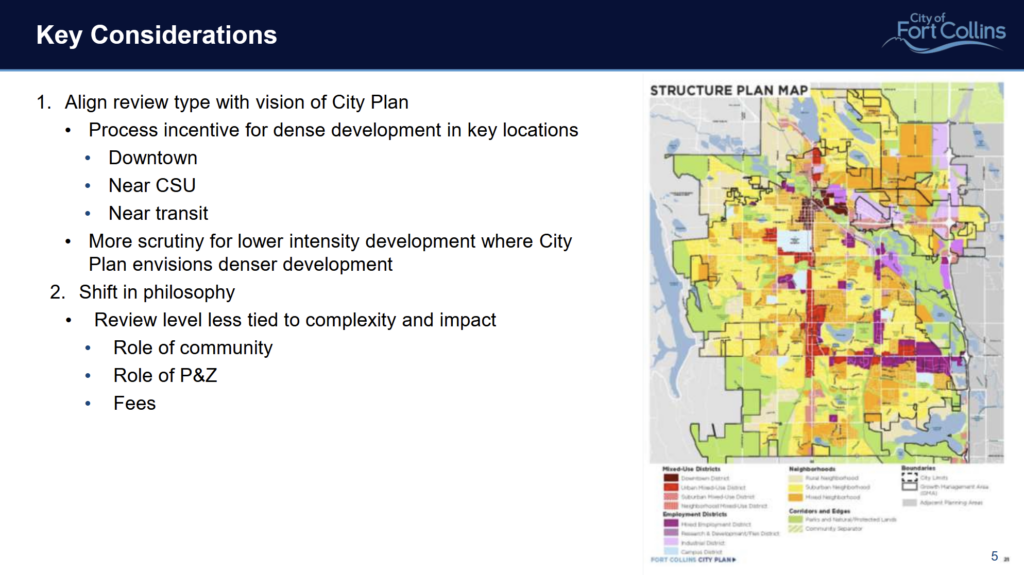
Frickey laid out two versions. The ordinance as drafted is staff’s, and staff recommended it. It keeps current review levels for single-unit, single-unit attached, and two-unit dwellings in commercial and employment districts, where City Plan, the city’s long-range land use blueprint, envisions density, and applies the change everywhere else. The Ad Hoc Committee on Affordable and Sustainable Growth had asked for those lower-density types to move to BDR in those districts too. The committee was established in March 2026 to explore ways to support housing affordability while guiding sustainable development, and to identify practical changes that make housing easier to deliver. Its three members are Nelsen, Conway, and Mayor Francis, who was absent. That version sits in the packet as an alternative land use table; adopting it would mean substituting the table into the ordinance, which the packet notes requires pulling the item from consent. Multi-unit and mixed-use dwellings are treated the same under both.
He flagged three consequences: fewer neighborhood meetings and hearings, a lighter caseload for the Planning and Zoning Commission, and lost fee revenue. Applied to projects from 2022 through 2026, 31 would have paid less – $873,400 less in total. The commission voted 5-0 on August 20 to recommend staff’s version, asking that Type 2 review be kept for large multifamily and mixed-use projects under a tiered framework based on unit count, acreage, building size, or community impact.
Potyondy: scale, cost, and what gets lost
Potyondy asked why an item this size was on consent, then spent most of the questioning on two things: proportionality and money.
On scale, she said having a duplex built next door is not the same as a 100-unit apartment complex, and that the difference warrants a different level of public involvement – traffic, sight lines, quality of life. She granted she did not know the right cutoff, and floated an eight-plex as a hypothetical case where BDR might be fine. When Nelsen pointed out the code already tiers notice by project size, Potyondy answered that notice and participation are not the same thing.
On money, she asked how much of the lost fee revenue reflects real savings to the city. Frickey said review work is identical either way, since the same codes apply; savings come only from staffing fewer neighborhood meetings and hearings, a small share of the total. He added that review positions are funded partly through those fees, which flow to the general fund, so losing revenue means harder conversations about paying for those positions. Potyondy said that mattered to her because programs should be self-sustaining.
She also asked Frickey to spell out what disappears. He walked through it: BDR still mails notice to owners in the notification area, sends notice of a forthcoming decision, and mails the decision to anyone who commented. What Type 2 adds is a neighborhood meeting before submittal – early enough that a developer can still change the plans – and a hearing where the commission takes comment and deliberates in public.
Potyondy said Fort Collins is known for being deliberative, sometimes to its own peril, and that she supports moving faster. But she framed the question as one of pacing against public trust, said too many questions were unanswered, and asked for the Planning and Zoning Commission’s minutes plus an ordinance incorporating its recommendation.
“I don’t feel comfortable voting on it tonight.”
Nelsen: pass it now, set the threshold later
Nelsen, an architect and one of the committee’s three members, said she pulled the item because she supports most of it and wants one piece fixed. She used her questions to establish what the ordinance does not do.
It does not change what can be built anywhere – only who decides. Notice requirements survive: mailers, a sign on the property, published notice, a 1,000-foot radius above 100 units, and appeal rights running from the director to the commission to council. Modifications of standards still get a staff report and written findings of fact, just from the director rather than the commission. Affordable housing and multi-unit projects near transit already go through BDR citywide at any size, under Proposition 123, the 2022 state affordable housing measure, and state transit-oriented communities law. Duplexes keep limited scope review, a cheaper fourth track for the smallest projects, at about $6,900 against BDR’s $16,900.
She also said she prefers staff’s version to her own committee’s, because City Plan designates commercial and employment corridors for denser development, and a single-family house proposed on one of those sites deserves a closer look.
Her case for the change rested on how fees land differently by builder size. BDR runs $16,900 against $49,250 for a project development plan plus final plan – a rounding error for a large developer with a full-time team, and potentially the reason four townhomes on an infill lot never get built. She placed the review process against mortgage rates near 6.7 percent, Colorado home insurance roughly doubled since 2020, and steel and aluminum up 17 and 30 percent, calling review one line in that stack and the only line council controls.
Her case for keeping large projects at a hearing was that the code still relies on judgment about compatibility and context, and until it is precise enough for staff to simply check compliance, that judgment should happen in public on projects shaping the city for decades.
“I would rather take the partial improvement tonight than wait for a perfect one.”
She also argued the real cost driver is how much of a building must be designed before anyone says yes. Frickey agreed, then raised a point that cuts against the savings case: BDR requires complete planning and engineering documents before a decision, while a project bound for the commission can be heard at roughly 30 percent engineering. On that measure the administrative track puts more money at risk, not less. Nelsen acknowledged as much, saying the volume of required drawings does not change under the ordinance and it was still worth trying.
Her ask was narrow: have staff bring back a threshold, perhaps starting at 100 units.
Hoeven: the process objection
Hoeven raised a process objection, and a pointed one: routing the item to consent after three committee members agreed on it amounted to deciding by proxy for all seven. She said she never agreed to that arrangement when the committee formed, that its founding documents repeat “Council will receive a full update,” and that its own timeline placed code changes in a later phase.
DiMartino took some accountability for the placement, saying a unanimous committee vote commonly routes an item to consent – the council finance committee had done exactly that the night before – with any member’s ability to pull it as the safeguard. Pignataro said the Leadership Planning Team, which sets council agendas, routes items the same way, and answered the charge directly: there is no voting by proxy.
Hoeven distinguished this committee from the legislative review and ethics review committees, calling it a decision-making body with major community impacts, created to find friction points rather than move quickly, and in existence only until the fourth quarter of 2027.
She said voting on one of two options presented on consent would signal acceptance of a process she considers unsound, and warned the city risks community trust and the appearance of transparency. Pressed by Pignataro on what an update should look like, she conceded council never defined the term and should have in March, and said the July work session fell well short.
She was also candid about her own position, saying the subject is not her area and she did not have enough information to decide.
Conway: urgency and who shows up
Conway grounded the discussion in the priorities council set in January, when members agreed by a two-to-one margin that affordability was the city’s most important issue. He argued there is a democracy question embedded in process design, since evening hearings favor people with the resources and confidence to attend. Under the current arrangement, he said, a large single-unit house sails through while smaller homes for less affluent people draw real questions.
He separated the committee’s schedule from the consent placement, saying permitting speed was always early-phase work while building code and zoning sit further out – but agreeing the item probably should not have been on consent.
“We all set our priorities seven months ago, and we haven’t made a lot of progress on our top priority.”
Later he asked Hoeven directly whether a commitment to keep items like this off consent in future would make her comfortable voting that night. She said it would not, because what she wanted was the process council had agreed to when it formed the committee.
Fudge: on the fence
Fudge asked whether a project of 150 units – his own figure, not a proposed threshold – could occur in District 3’s zoning at all. Frickey said not in Urban Estate or low density residential, and unlikely in low density mixed-use given building size and height caps.
He said he wanted to respect colleagues asking for more information but feared waiting until November or December. He noted he campaigned on making density easier along the Harmony and Lemay corridors, and said this ordinance does not do that directly. Separately, he supported keeping closer scrutiny for low-density projects in areas planned for density – which Pignataro noted is what staff’s version already does. He called the consent placement a useful lesson for newer members and said the discussion it forced was worth having.
Pignataro: ready to pass it
Pignataro took responsibility as part of the Leadership Planning Team, answered the proxy charge, and reminded members that a 3-3 split among six would fail.
She asked staff what the risk would be of passing the ordinance as written and adding a threshold in the fall. Frickey said the risk seemed low. Daggett noted that applications filed in the interim could include fairly large projects, and Frickey said staff normally warn applicants when code changes are coming, though no one had been warned yet.
Disclosing her own position late, she said this was the fourth or fifth time the subject had come before her, that she has advocated for it for six years, and that she aligned with Conway. She would have passed it and added thresholds with the fall land use code package.
“I think we’ve been very spoiled so far and that we have had some very rare split votes and it is good for us to have split votes.”
Where it landed
Daggett advised that if council did not adopt on first reading, postponing indefinitely and returning with a new ordinance would be cleaner than amending between readings, and confirmed that a failed motion to approve amounts to the same thing. Frickey offered to bundle the threshold work with commercial zone code changes going to the commission in November, and said setting a threshold is not a two-week job.
With no consensus, Nelsen moved to postpone first reading of Ordinance No. 118, 2026 to September 15, 2026. Fudge seconded. It passed 5-1, Hoeven voting no. She had said shortly before the vote that it would be hard for her to vote for whatever was presented that night, because voting on one of two options offered on consent would signal she accepted a process she considers questionable – an objection to the item’s path rather than to the two-week timing.
The two weeks are about the full council, not the threshold. Nelsen said she was leaning toward postponing “not indefinitely, just for two weeks,” that she would rather get a first iteration out, and that she considered the interim risk extremely low; when she framed the motion she said she wanted to take it up with a full council seated. The threshold work runs on the separate track Frickey described – bundled with the commercial zone code changes reaching the commission in November. Frickey had also noted that materials for the September commission meeting were due the following day.
That means the ordinance returns on September 15 unchanged, as a first reading of the same staff version, with the full council seated. Two requests made during the discussion remain open. Potyondy asked for the commission’s minutes and an ordinance incorporating its recommendation; Frickey said he would have to check whether August minutes could be ready in two weeks, noting he had received July’s only that day. Hoeven asked for a full update to council before any code changes moved.
Other Business
Context: RP3 limits on-street parking in designated neighborhoods to permit holders during posted hours. New rates took effect September 1 – the day of the meeting. A household’s first vehicle now costs $20, up from nothing, and the second $40, up from $15. The third stays at $40, while the fourth falls from $100 to $40 and the fifth from $200 to $100. Guest permits stay free for 24 hours or less; a one-to-15-day guest permit rises from $10 to $20. The change raises costs for households with one or two cars and lowers them for households with four or five. Permit holders were emailed the new schedule in August, at least more than two weeks before it took effect, though the city’s public RP3 page still listed the old rates a week after the meeting.
Hoeven asked staff to pause rate increases in the Residential Parking Permit Program (RP3) for a month, saying residents in her district were surprised the first vehicle is no longer free. Daggett said such a request needs two other members’ support, but that fee implementation here is the city manager’s administrative decision, so council would be expressing a view rather than acting. Conway and Pignataro each said they would abstain, leaving the request without the support it needed to advance. DiMartino said staff would likely stay the course on the existing timeline while improving communication.
Council Reports
Hoeven reported an August 22 listening session, one of two new CSU neighborhood meetings, a walking tour with Outreach Fort Collins, and the grand opening of the First Peoples Community Center on East Prospect Road. She noted CSU’s first home football game that Saturday, with parking regulations in effect, and said Safe Lots, the city’s program for sanctioned overnight parking for people living in vehicles, comes to next week’s work session. Potyondy also attended the First Peoples opening and the Center for Family Outreach’s Summerfest.
Adjournment
Pignataro closed the meeting, telling anyone who had expected a short night that the joke was on them.
Leave a Reply