
We’re playing catch up with a few of our summer council recaps, pardon the out-of-sequence posts.
The Fort Collins City Council met for a work session on August 11, 2026. Work sessions are for discussion only – council takes no votes and passes no ordinances. The purpose is to give staff direction before an item returns for formal action.
Two items were on the agenda: a yearly report from Innosphere, the Fort Collins nonprofit that runs a federally funded regional innovation program, and a lengthy update on downtown parking. Parking took up most of the evening.
Mayor Emily Francis presided. Council Members Chris Conway (District 1), Josh Fudge (District 3), Melanie Potyondy (District 4), Amy Hoeven (District 5), and Anne Nelsen (District 6) all took part. Mayor Pro Tem Julie Pignataro (District 2) was absent.
Community Report: Innosphere and the NSF ASCEND Engine
City Manager Kelly DiMartino introduced the item, handing off to Economic Health Director SeonAh Kendall, who sits on the Innosphere board as the city’s appointed representative. Kendall turned it over to Innosphere CEO Mike Freeman.
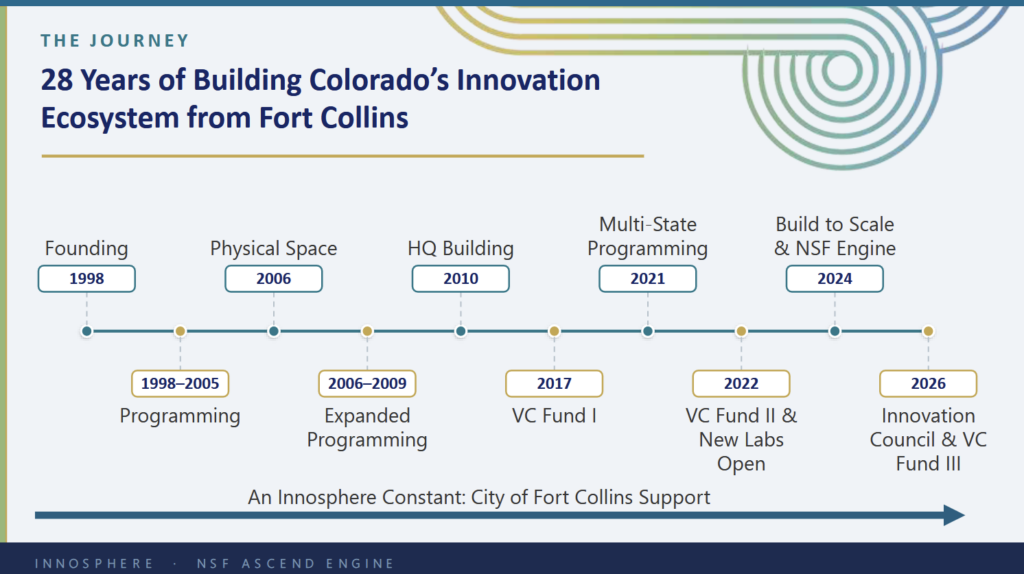
Innosphere began 28 years ago, founded by the City of Fort Collins, Colorado State University (CSU), and the former Northern Colorado Economic Development Corporation. It has grown from startup coaching into venture capital, lab space, and now a major federal grant program. It owns two buildings on Vine Drive, financed with help from the Fort Collins Urban Renewal Authority and federal New Markets Tax Credits; the second is entirely wet lab space for biotech companies, which Freeman said is very hard to come by. Tenant companies in the two buildings employ close to 200 people.
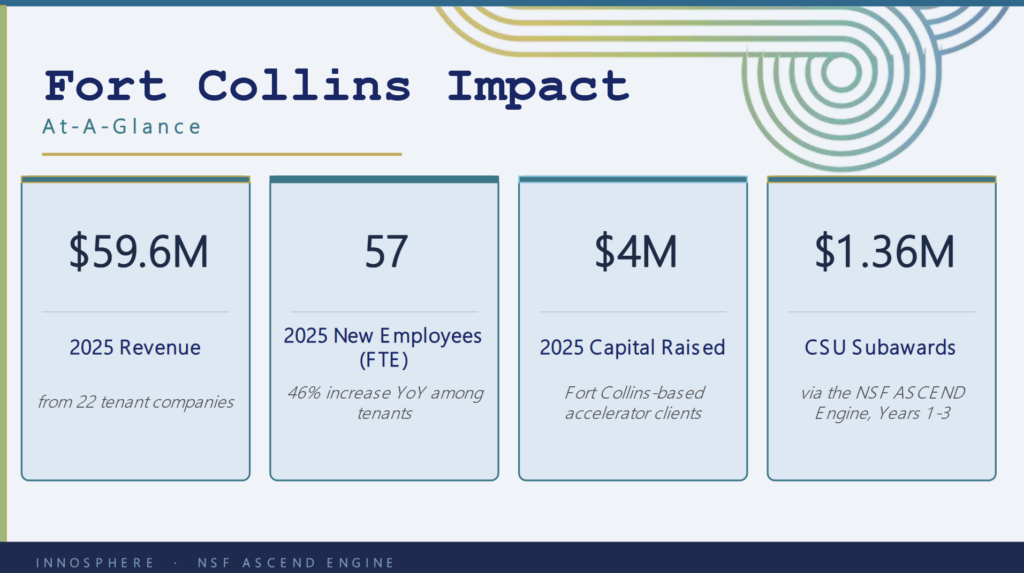
For 2025, Innosphere reported that its 22 Fort Collins tenant companies generated $59.6 million in revenue and added 57 new full-time positions, and that local accelerator clients raised $4 million in capital.
The larger news was the NSF ASCEND Engine. ASCEND – Advanced Sensing and Computation for Environmental Decision-making – is one of the U.S. National Science Foundation’s Regional Innovation Engines, a program created under the federal CHIPS and Science Act to invest in regional economies. Innosphere leads the Colorado-Wyoming engine, which is eligible for up to $160 million over ten years. Freeman said roughly 500 regions applied in the first round, and that 12 more engines were awarded nationally about three weeks earlier, bringing the total to 20.
“We’re in very, very rarefied air with this project.”
The engine’s work centers on wildfire, drought, soil health, extreme weather, and air quality. Freeman said it has directed $1.36 million in subawards to CSU and employs 19 people in Fort Collins.
Hoeven asked what the city could do to help. Freeman pointed to a possible third building on Vine Drive – which he said would not happen for a nonprofit without public support – and to closer alignment with the city’s climate work. Conway asked whether companies leave once they grow; Freeman said relocations are far less common than people assume, and that investor pressure to move companies has largely disappeared since the pandemic.
Discussion Item: Downtown Parking Optimization
Deputy City Manager Dean Klingner opened by acknowledging where things stood.
“This has definitely struck a nerve downtown.”
Deputy Transportation Services Director Drew Brooks laid out the problem as staff sees it. Studies since 2004 have called the downtown system an “upside-down” model: the most convenient parking, at the curb, is free, while garages and surface lots charge. That leaves Parking Services few tools to shift drivers toward spaces sitting empty. The second problem is money – the system does not generate enough revenue to fund major maintenance on its garages, which has historically come from the general fund.
What the data showed
Senior Parking Services Manager Eric Keselburg walked through spring 2026 occupancy data. Downtown has 4,369 public spaces – 2,443 on-street across 78 block faces, and 1,926 off-street across 12 facilities. At peak times, individual block faces in the core exceed the 85% occupancy that the industry treats as the threshold of a healthy system. Keselburg explained “healthy” means an arriving driver can reasonably expect to find a space rather than circling. Meanwhile the garages sat at roughly 45% to 70%, and district peak occupancies across the full system ran between 55% and 72%.
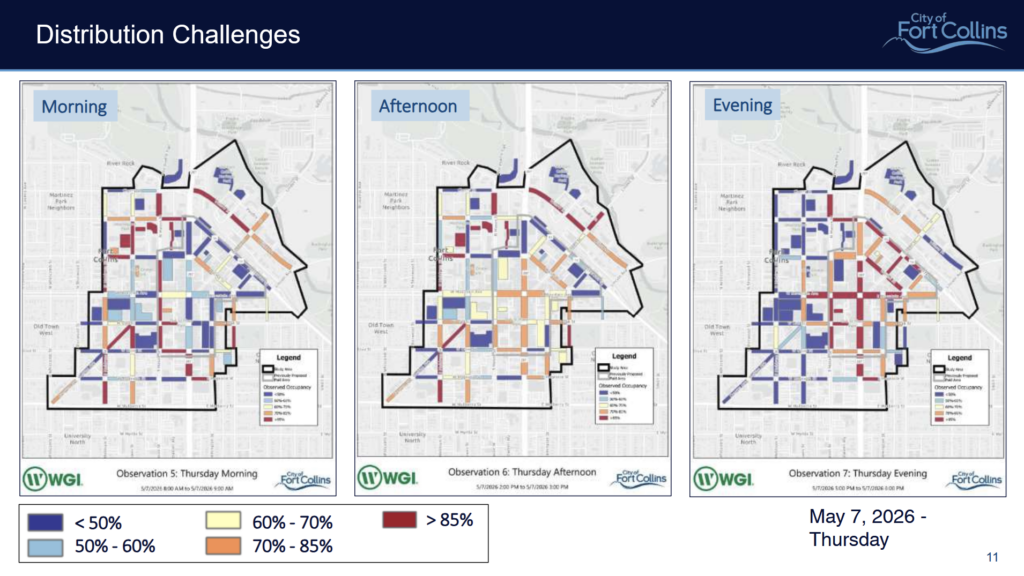
“It’s less of a capacity issue, whereas it’s more of a distribution issue.”
A consultant’s study projected modest future gaps – most significantly up to 362 spaces in the Civic district over ten years, tied partly to a Larimer County Justice Center expansion. Staff stressed these are long-term possibilities to monitor, not immediate needs.
Potyondy pressed staff to keep pursuing shared-use agreements with private lot owners first.
“Once we build a parking garage, we have a parking garage forever for the foreseeable future.”
DiMartino said that beyond legal and liability questions, lot owners want to preserve future use of their land, and at least two already have private agreements with employers.
Nelsen asked how the city decides when a garage has reached the end of its life. Brooks said precast structures like Old Town are generally built to last around 50 years, though many last longer with upkeep. The Old Town structure is now 42 years old. DiMartino said the city and the Downtown Development Authority, which owns it, are aiming to stretch that to 75 years through preventive maintenance.
Immediate actions and the financial picture
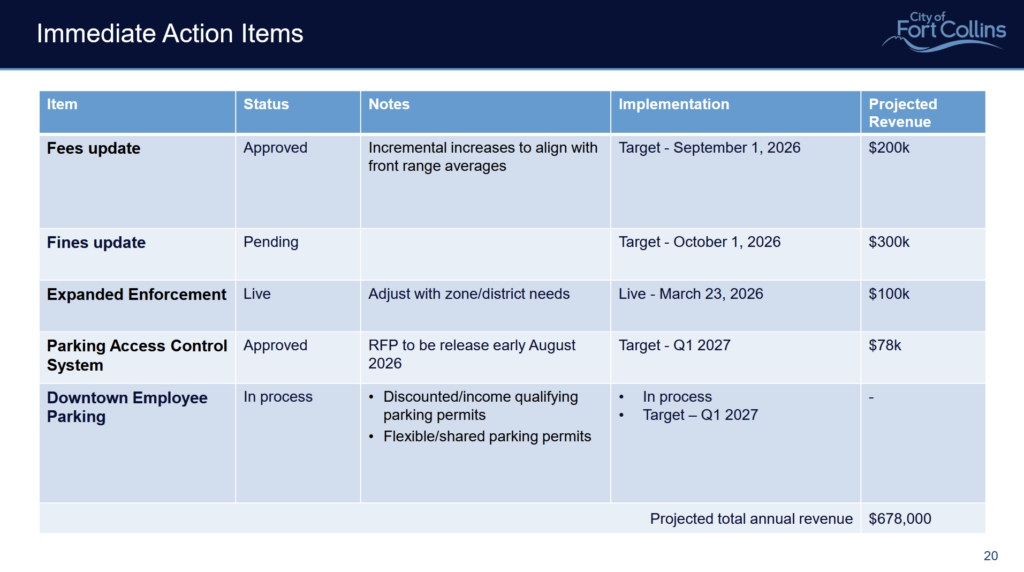
Several changes are already moving. A fee update takes effect September 1, projected at about $180,000 a year. Expanded enforcement – until 6 p.m. weekdays and now Saturdays – went live March 23 ($200,000). A parking access control system is targeted for early 2027 ($78,000).
A fines update is a different kind of change. Council sets fees – permit prices, hourly rates – but it does not set fine amounts. Under the city code, the schedule of payable fines is established by the chief judge of the Fort Collins Municipal Court. Parking Services has asked the court to review the parking-related fine schedule and recommended changes including removing the $0 penalty for a first time-limit violation, aligning fines across payment types, and raising restricted-zone and accessibility violations toward industry averages. Keselburg said the request is pending, and that if the recommendations are approved as submitted the increase would be worth roughly $300,000, with an October 1 target. Senior Finance Manager Monica Martinez returned to the point later: because citations make up about half the system’s revenue, any future adjustment there depends on what the judge is comfortable with, not on a council vote.
That division of authority shaped one of Nelsen’s requests. She asked to understand the registration and expired-plate citations better before the recommendations reach the judge, since that is the point at which council’s window to weigh in effectively closes.
Together, the immediate actions are projected at roughly $750,000 a year.
Martinez modeled the system out over ten years. For one to three years the system meets operating costs and can set aside capital maintenance money. In years four through nine, operations hold but the maintenance reserve falls short. Past year nine, operations are not covered. The model assumes no further increases; Martinez said raising permits could buy perhaps three to five more years before Fort Collins prices itself above comparable cities.
By comparison, on-street paid parking is projected at $3.5 million annually. Martinez raised the option of using that to reduce reliance on citations, which she noted are generally understood to be regressive.
Residential parking permits
The September fee update also covers the Residential Parking Permit Program (RP3), which lets residents in permit zones – largely the neighborhoods around CSU – park on-street beyond posted time limits.
Potyondy said she supported standardizing rates across neighborhoods but had heard from residents questioning how the fee scales with the number of vehicles in a household, which appears to favor households with four or five cars. Keselburg explained the design: a $20 first permit, drawn from a study-recommended range, then a flattened middle rather than a fee that climbs with each additional vehicle, and a roughly $100 spike at the fifth permit. Staff set it that way, he said, because multi-vehicle households are often multigenerational families or roommates, so the cost is spread across users rather than charged against the house.
Conway said that reasoning resolved his own skepticism. Potyondy said it did not fully resolve hers, noting the structure sits awkwardly against the city’s goal of becoming less car-centric, though she agreed it was not the central question of the evening. Hoeven separately asked how state rules on abandoned vehicles interact with enforcement; Keselburg described the city’s practice of chalking and tagging vehicles parked on-street more than 48 hours.
Council gave no direction to change the RP3 structure, and the fee stands as approved.
The proposed pilot
Staff proposed a “parking innovation zone,” or learning lab: a paid-parking pilot at the roughly 150-space Oak & Remington surface lot, with kiosk and mobile payment, a free grace period, and a day rate, paired with a public dashboard. A delay in the College Avenue watermain project opened room in the schedule.
Council was broadly supportive of piloting something – and broadly unconvinced this was the right pilot.
Conway was most direct: until the model is actually flipped, he said, the city will not learn what it needs to know. He floated an evening pilot – Thursday through Saturday, 5 to 9 p.m. – with on-street paid and garages free during those hours. He opposed daytime paid parking, noting the data shows the curb is not full during the day, and said he could not support a program without a parking benefit district governing where the money goes. He also named the perception problem: many residents see this as a money grab rather than a distribution fix.
“I don’t support taking this money and moving it out of Old Town.”
Fudge said he supports the Remington lab even if the data is imperfect, agreed daytime paid parking makes little sense, and suggested later evening enforcement – citing Milwaukee at 9 p.m., Boulder at 7, and Denver at 8 or 10. He floated a sunset clause on any paid parking system. On the revenue forecast: “I get the shakes.”
Potyondy said Remington is fine and immediately implementable, but wanted a pilot with on-street or evening components, suggesting Linden Street. Her firmest position was employee parking.
“I don’t want to be charging our… service workers for going to work.”
Nelsen, whose District 6 covers much of downtown, spoke at greatest length. She said the diagnosis is right on both halves – distribution and revenue – but questioned the order of operations, noting the consultant’s recommendations came with a sequence attached, putting worker support and a reinvestment policy ahead of pricing changes. She argued evening turnover matters most and the city has no tool for it, since time limits end at 6 p.m.
“Someone can take the best spot on Linden at a quarter to six and stay until close, and they haven’t broken any rules.”
She asked for dwell-time data by block face and time of day, and suggested council adopt the study’s occupancy thresholds as policy – pairing a dashboard that measures with a standard that decides. On employee parking, she drew a distinction that reframed the discussion: everything the city offers employees is a permit.
“A permit is a license to look for a space. But it’s not a space.”
She proposed trialing Oak & Remington as a dedicated – possibly free – employee lot instead, to test whether the problem is price or certainty. On the citation question raised earlier, she put a number to it: expired plate and registration citations came to about $769,000 in 2024, more than half of citation income and roughly a quarter of everything the system collects, despite having nothing to do with parking. She asked that accessibility deficiencies identified in the study return to council separately, and closed on demand rather than supply, noting local transit ridership sits near 1% against about 4% nationally.
“Every person who can get downtown without a car is a space that we don’t have to build, price, manage, or receive several hundred emails about.”
Hoeven asked how stakeholders would be involved. Keselburg said the pilot boundary itself is contentious because every downtown business has a different stake, and that staff would work with the Downtown Development Authority and business groups aiming for buy-in, if not consensus.
Staff confirmed that any on-street paid parking – including a pilot – requires council to adopt an ordinance, which could cover a limited geographic area.
Whether the garages are usable
Running underneath the distribution conversation was a more physical question: if the plan depends on moving drivers into garages that sit half empty, are those garages actually pleasant to use?
Potyondy raised it first, prefacing that it might sound like a silly question. She asked whether industry standards for the width of a parking space have changed since the city’s garages were built, saying she has noticed spots that are not realistically parkable now that vehicles have grown, and wondering whether other communities are restriping and losing spaces as a result – which would change the capacity math.
Brooks said staff attend parking conferences regularly and he had not heard that raised as an industry issue; the local version of the problem is long trucks on College Avenue extending into travel lanes, and enforcement works to keep vehicles inside the lines. Keselburg said he did not have a direct answer, but that the garages keep travel lanes open on the first floor so longer vehicles park higher, and that the city’s spaces are already fairly wide. The conversation in the industry, he said, is running the opposite direction – toward whether driverless vehicles will eventually allow more spaces per structure, not fewer.
Fudge backed her up, saying it was not a silly question. He described parking in the Civic Center structure on a Saturday and watching a full-size pickup knock the door handle off another truck, and relayed a resident’s suggestion – which he said he was only half joking about – that the city reserve rooftop spots for oversized vehicles.
Potyondy returned to it later, asking staff to research whether a designated area of larger spaces would be workable. She said she had hit a vehicle in a garage herself and is now less comfortable parking in one. She also flagged a smaller observation: businesses appear to be buying permits to park advertising-wrapped vehicles long-term in prime spots, which she called a smart move commercially and a waste of parking. Brooks said staff would take note.
Mayor Francis connected the thread to something broader – that Fort Collins has a culture of avoiding garages, and that it is hard to break. She said she avoids them herself because of the tight corners, but that comfort grows with use. She relayed a downtown business owner’s suggestions for getting people inside them for reasons other than parking: involving Poudre School District (PSD) students in painting individual spaces, and holding an open streets-style event inside a structure. She compared it to what the city has done with its downtown alleys.
Francis also asked a question staff did not fully answer: whether garage use actually rises on Sundays and holidays, when they are already free – or whether price was never really what was keeping people out.
Direction to staff
Mayor Francis summarized where council landed.
“It feels like there’s not a readiness to move forward with paid parking on street, but maybe a pilot.”
She said she was not prepared to pick a pilot location without staff analysis of the trade-offs, and asked for three things: pilot options to return for a focused discussion, movement on employee parking rather than waiting, and an update to the city’s parking plan – which Brooks clarified means the 2013 plan – so council and staff share the same assumptions.
DiMartino confirmed the direction back to council: staff will develop pilot options including a possible on-street component, along with the path to get there, including an ordinance. Klingner said recent studies could be assembled into an updated plan.
Francis closed by thanking staff for a conversation that has run about two years.
“This is like local government at its best. This is what we do.”
Adjournment
With no announcements, the mayor adjourned the work session: “Good night, Fort Collins.”
Leave a Reply