
The Fort Collins City Council met on June 2, 2026, for a relatively light formal agenda that was overshadowed by another large turnout of residents who came to speak about Flock surveillance cameras – even though the camera item itself had been pulled from the night’s agenda.
Meeting agenda, details, and video recordings available on Fort Collin’s Municode website. The next city council meeting is on June 16thand will be a regular meeting, that does include opportunities for public comment.
Only four of the seven council members were present. Mayor Emily Francis presided, joined by Mayor Pro Tem Julie Pignataro (District 2), Council Member Amy Hoeven (District 5), and Council Member Anne Nelsen (District 6). Three members were absent: Chris Conway (District 1), Josh Fudge (District 3), and Melanie Potyondy (District 4). Francis described the group as “a small but mighty team tonight.”
Because of the absences, City Manager Kelly DiMartino reshuffled the agenda at the start of the meeting. The most consequential change: the Flock retention and data sharing item was withdrawn and postponed to June 16, so the full council could weigh in. A second item – a transfer of state grant funds to develop a new housing action plan – was also delayed. That left two discussion items, a 13-item consent calendar, and routine other business. Despite the Flock item’s removal, the public comment period ran long, with resident after resident urging the council to drop the cameras.
The meeting opened at 5:00 p.m. with three proclamations, recessed, and reconvened as the regular meeting at 6:01 p.m. With only four members present, every recorded vote passed 4-0.
Awards and Proclamations
The evening began with three proclamations, which Mayor Francis described as drawing “the most enthusiastic proclamation event we’ve had.”
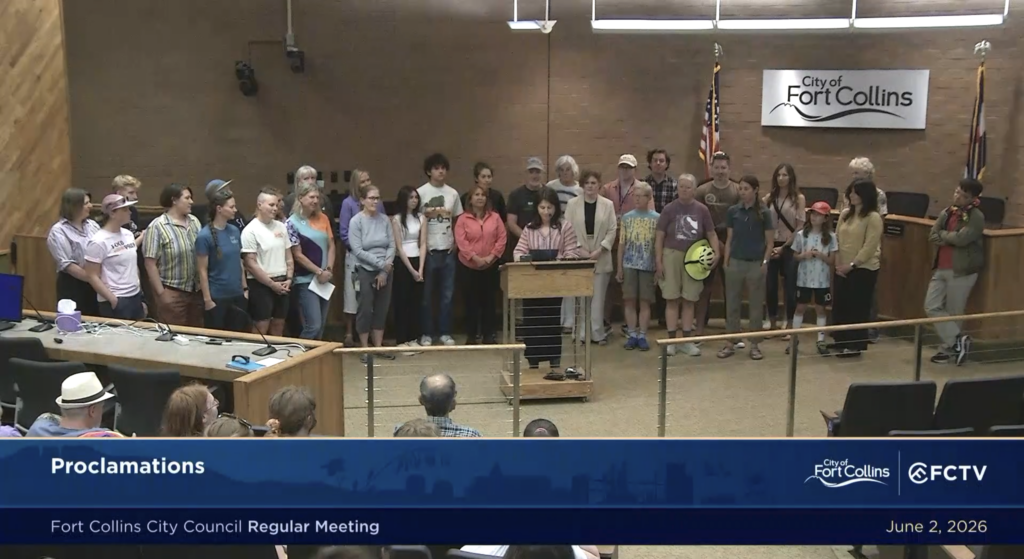
Bike Month (June 2026). Francis, a former city bike program employee, read a proclamation noting that Fort Collins maintains over 330 miles of bikeway network and is one of only three communities nationally to hold platinum-level Bicycle Friendly Community status from the League of American Bicyclists. The proclamation highlighted the city’s Active Modes Plan (2022), Vision Zero Action Plan (2023), and the goal of a “15-minute city.” A representative from a local cycling community accepted, encouraging residents to take part in June events, including the 38th annual Bike to Work Day on June 24.
Plastic Free July (July 2026). The proclamation tied the city’s single-use plastic reduction work to its 2021 Our Climate Future plan and cited concerns about microplastics in waterways, snowfall, soil, and human bodies. Representatives from FoCo Trash Mob and the League of Women Voters of Larimer County accepted. They announced the city is now a registered participant on the Plastic Free July website, thanked city environmental staff by name, and noted that council members agreed to take part in a one-week household “plastic audit” in July. FoCo Trash Mob also flagged two upcoming events: a June 27 collaboration with a refill store in Timnath, and a screening of a plastics documentary. The League presented the mayor with a reusable, non-plastic water bottle.
Pride Month (June 2026). The proclamation recognized the LGBTQ+ community and referenced the 1969 Stonewall uprising and the 2015 Supreme Court ruling on same-sex marriage. A member of the FoCo Pride board of directors accepted, drawing applause for an explicit affirmation of transgender residents: he emphasized the “T” in LGBTQIA and told trans community members, “we stand with you… and that T isn’t going anywhere, and neither are you.” He invited residents to the Pride celebration at Library Park that Saturday at 11 a.m., where another proclamation would be read. City Hall is lit in rainbow colors through June.
Public Comment
Even with the Flock item formally off the agenda, public comment was the heart of the meeting with seventeen speakers. City Manager DiMartino had announced at the top of the meeting that anyone who signed up specifically for the postponed Flock item was automatically moved into general public comment so they could still be heard.
The overwhelming majority – roughly 15 of the 17 speakers – addressed Flock and automated license plate readers (ALPRs). Nearly all asked the council to end the city’s relationship with the technology. The remaining comments touched on water fluoridation, the city’s “sanctuary city” status, and a wide-ranging set of surveillance and geopolitical concerns.
Context: Flock Safety sells networks of automated cameras, primarily to police departments, that photograph passing vehicles and read their license plates, creating a searchable database of where and when cars have traveled. Fort Collins operates roughly 14 of these cameras. The cameras have been the subject of months of public pushback in Fort Collins, focused on privacy, data retention, and whether the data can be accessed by outside agencies – including federal immigration enforcement. The council held a work session on the topic May 12, where staff laid out four options ranging from keeping the current contract to eliminating ALPRs entirely. The formal decision was scheduled for June 2 but pushed to June 16.
Data retention and how long Flock keeps records
Several speakers focused on the technical question of how long Flock data should be stored. Data is currently retained for 30 days, with proposals to shorten that window to 21 days or fewer.
A retired psychologist who described a career working alongside law enforcement walked through the police department’s own usage data, noting that a Fort Collins review of searches between April 20 and May 20 found that about 52% of searches occurred in the first week (days 0-7) and about 39% occurred in days 22-30. She argued the city needs to understand why searches cluster late in the retention window before deciding on a retention period, and pressed the city to push back on Flock’s claim that it cannot set different retention or access rules for local police versus outside agencies.
“Simply being told that such differentiation is not possible is not a satisfactory answer.”
A resident from the Disability Advisory Board, speaking only for himself, made a related point: searches in the first few days are more likely to involve crimes against people, while late-window searches by detectives tend to involve property crimes. He suggested the city weigh civil liberties more heavily than property-crime investigations when setting a retention period.
“Policy isn’t enough – we need an ordinance”
A recurring theme was that a written police policy is weaker than a binding law. One speaker pointed to Denver’s recent experience: she described a Denver City Council vote that narrowly approved a surveillance contract (she said 7-6) after the cameras had already been removed and oversight recommendations stalled, leaving the council boxed in.
“Fort Collins needs more than a surveillance policy. We need an ordinance… that clearly states Fort Collins values, and if surveillance technology is to be deployed in Fort Collins, it defines that deployment.”
She noted that body cameras, red-light cameras, and speed cameras are all governed by state legislation and local ordinances, and argued ALPRs deserve the same treatment because they build a “pattern of life” without a warrant.
A dedicated technical review board
A speaker from the Northern Colorado Privacy Coalition proposed creating a standing technical review board to evaluate surveillance and other rapidly changing technologies – working alongside the existing Citizen Review Board, which would handle the policing side while the new board addressed vendors, infrastructure, and procurement frameworks. He argued Fort Collins has ample local tech expertise to draw on and that an ongoing body could prevent future surprises.
Constitutional and legal challenges
Multiple speakers raised legal arguments. One described a recently filed class-action lawsuit in Boulder County District Court arguing that ALPR cameras violate Article II, Section 7 of the Colorado Constitution’s protections against unreasonable searches. He said the plaintiffs’ position is that no warrant or finding of probable cause has ever authorized photographing everyone who passes a camera, and that switching vendors would not cure the problem because, in the attorney’s framing, the underlying technology is the same. His conclusion: only ending ALPR use entirely (the work session’s “Option 4”) removes the legal exposure.
Context: Speakers repeatedly referenced “Option 4,” which refers to one of four choices city staff presented at the May 12 work session – eliminating ALPR use entirely. The other options ranged from keeping the current Flock contract through 2027, to continuing it with added restrictions, to switching vendors.
Another speaker invoked the U.S. Supreme Court’s Carpenter decision on cell-phone location tracking, arguing that police and the companies they contract with treat constitutional rights as “a technicality.”
Data sharing, Loveland, and immigration enforcement
A finance-professional speaker raised what he called a direct contradiction: police told residents at work sessions that Fort Collins data is shared only with trusted agencies and not used for immigration purposes, yet (he said) Loveland has been independently documented sharing ALPR data with federal immigration authorities through an intermediary – once in 2025 and again recently – while Loveland remains listed on the Fort Collins Police Services website as a data-sharing partner.
“Flock is a network, and we’re only as strong as the weakest point in that network… right now it’s pretty obvious that Loveland is a weak point.”
He echoed an argument made by another speaker – that the city should identify the problem it is trying to solve before committing to a tool. That “problem-based versus product-based thinking” framing came from a coalition member who argued the city had heard plenty about Flock’s benefits and drawbacks but never a clear statement of the gap the technology was meant to fill.
The system itself, not just misuse
One speaker argued the deeper issue is not that individuals can abuse the system but that the system makes abuse “easier, broader, and more routine.” She cited reports from the Electronic Frontier Foundation about Flock searches used in other states for purposes like verifying student residency and running employment background checks, and noted the FBI is seeking nationwide access to Flock’s network. Her conclusion was that audit logs only tell the community about a search after it has already happened, and that the cameras should be removed now.
Another speaker made a similar accountability point, relaying a concern she attributed to Chief Jeff Swoboda at a recent business-association meeting: that the citizen oversight board may lack the capacity to review thousands of search logs. Her takeaway was that an audit log without the capacity to review it does not produce real accountability, and she urged at least pausing the contract until a meaningful review mechanism exists.
Personal stakes
The most personal comment of the night came from a District 5 resident who said she had fled another state and changed her name to escape a stalker she identified as a police officer. She told the council that if a tool like Flock had existed then, she believes she would not have been able to disappear safely.
“I’m sure I’m safe. And I’m sure you’ll keep seeing my face. But if you don’t, I hope that you remember it. So please choose option four.”
History, fascism, and broader warnings
Several speakers reached for historical and political framing. One recounted his family’s flight from Soviet-controlled Poland and described surveillance in Cold War East Berlin as a warning about where mass surveillance can lead. Another defined fascism, attributing the definition to Mussolini, as the merger of state force with corporate power, and argued Flock fits that description; he also told the council he had never seen a single resident speak in favor of the cameras across months of meetings.
One speaker’s comments ranged more widely, into claims about phone manufacturers, federal legislation, and geofencing of churches; these assertions stood apart from the evening’s main privacy arguments and were not corroborated by other speakers or staff.
Fluoride and sanctuary-city status
A 50-year resident and retired teacher used her time to thank the council, then raised two separate concerns. She asked whether Fort Collins is a “sanctuary city” and said she had gotten an “I’m not sure” answer from someone in local law enforcement, prompting her to bring the question to council. She also urged the council to research water fluoridation, citing personal health concerns and arguing residents who want fluoride could get it from toothpaste, while acknowledging she was unsure how much authority the council has over that issue.
Public Comment Follow-Up
Council members responded briefly before moving on, mostly expressing regret that they couldn’t act on Flock that night.
Mayor Pro Tem Pignataro thanked the crowd and said she had hoped to vote on the Flock item but agreed it was best to have the full council present, thanking speakers for keeping comments civil. She then asked City Attorney Carrie Daggett a follow-up question prompted by public comment: whether the term “sanctuary city” has any binding legal definition. Daggett confirmed it does not – different organizations define it their own way, but nothing legally binds the city to a particular definition.
Council Member Nelsen and Council Member Hoeven both thanked residents for their continued advocacy and said they looked forward to taking up the issue as a full council in two weeks. Mayor Francis closed the segment by acknowledging that the government “can be slow, but it’s deliberative.”
Consent Calendar
What the consent calendar is: The consent calendar bundles routine items – first and second readings of ordinances, resolutions, and administrative actions – that are expected to pass without controversy, and the council approves them all with a single vote. Any council member (or the city manager) can pull an item out for separate discussion. Importantly, a consent item is often the latest step in a multi-year project: a second reading appropriating money for a road or bridge may be the formal funding action on something designed and partially funded across several budget cycles. The short descriptions below don’t capture that backstory.
The council approved all 13 consent items 4-0. No items were pulled, though Council Member Hoeven offered a comment on Item 8, expressing enthusiasm for the Foothills Multi-Use Site (the former Hughes Stadium site) planning work and suggesting that adaptive cyclists be explicitly named among the external partners and community members consulted.
The consent calendar included:
- Approval of the May 19, 2026 regular meeting minutes.
- Ordinance 053 (second reading) – appropriating $80,074 in philanthropic gifts received through City Give, supporting departments including the Lincoln Center, Police Services, Arts & Culture, Forestry, and Utilities.
- Ordinance 054 (second reading) – appropriating roughly $1.5 million in federal Broadband Equity, Access, and Deployment (BEAD) grant funds (with a required local match of about $531,000) for Connexion’s broadband buildout.
- Ordinance 055 (second reading) – a $7,500 state grant from the Colorado Office of Economic Development and International Trade (OEDIT) for the Fort Collins Creative District.
- Ordinances 056 and 057 (second reading) – aligning the city’s waste-hauler rules with Colorado’s new Extended Producer Responsibility (EPR) program and adding a shared-cart variance for small multi-unit buildings (7 units or fewer).
- Ordinance 060 (second reading) – annexing roughly 70 acres known as the Peakview Annexation No. 2, near East Mulberry Street and Greenfields Drive.
- Ordinance 061 (second reading) – zoning for the Peakview Annexation No. 2 property.
- Ordinance 062 (first reading) – appropriating $250,000 from the Conservation Trust Fund to plan a Conceptual Framework Plan for the Foothills Multi-Use Site (formerly the Hughes Stadium site).
- Ordinance 063 (first reading) – appropriating about $245,000 in Colorado Energy Office Fleet Zero grant funds, plus a roughly $295,000 match, for fleet EV charging stations.
- Ordinance 064 (first reading) – appropriating $35,120 in state Division of Criminal Justice funds for restorative justice services through Conflict Transformation Works.
- Ordinance 065 (first reading) – conveying a roughly 2.37-acre easement on Meadow Springs Ranch for a wind generation-tie corridor.
- Ordinance 066 (first reading) – modernizing the city’s organizational structure in code, including creating a new Transportation Services area and consolidating Sustainability with Planning and Development.
- Resolution 2026-075 and Ordinance 067 – an intergovernmental agreement with the Town of Timnath and roughly $400,000 in combined funding for an I-25 interchange and Harmony Road/Weld County Road 74 corridor and traffic study.
Discussion Items
Item 14 – Municipal court sentencing and default code updates
This was a second reading of two ordinances aligning the city’s penalty framework with recent Colorado Supreme Court decisions (In re People v. Camp and In re People v. Simons), which hold that municipalities cannot impose penalties exceeding what state law allows for similar conduct. The item returned to discussion mainly so the council could adopt amended language adding “petty offense,” alongside “misdemeanor,” as a possible escalation level for repeat infractions. A senior prosecuting city attorney was on hand for questions, but there were none.
- Ordinance 058 (extending the window to ask a court to set aside a default judgment from 7 to 14 days) passed 4-0.
- Ordinance 059 (the amended general-penalties section) passed 4-0 after a lengthy formal reading of the amendment.
There was no public comment on either ordinance.
Item 16 – Updated business assistance package incentive policy
Economic Health Director SeonAh Kendall, joined by a lead business specialist from her office, presented an updated business assistance policy intended to replace a framework dating to 2013 and last meaningfully updated in 2018. Kendall framed the policy as the “what” – the umbrella under which future, case-by-case incentive deals would be evaluated – with the “how” (specific programs, including a future Economic Development Fund) to come later. She noted a work session on the Economic Development Fund is anticipated for August 11.
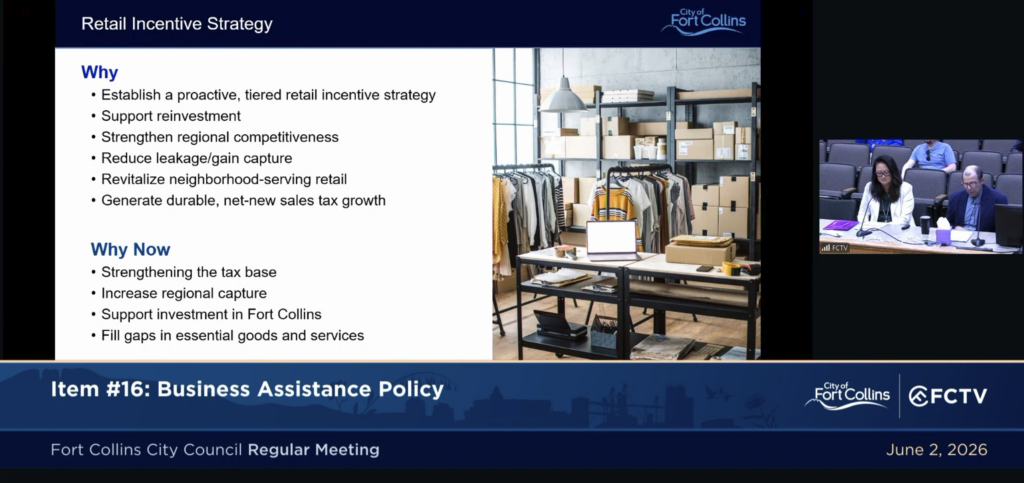
Kendall argued Fort Collins is at a disadvantage compared with neighboring communities because of the limited incentive tools it currently has, and tied the update to council’s priority of a “thriving economy” built on high-quality primary-employer jobs in sectors such as clean and climate tech, bio and life sciences, advanced manufacturing, and semiconductors. The lead business specialist described the retail side, noting the city currently has no retail incentive strategy at all. He outlined potential tools – sales-and-use-tax rebates and sharebacks paid only after outcomes are verified, expedited review, fee waivers, and amortization options – and stressed that meeting eligibility thresholds would open a conversation with the Economic Health Office, not guarantee approval.
Council questions focused on process. Mayor Pro Tem Pignataro asked where the Economic Advisory Board and other boards fit in; Kendall said staff would present proposed assistance packages to those boards for feedback before bringing them to council. Council Member Hoeven asked who evaluates an application and who pays for that evaluation; Kendall explained that a third-party sales-tax “cannibalization” study would be paid for by the applicant, while two consultants already on contract could perform other analysis, reimbursed to the Economic Health Office by the company. Mayor Francis tied the policy to affordability, noting that bringing high-paying jobs to Fort Collins is one part of the affordability picture alongside housing.
Resolution 2026-076, adopting the updated business assistance package incentive policy, passed 4-0.
Other Business
With the discussion items finished, the council handled two procedural matters:
- Canceling summer meetings. The council voted 4-0 to cancel its regular meetings on July 7 and August 4, 2026, under city code.
- Executive session. The council voted 4-0 to go into a closed executive session to discuss a potential acquisition and sale of real property in Fort Collins for possible economic redevelopment, and to develop a negotiating strategy. Mayor Francis noted there would be no further public business after the closed session.
Council Reports
- Council Member Hoeven gave the night’s only substantive report. She thanked Veterans Plaza volunteers for the Memorial Day celebration, including one who explained the missing-man table setting. She congratulated the Boys & Girls Clubs of Larimer County on a fundraiser that raised $200,000 and recognized its youth-of-the-year honorees. She also thanked the Parks and Natural Areas trails team, recounting watching staff guard a turtle laying eggs along Spring Creek Trail before 7 a.m.
- Mayor Francis highlighted upcoming weekend events, including the Pride festival at the downtown library and an Eco Fest.
Adjournment
After the votes on summer meeting cancellations and the move into executive session, Mayor Francis announced the broadcast would end, signing off: “Good night, Fort Collins.”
Leave a Reply