
At a work session, City Council discusses items in depth and gives staff direction but takes no formal action. Items generally return to a regular meeting for a vote.
Meeting agenda, details, and video recordings available on Fort Collin’s Municode website.
All seven council members took part on August 25, 2026: Mayor Emily Francis, Mayor Pro Tem Julie Pignataro (District 2), Chris Conway (District 1), Josh Fudge (District 3), Melanie Potyondy (District 4), Amy Hoeven (District 5) and Anne Nelsen (District 6).
City Manager Kelly DiMartino introduced two items:
- A proposed agreement for the City to supply wholesale water to East Larimer County Water District (ELCO) for Montava, a planned 4,000-plus-unit development in northeast Fort Collins.
- A first conversation about data centers.
Council members who spoke on the water agreement supported moving it forward. On data centers, five council members voiced interest in a temporary moratorium on larger facilities while the City writes rules.
Item 1: Wholesale Water Agreement with ELCO to Serve Montava
What staff brought forward
One Water Executive Director Nicole Poncelet-Johnson and Joe Wimmer, Deputy Director of Utility Finance, asked whether council supports the arrangement and has concerns.
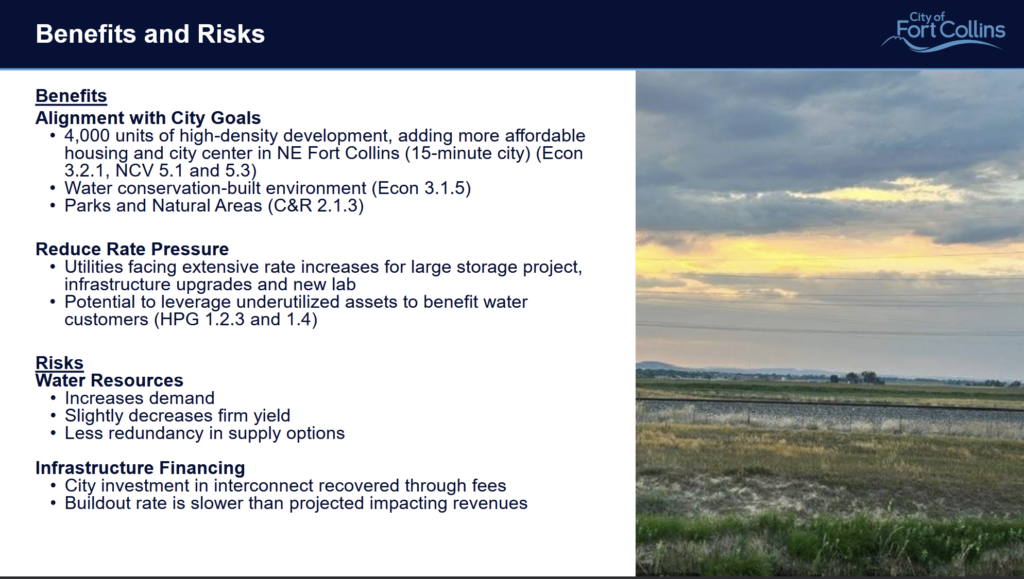
Context: Montava is inside city limits but within ELCO’s water service area. Staff said securing water up front for a 20-year buildout has been a major hurdle, because lenders want water in hand for the whole project. Poncelet-Johnson said Montava needs roughly 800 acre-feet a year for indoor use. An acre-foot is about 326,000 gallons.
The presentation
- How it works: The City would treat water from its Colorado-Big Thompson (C-BT) supply, stored in Horsetooth Reservoir, at its own plant, which has unused capacity. ELCO would deliver it to Montava for indoor use only. Residents would remain ELCO customers. A separate untreated-water system, run by the developer and later the Montava Metro District, would handle irrigation. That system is governed by a second contract whose terms Northern Water required.
- Cap: Northern Water allowed up to 800 acre-feet. The City set a limit of 720 acre-feet a year to allow for about 10% in water losses.
- Money: Wimmer said the City would bill ELCO at cost, with no profit.
- The City’s development fees would apply, which he said are about $25,000 lower than ELCO’s for a single-family home.
- He estimated about $50 million in fees and water sales over 20 years (the packet says $52 million). He said that is equivalent to about a 3% rate increase that could be offset for existing customers.
- Risks: Staff said the deal increases demand on City water and slightly lowers “firm yield,” the supply the City can count on in a severe 1-in-50-year drought. It also reduces flexibility. Poncelet-Johnson said the Water Commission reviewed the proposal and supported it.
Council discussion
Supply. Potyondy, who called herself “incredibly risk averse with water,” asked whether the Water Commission had concerns about lost flexibility. A Water Resources staff member said it did not. Potyondy said she remained concerned.
Conway asked why C-BT water specifically. Eric Potyondy of the City Attorney’s Office said many City water rights can only be used in certain places, while C-BT water can be used throughout Northern Water’s boundaries. Conway said that meant dedicating some of the City’s more flexible water to Montava. Eric Potyondy said that was “kind of by necessity.”
Infrastructure cost. Potyondy asked about the City paying for the pipeline connection to ELCO. Wimmer said a preliminary estimate was about $2 million (the slides say about $2.5 million). He said the cost could be recovered through development fees, but funding hasn’t been decided. Potyondy said some residents may see this as development not paying its own way, and she would prefer the cost not come from City funds.
Backstops. Nelsen asked what happens if the irrigation system falls short. Eric Potyondy said both the City and ELCO would review that system, but he didn’t believe the draft contract has express terms for a shortfall and that responsibility would likely fall on the system’s owner. He said staff would slow new construction approvals as Montava’s total use nears the 720-acre-foot cap, which Poncelet-Johnson said would be reviewed annually.
Should this deal be repeated elsewhere? Some Fort Collins neighborhoods get water from districts such as ELCO and the Fort Collins-Loveland Water District rather than the City. No specific proposal was on the table, but council discussed whether the Montava deal should become a pattern: the City selling its treated water to a district to serve new development in that district’s territory.
Nelsen asked whether the structure was a one-off or a template for use elsewhere, noting that council was setting a precedent.
Poncelet-Johnson said the City has had a somewhat different arrangement with the Fort Collins-Loveland Water District for some past developments. Eric Potyondy placed those in the 1990s. She said the Montava structure could serve as a template, with caveats:
- It took 18 months and extensive work with Northern Water and the state engineer.
- The City’s water supply is finite.
- Any future deal should bring real value back to the City.
She called that a policy decision for the council.
Conway said he agreed with Nelsen about thinking of the deal as a possible model. He said residents in northeast Fort Collins, which he represents, tell him they lack the bus service, bike routes, parks and natural areas other neighborhoods have. He said the area is hard to serve because “they’re relatively isolated from the rest of the city.” He said he hoped the added density from Montava would help bring those investments.
Potyondy took the opposite view:
“For me, I would like this not necessarily to be a model. I think if we revisit this, I think we need to start from scratch because I am concerned about other developers thinking that this is something that we can extend to other developments.”
She called Montava an exceptional case for a development she believes brings significant value. Before the City takes on similar long-term obligations again, she said, she would want to see “significantly more water rights” brought to the table. She said she would support the agreement in this case.
Council did not reach a conclusion on whether the arrangement should be repeated.
Where council landed
Every council member who stated a position supported moving forward, and none spoke against it.
What’s next
Wimmer said the contracts could be ready for council “around the October timeframe.” Staff plan to bring an ordinance authorizing the City Manager to sign them.
Item 2: Data Center Information and Potential Next Steps
What staff brought forward
Deputy City Manager Dean Klingner and Ginny Sawyer, Assistant to the City Manager, asked for questions and feedback on next steps.
The presentation
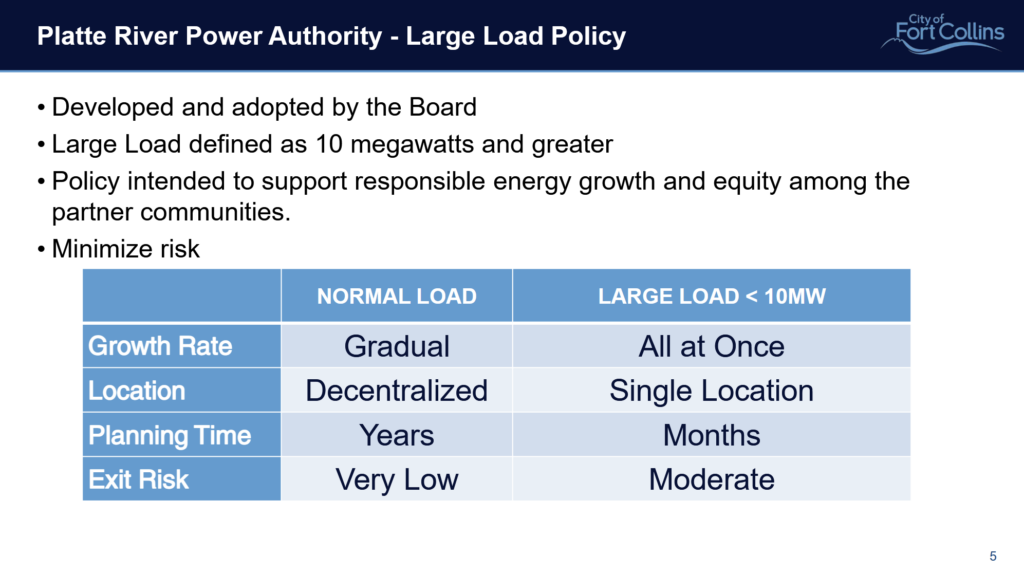
Context: Data centers house computer servers. They range from small server rooms to “hyperscale” campuses that can use more than 100 megawatts (MW) of power. Fort Collins’ peak demand on a hot day is about 325 MW, and its largest existing customers use 12-25 MW.
- Current rules: The Land Use Code doesn’t define data centers, so applications get a case-by-case review. Staff said Fort Collins is not a strong candidate for large facilities because of land costs. They said Light & Power could serve facilities of roughly 15-60 MW in the right location.
- Regional activity:
- Platte River Power Authority (PRPA), the City’s power supplier, requires customers of about 10 MW or more to cover their own costs and risks.
- Larimer County is under a moratorium until February 2027.
- Longmont banned hyperscale facilities on June 9, 2026.
- Staff expect state bills in 2027.
- Proposed next steps: Continue regional work, create definitions and size thresholds, consider added regulations, and possibly review how the City allocates limited water among types of development.
Council discussion
Early views. Potyondy said that, measured against City goals on water, emissions, air quality and jobs, she did not see large-scale data centers meeting them. She said she supported exploring measures like Longmont’s, including a moratorium on larger users.
Fudge said he mostly agreed. He said the City shouldn’t rely on being an unattractive location and that he favored a moratorium, at least short-term and especially for larger projects. He also said he worried that one-size-fits-all rules could block efficient future technology.
The current process. Nelsen said the lack of a definition “isn’t a neutral problem” and that she supported defining the use either way.
Clay Frickey of the Planning department said the case-by-case process, called an Addition of Permitted Use, is available in any zone. The planning director decides, weighing impacts such as traffic, building size, noise and pollution. He said a firm recently asked about a 20 MW facility in an existing building of just under 50,000 square feet.
Frickey said that, going “out on a limb,” a moratorium would be the safest option to give staff time to write consistent rules. He said staff might need outside help given other code work, and gave no timeline.
City Attorney Carrie Daggett called a moratorium on a use the code doesn’t address “a pretty classic example of an appropriate use of a moratorium.” She said it is low-risk if it isn’t too long.
Capacity.
- Power: A Light & Power staff member said some substations could take 15-50 MW. Above about 50 MW, he said, a new substation might be needed.
- Water: A Utilities water treatment manager said the plant has about 18 million gallons a day of spare capacity, which he expected significant data center development would exceed. He suggested the City might require data centers to supply their own cooling water. Daggett said the City would need to study the implications of that.
Ratepayers and emissions.
- Conway asked whether current policies protect ratepayers. The Light & Power staff member said capacity fees make growth pay its own way.
- Potyondy asked about clean energy goals. He said PRPA would aim to keep its renewable share steady but would likely need more backup fossil-fuel generation, which Potyondy said concerned her.
Other questions.
- State and federal land: Frickey told Hoeven that state and federal entities, such as Colorado State University, aren’t subject to the Land Use Code. Daggett added that the City has some influence where it provides utilities.
- Scope: Pignataro asked that “data center” not be treated as shorthand for hyperscale. Daggett confirmed council could limit a moratorium to facilities above a certain size, and Pignataro said she would be much more comfortable with that.
- Other projects: Fudge asked whether a 100 MW moratorium could catch non-data-center projects. The Light & Power staff member said, in his opinion, a cap around 60-70 MW would be safe for other opportunities he had seen at 30-50 MW. Frickey said a moratorium could clearly define what counts as a data center.
Where council landed
Sawyer summarized:
“It sounds like there’s an interest in some level of moratorium, perhaps at a higher megawatt level. And then we could look at … thresholds and confirming that some threshold level works for us.”
Francis said Sawyer “summarized my thoughts.” Potyondy said she wanted “a moratorium in the sweet spot with multiple metrics that we are using as the yardstick.” Nelsen said a moratorium would probably be appropriate. Conway and Hoeven asked questions but did not say where they stood. No threshold was settled.
What’s next
Staff gave no return date. Frickey said Larimer County hopes to finish its rules later this year.
Adjournment
There were no announcements, and Francis adjourned the meeting.
Leave a Reply