
The seven-member Fort Collins City Council includes a mayor elected citywide and six members elected by district. Work sessions give council time to discuss issues in depth with city staff and community partners before decisions are made. Council takes no votes and does not hear public comment at work sessions. Instead, council members ask questions and give staff direction. Items that need formal action come back to a later regular meeting for a vote, where the public can comment.
The October 13, 2026, work session had two items. The first was council’s third session on the recommended 2027–2028 budget, covering follow-up questions and possible changes. The second was an update on council’s five priorities for its term.
Present:
- Mayor Emily Francis
- Chris Conway, District 1 (attended remotely)
- Julie Pignataro, District 2 (Mayor Pro Tem)
- Josh Fudge, District 3 (attended remotely; joined after the meeting began)
- Melanie Potyondy, District 4
- Amy Hoeven, District 5
- Anne Nelsen, District 6
Absent: None
2027–2028 Budget: Follow-Up and Trade-Offs
What staff brought forward
Chief Financial Officer Caleb Weitz and Budget Director Victoria Shaw presented. The recommended budget is balanced, so anything council adds needs a matching cut or new revenue. Staff asked what council thought of the possible additions, which offsets it wanted before adoption, and whether it wanted to discuss other changes.
Follow-up information
Shaw said parks projects funded by the 2050 tax include a $12 million replacement of the Rolland Moore Park tennis courts and playground, a $5 million update to Landings Park and a $4 million update to Soft Gold Park.
Of $15.8 million set aside for affordable housing across two capital tax sources, about $10.25 million is unspent. City Manager Kelly DiMartino said a recent call for $5.7 million of that money drew six applications totaling $7.67 million.
Municipal Court
After the budget was published, the court identified a need of about $250,000 a year. Assistant City Manager Rupa Venkatesh said it would pay for a new clerk, pay adjustments to help keep and hire staff, added security for the court’s larger renovated space, and jail costs that run over the city’s contract.
To cover it, the city manager proposed cutting contracted landscaping at the Gardens on Spring Creek, dropping a planned business-support position for the Southeast Community Center, and raising from 10 to 11 the number of positions to be cut as employees leave over the budget cycle. Mayor Francis said she supported the court funding and offsets.
Grocery rebate, human services and the gas franchise fee
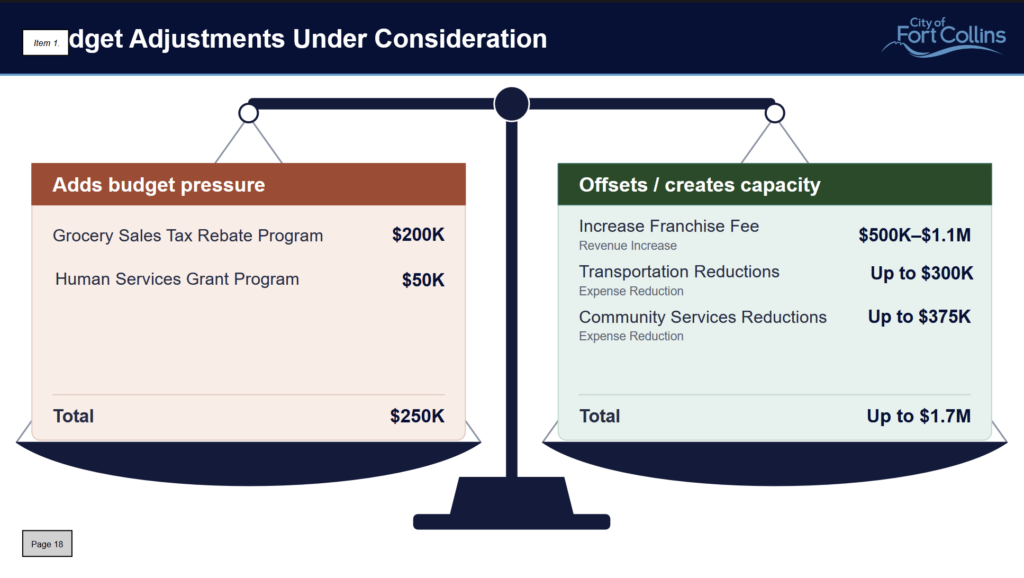
Council members had asked about fully funding the grocery sales tax rebate (200,000)andrestoringhumanservicesgrants(50,000). The rebate pays $81 per person per year to households earning up to 60% of Area Median Income (AMI) in city limits or the Growth Management Area (GMA).
Shaw presented three ways to pay for them. The first was raising the franchise fee Xcel Energy pays on natural gas, which has been 1.07% since 2018. Council can raise it by resolution to as much as 3%, which she said is the common rate among other Colorado communities staff contacted. A 2% fee would bring in about $500,000 a year and a 3% fee about $1.1 million. She said staff expected Xcel to pass the cost on, adding about $6.50 a year to a typical residential bill at 2% or $13.60 at 3%.
The other two options were cuts, either up to $375,000 in Forestry and the West Nile virus program or up to $300,000 in street maintenance. Matt Parker, who oversees the West Nile program, said the recommended budget already cuts larvicide work by 40%, and further cuts would leave the county with an incomplete picture of local risk.
Staff said Xcel offers gas bill assistance for lower-income customers. Weitz said proposed city utility rates would raise the combined bill for an average residential customer about $18.90 a month.
Council members did not agree on the fee:
- Pignataro said she would support 3% and that none of the cuts appealed to her.
- Francis said she would rather slow down and decide first where the money would go, saying a higher bill would hit households that earn too much for GetFoCo help.
- Nelsen said she would be open to 3% if the extra money went toward affordable housing or fee relief.
- Potyondy wanted more information and said the money should go toward everyday costs such as the grocery rebate.
- Conway said he wanted to explore the fee, did not favor tapering the rebate by household size, and would need more information.
Councilmember Fudge also spoke, but his remote audio was too unclear to follow.
The direction given
DiMartino checked for agreement and said she saw head nods for this approach:
- Study the franchise fee further.
- Leave out the Forestry, West Nile virus and street cuts.
- Hold off on restoring the grocery rebate and human services money until the fee discussion, with the option of adding one-time money at mid-year.
Weitz said staff would add the $250,000 for the court, with the city manager’s offsets, to the appropriation ordinance for first reading.
Pignataro asked whether waiting would mean no change for a year. She said she would rather get the fee information by October 27 and skip the Council Finance Committee. Weitz said one-time reserves could cover the rebate and grants next year. DiMartino said staff would try to bring the fee to the finance committee soon but would not assume it could take effect in time for this budget.
What’s next
The second budget public hearing is set for October 20. First reading of the budget is November 3, with second reading on November 17.
Council Priorities Update
What staff brought forward
Ginny Sawyer, Assistant to the City Manager, reviewed progress on council’s five priorities. Staff asked for questions, for feedback on future updates, and whether to rework the workstreams and success measures. A slide added a fourth question: whether staff should build a plan for 20 mph speed limits on neighborhood streets and bring it back December 8.
Neighborhood speed limits
Councilmember Potyondy said she was excited about looking at speed limits. Councilmember Pignataro asked how much the change would reduce serious injuries.
“I would hate for this to be performative and just makes people feel good and doesn’t actually help our Vision Zero goals.”
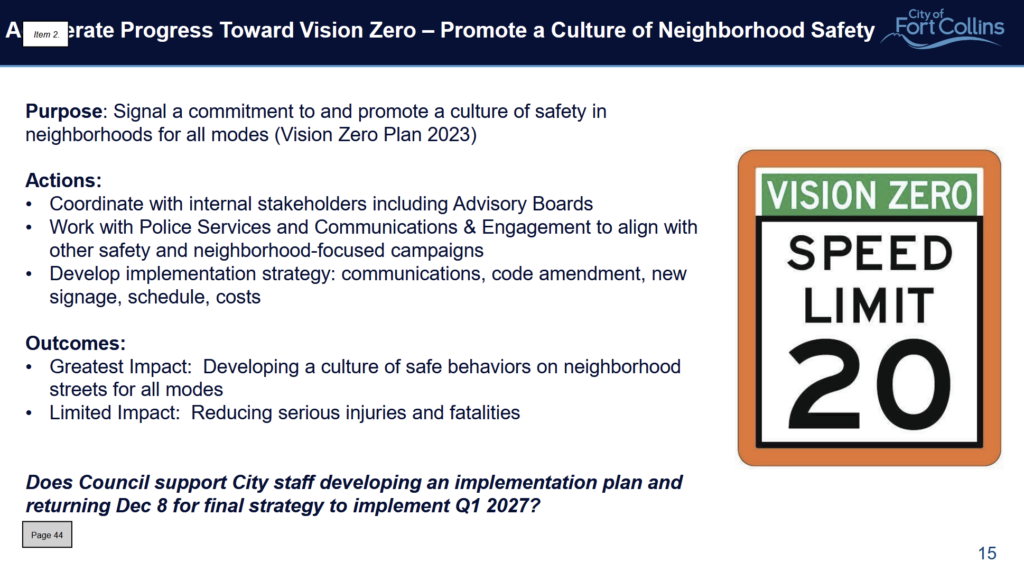
Drew Brooks, Deputy Director of Transportation Services, said neighborhood streets are “typically not where we would see serious injuries and fatalities.” He said average speeds on the 25 mph neighborhood streets the city measures are currently 28 mph.
Asked by Potyondy whether lowering neighborhood limits first could help with later citywide changes, Brooks said the neighborhood change is simple, while changing limits on major roads with speed cameras takes longer. Councilmember Nelsen said she would be very open to staff bringing back an implementation plan.
Debate over the ad hoc committee’s focus
The development priority is being worked on mainly through a council ad hoc committee of Mayor Francis, Councilmember Conway and Councilmember Nelsen. Councilmember Hoeven said she had changed her view since the priority was set.
“I’m looking in hindsight that I wish there was more we were doing to help the cost burdened in this priority with our renters who are so cost burdened.”
Citing the regional housing needs assessment, Hoeven said about 7,400 homes are in the development pipeline, against a need of about 7,000 over the next 10 years. She asked whether the committee could focus more on cost-burdened renters.
Mayor Francis said much of the housing burden comes from limited supply, and that steps like eviction prevention and land banking are budget questions. She said permitted projects do not always get built, citing Sanctuary on the Green, and called the 7,000-home figure “the floor,” not the ceiling.
“I’m comfortable keeping the direction of the committee. I would say, and we can talk at the committee about adding things, but it would be outside the scope of the resolution that formed the committee.”
Councilmember Pignataro said the committee is “working at the root of the problems,” while rental assistance “is more of a symptom.” Councilmember Conway said finding money for the most cost-burdened renters “is really a complement to the work we’re doing on the Ad Hoc Committee and not like a competing priority.”
Councilmember Nelsen said affordable housing projects also depend on development being fast and affordable to build. Hoeven replied that in market-rate housing, “cost does not equal price,” so lower developer costs do not guarantee lower rents. Nelsen said that may hold for national developers but less so for local ones. She said they have hesitated to build in Fort Collins compared with neighboring cities, and that Basic Development Review had made projects more approachable for small-scale builders. Hoeven said she wasn’t questioning that. She said the city built more housing in the past two years than in the previous 10, and that the committee should address immediate needs.
DiMartino noted that a Housing Action Plan update, including housing cost burden, comes to council October 27.
Tracking the development review changes
Staff’s slides summarized progress on the development priority in broad statements, such as process improvements having been “deployed to increase predictability and transparency in development review.” Nelsen said she could not match the actual work to those statements.
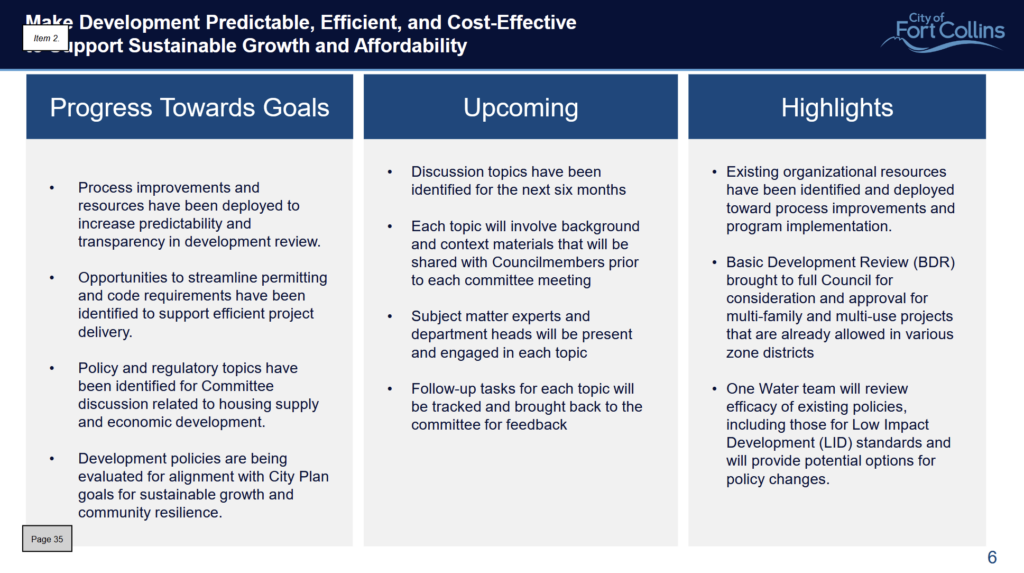
“I really could not take the work that we’re doing and put it in one of those categories with a lot of confidence.”
She asked for more detail, such as a decision log or timeline showing who is doing what and what has been decided. Francis said she also had trouble telling residents which process improvements staff has made.
DiMartino said staff had recently assigned full-time staff to pull that information together. Individual efforts such as the FC Clear system project have their own work plans, she said, but they had not been combined. Assistant City Manager Jacob Castillo said a first draft roadmap would be ready by the first week of November. It would list priority projects through the end of 2027 with dates, deliverables and owners, covering both process and policy changes.
Direction and what’s next
No council member objected to staff reworking the workstreams and success measures. Sawyer said staff would keep improving what the updates include.
“It sounds like we will include some speed limit conversations on December 8th going forward.”
The next priorities update is January 12, 2027.
Announcements and Adjournment
The mayor announced Open Streets on Laurel Street from Shields to Mason the following Sunday, then adjourned the meeting.
Leave a Reply