
Fort Collins City Council held a work session on September 8, 2026. At work sessions, council hears updates on existing programs, proposed programs and local agencies. No policy decisions or votes occur, but council uses the discussion to steer the direction staff is taking on a policy, generate new ideas and strengthen partnerships.
City council members in attendance:
- Mayor Emily Francis
- Mayor Pro Tem Julie Pignataro of District 2
- Chris Conway of District 1
- Josh Fudge of District 3
- Melanie Potyondy of District 4
- Amy Hoeven of District 5
- Anne Nelsen of District 6
The agenda held the 2026 Community Survey results, an update on electric mobility devices, a proposed grant program for small businesses, and a proposed safe parking pilot.
2026 Community Survey
Chief Communications and Engagement Officer Amanda King introduced the results, presented by Sonya Wytink of Polco, which has run the survey with the city since 2001, now in its 17th round. Surveys went to 4,400 randomly selected households in April, drawing 537 responses, a 13% response rate, plus 363 from an open online version, for 900 total and a margin of error of three percentage points.
Quality-of-life ratings held steady, with 87% rating life in Fort Collins good or very good. Affordability stayed at the bottom: affordable, quality housing drew positive marks from 6% of respondents, the lowest-rated item on the survey. The availability of job opportunities fell from 35% in 2025 to 25% this year, a record low for that question. Ratings for the city listening to community members dropped 10 points to 40%. Wytink said the survey was in the field as public discussion of the city’s Flock Safety license plate reader cameras picked up, and that next year’s results will show whether the drop holds.
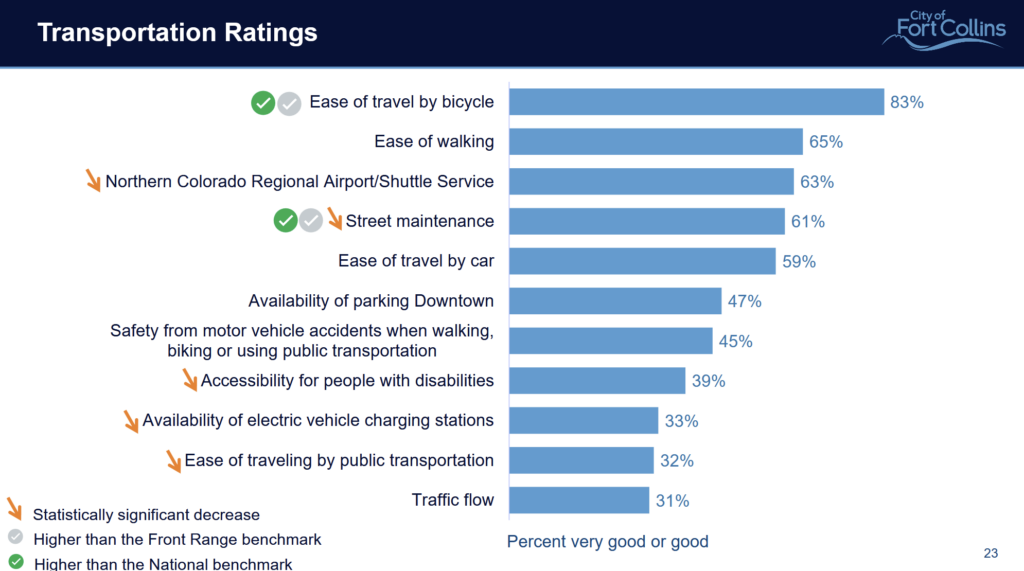
Asked whether that response rate is normal, Wytink said it is typical for a city this size. Potyondy said she would raise the declining ratings for accessibility for people with disabilities with the Disability Advisory Board.
E-Mobility Devices and Enforcement
Assistant Police Chief Justin Gallimore, appearing before council for the first time, presented with Lieutenant Kevin Cronin and Sergeant Dave Lindsay. Staff sought no direction on the item.
Police presented these figures on injuries and enforcement:
| Measure | Figure |
|---|---|
| Increase in e-mobility injuries, 2024 to 2025 (UC Health) | 184% |
| Further increase in 2026 over the same period | 84% |
| Chance of injury for a rider involved in a crash (police data) | 81% |
| Citations issued, 2025 | 35 |
| Citations issued, 2026 to date | 31 |
Cronin said those numbers put 2026 on pace to pass last year’s injury total. Citing a January 2026 Massachusetts study, he said a standard bicycle helmet doesn’t protect a child at the speeds these devices reach. A child falling from a regular bicycle is typically going 5 to 7 mph, he said, and e-mobility crash injuries are of a different kind:
What the physicians often referred to was those victims were being catapulted from those devices.
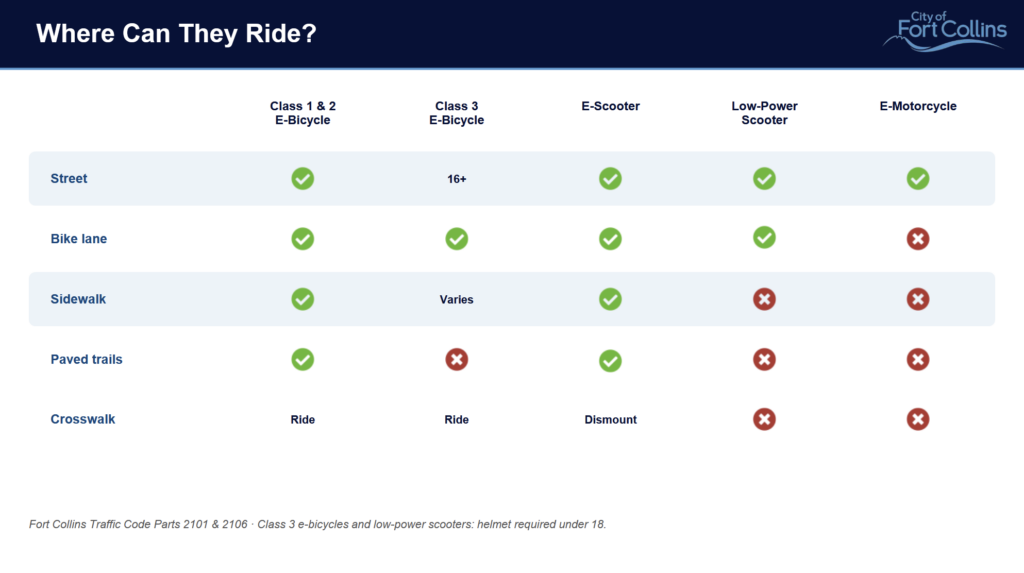
Lindsay walked through the device categories:

Education work includes one city webpage covering what can be ridden where, school resource officers talking with students at bike racks and in classrooms, a newsletter to parents through Poudre School District (PSD), and safety videos. Two state laws have taken effect: HB25-1197 requires sellers to disclose a device’s class, speed and wattage, and HB26-1079 requires a parent’s written consent for a minor’s motorcycle instruction permit. A third bill, HB26-1125, would have penalized parents who allow unlawful use; a House committee postponed it indefinitely in March at the sponsor’s request.
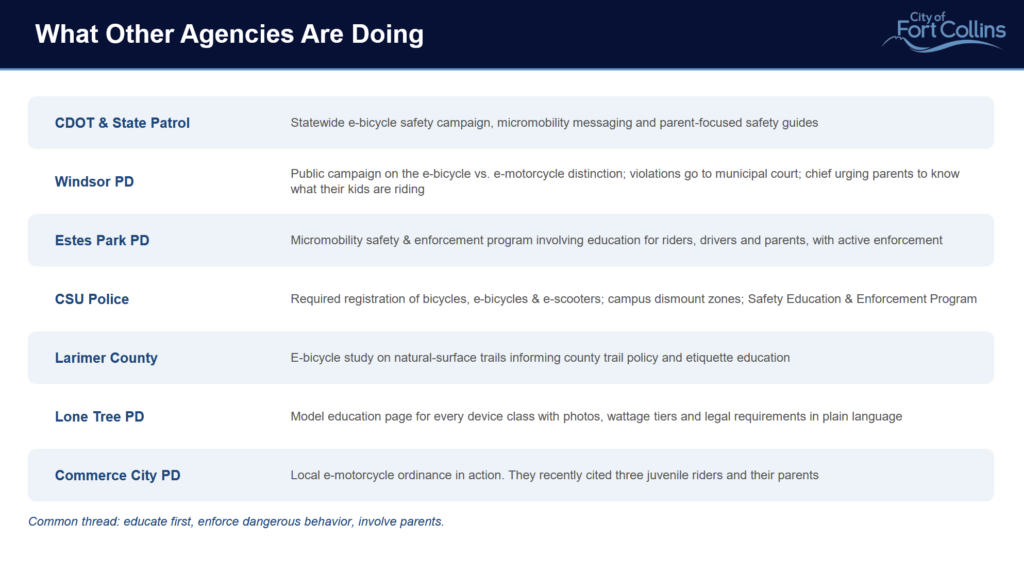
Francis asked how officers tell a legal e-bike from an e-motorcycle. Lindsay said the only reliable method is examining the device, since the motor is usually labeled with its maximum wattage. Francis suggested a voluntary registration program so riders could have a device identified and marked in advance; Gallimore said it was worth pursuing, and Conway said he supported it. Conway asked police to address the safety problems while keeping in mind that e-bikes get people out of their cars and help the city meet its climate goals.
Potyondy asked whether PSD is considering limits on campus. A district representative said PSD can act on behavior at school and already permits vehicles at its high and middle schools, with guidance coming for younger grades. Fudge asked whether the traffic code needs changes; Lindsay said staff are working with the City Attorney’s Office, but the state is likely to act first, setting the framework for local rules.
Economic Development Investment Program
Economic Development Director SeonAh Kendall introduced the proposed Economic Development Investment Program, or EDIP, presented by Michael Bussmann and Tyler Menzales. It would sit alongside the Business Assistance Policy (BAP), the city’s incentive tool for larger employers and retail projects, which council updated earlier this year.
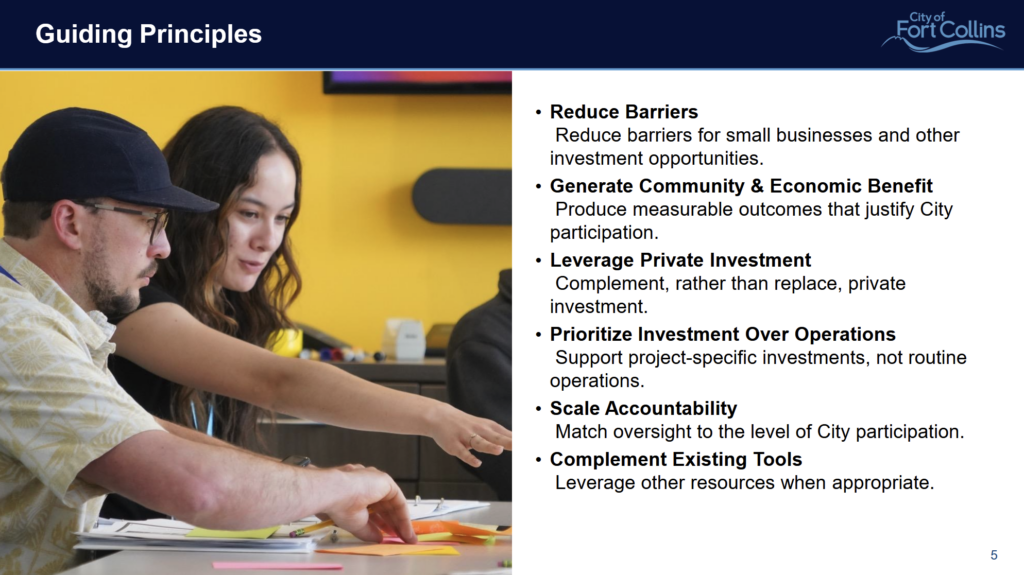
The EDIP would serve businesses with fewer than 50 employees — Menzales said 96% of Fort Collins businesses meet that definition. Money could go toward tenant and site improvements, facades or equipment tied to a defined project, reimbursed after the work is documented. Staff proposed letting the city manager approve up to $50,000 per project and $250,000 in total per year, with anything larger going to council, and asked council four questions: whether the framework matches its intent, what role the Economic Advisory Board should play, whether the thresholds are right, and what other guardrails it wants.
All seven members said they supported the framework. On the Economic Advisory Board, Francis said she would not want it involved because it would add time to a program meant to be responsive, and Nelsen called it one extra step. Pignataro said she would want to know whether the board wants the role, but that it should not have veto power; Conway said he shared her position. Fudge suggested the board review projects after the fact and recommend improvements. Hoeven said she would follow the board’s own preference, and added that she did not want public involvement treated as a bottleneck, noting she is council’s liaison to the board. Menzales said he presented to the board last month and heard the same concern about delay.
Asked by Nelsen where the $50,000 figure came from, Bussmann said it works out to roughly 30% of a large facade or interior job.
Kendall said about $270,000 from Platte River Power Authority (PRPA) economic development funds is already set aside, left over after a revolving loan fund effort drew no workable bids. Menzales said $1 million would capitalize the program through the next two budget years, meaning a request for roughly $700,000 more. The city’s budget director said the recommended budget published the previous week assumes no direction from this meeting, and named use tax revenue as a possible source. Fudge said he supports the concept and the thresholds but has reservations about an ongoing appropriation of that size in this budget climate.
Pignataro said the program cannot substitute for examining what the city itself requires of businesses that expand, and Bussmann agreed. Conway said he wants the money aimed at distinctive neighborhood businesses rather than job counts:
If Home Depot and Walmart disappeared tomorrow, we’d be okay as a community. But if Old Town disappeared I think we would fall apart as a community.
Francis echoed that emphasis and asked what prevents an owner from taking the money and selling; Bussmann said the guardrails aim to support the operating business, not a landlord raising rent afterward. Potyondy asked that the award criteria be clear enough to read as fair. Kendall said the program would require one added position for compliance work, in a department of seven. Staff will return in November or December with a policy for adoption.
Safe Parking Pilot Program
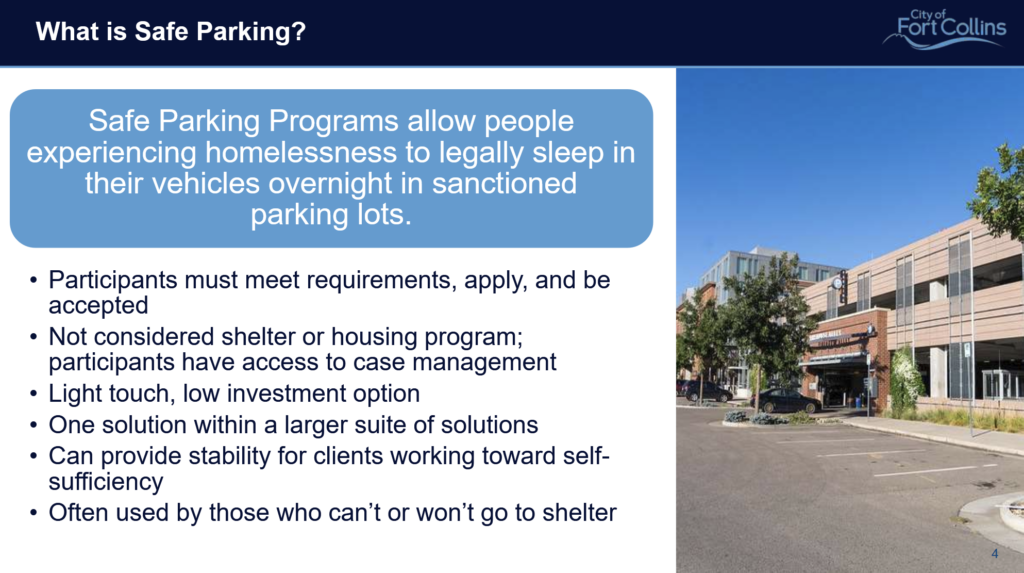
Assistant City Manager Jacob Castillo introduced the final item, presented by Senior Housing Manager Vanessa Fenley and Homelessness Lead Specialist Brittany Depew. Safe parking programs let people experiencing homelessness sleep legally in their vehicles overnight in a sanctioned lot. City code prohibits sleeping in vehicles, so one cannot operate here without council action.
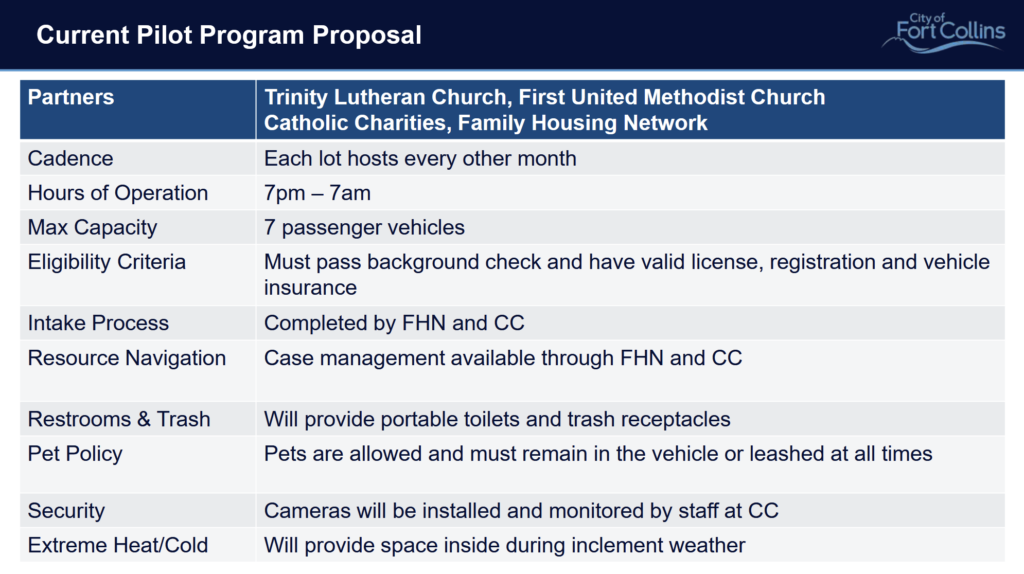
Depew described the proposal: a one-year pilot run by Catholic Charities and Family Housing Network at two church lots, Trinity Lutheran Church in District 5 and First United Methodist Church in District 1. The lots would alternate months, operate from 7 p.m. to 7 a.m., and hold up to seven vehicles. Participants would pass a background check and hold a valid license, registration and insurance. The partners would provide portable restrooms, allow pets, and install cameras monitored overnight by Catholic Charities staff. The city would set the parameters and the conditions for ending the pilot early, with no role in daily operations; other laws would still be enforced.
Staff asked whether council wants code changes brought forward, and what should shape them. Every member who spoke said yes.
Potyondy asked how many people sleep in vehicles citywide; Depew said the city lacks that data but providers believe the number is substantially higher than seven. She said the churches and nonprofits are absorbing the costs, are seeking grant funding, and modeled the hours on Loveland’s SafeLot, which opened in November 2023.
The longest exchange concerned the two sites. Hoeven said residents near Trinity Lutheran have raised security concerns, given the lot’s location near the Spring Creek Trail, and asked whether the pilot could set different expectations at each site given different crime statistics nearby. City Attorney Carrie Daggett said code exceptions could be tied to participation in a city program, with the program rather than the code setting standards. Francis said she was uncomfortable with that approach:
I feel uncomfortable placing additional standards on Trinity Lutheran where they’re not responsible for the location and built environment.
She said the pilot should run first, with adjustments following from what it shows. Hoeven said she agreed, and asked whether a neighborhood meeting could be held before any code change. Staff said there is no required sequence, and Hoeven said a meeting first would help.
Pignataro said she would prefer changing the code outright rather than a temporary waiver, since the changes would apply to future operators too. Daggett described the alternative: an ordinance suspending the requirements for the life of the pilot, leaving permanent code changes for later. Francis said she leaned toward permanent changes, citing the difficulty of unwinding a COVID-era exemption. Depew said any exemption would apply to lots approved through a city process and would not be limited to churches. Staff will now work on code updates for the pilot. No return date was given.
Announcements and Adjournment
Hoeven encouraged residents to take part in the 9/11 Memorial Stair Climb at Canvas Stadium that Friday, the 25th anniversary. The mayor adjourned the meeting.
Leave a Reply