
The Fort Collins City Council held a light regular meeting on Tuesday, August 18, 2026. Six members attended: Mayor Emily Francis, Mayor Pro Tem Julie Pignataro (District 2), Chris Conway (District 1), Melanie Potyondy (District 4), Amy Hoeven (District 5), and Anne Nelsen (District 6). Councilmember Josh Fudge (District 3) was absent.
Council approved all 25 consent items without discussion. The longest conversation was a staff update on the Rental Housing Program. The only discussion item, a grant for accessory dwelling units (ADUs), was on the discussion agenda only so the mayor could recuse herself.
Proclamation: Women’s Equality Day
Mayor Francis proclaimed August 26 as Women’s Equality Day. The date marks the certification of the 19th Amendment, which guaranteed women the right to vote. A representative of the League of Women Voters of Larimer County accepted the proclamation. She said the league is marking its 75th year; its first local chapter formed in Fort Collins in 1951.
Public Comment
Nine people signed up to speak, and eight spoke.
314 North Howes Street and EcoThrift
Context: On the consent calendar, council gave final approval to transfer city-owned property at 314 North Howes Street to Housing Catalyst, the local housing authority, for future affordable housing. The building’s current tenant, the secondhand store EcoThrift, has a lease that ends September 30.
EcoThrift’s owner said the city’s real estate staff told her in February that federal relocation help might cover the store. She later learned the project has no federal funding yet, so no relocation help applies, and the store will close in September. She asked the city to treat reuse as part of its sustainability work:
“It is not commercially viable in this community. It cannot be privately managed. The city’s going to have to figure it out.”
Rigden Farm pig grazing
Context: The Rigden Farm homeowners association (HOA) wants a contractor to graze up to 15 pigs on part of a park tract to clear a stubborn weed. Farm animals aren’t normally allowed there, so the plan needed council approval, which was on the consent calendar.
Two Rigden Farm residents spoke. One opposed the grazing, saying it conflicts with the neighborhood’s covenants on nuisances, odors and structures. She also raised concerns about pig waste and home values. The other supported it. She said the HOA tried other weed-control methods first, that the city recommended the contractor, and that the pigs will leave once the job is done.
A third speaker asked who would monitor animal health and handle complaints, and also questioned the Howes Street transfer and the consent calendar’s ethics items.
Other topics
- Police budget: A District 4 resident criticized Fort Collins Police Services. He said many residents responded to a video he posted with cases they felt were mishandled, and he asked council to deny a proposed budget increase for 2027 and to put the money toward safety-net programs and affordable housing.
- Other: One speaker asked the city to supervise the weight rooms at Northside Aztlan Community Center and Foothills Activity Center, saying young children use them without supervision. Others spoke about wildlife-crossing funding and bear safety, and about climate change and housing.
Public Comment Follow-Up
Nelsen said the funding delay at the Howes Street site reflects how competitive affordable housing subsidies are:
“Currently the only way to achieve deep affordability is through subsidies that are insufficient on their own to meet the affordable housing goals of our community because so many projects are competing for the same very small pot.”
Potyondy encouraged residents with procedural or funding questions to contact Police Services staff.
Hoeven told the Rigden Farm residents she was sorry for what they are experiencing. She said it sounds like there is an “off ramp” if the grazing doesn’t go as planned.
Consent Calendar
The consent calendar bundles items expected to pass without debate; any council member can pull one for discussion. Many items are one step in multi-year projects, and this list doesn’t capture that background.
No items were pulled. Pignataro moved to approve items 1 through 25, Potyondy seconded, and the motion passed 6-0.
Affordable housing
- About $5.7 million in remaining revenue from the 2016–2025 Community Capital Improvement Program (CCIP) sales tax goes to the Affordable Housing Capital Fund (first reading).
- $1 million in federal American Rescue Plan Act (ARPA) money will buy land in northwest Fort Collins for the affordable housing land bank. An earlier planned purchase in northeast Fort Collins fell through (first reading).
- Final approval of the 314 North Howes Street transfer.
Rigden Farm
- Final approval of the pig grazing. As a quasi-judicial decision passed on consent, it was decided on the written record.
Grants
- $1.8 million from the state to replace 13 aging city vehicles.
- $528,000 for bike and pedestrian planning along North College Avenue.
- Smaller grants for radon testing, auto-theft enforcement and a Municipal Court accessibility audit.
Transportation
- About $1.4 million for right-of-way and stormwater work on North Mason Street.
- $112,000 from the Downtown Development Authority for interim parking on Linden Street.
Code and policy
- Updates to align city penalties with recent Colorado Supreme Court rulings.
- A change allowing new liquor licenses in commercial areas where a school or college has located (first reading). An exemption like this has applied around Colorado State University (CSU) since 1997.
- An Ethics Review Board change to how a council member who works for a city subcontractor reports contacts with staff. The change arose from an ethics opinion Nelsen requested (first reading).
Natural areas and wells
- Support for a $4 million Great Outdoors Colorado (GOCO) grant application toward buying a 4,507-acre ranch northwest of the city.
- A development review waiver so Larimer County can plug orphaned oil and gas wells in northeast Fort Collins.
After the vote, Pignataro thanked the Ethics Review Board. She said board and commission openings sometimes draw twice as many applicants as seats, and new code of conduct changes aim to ensure appointed members participate actively.
Staff Report: Rental Housing Program
Assistant City Manager Jacob Castillo introduced the update. Marcy Yoder and Vanessa Fenley of Housing and Community Vitality presented.
The program grew out of the 2021 Housing Strategic Plan, piloted in 2024 and became mandatory in 2025. Yoder said about half of Fort Collins properties are renter-occupied and that voluntary compliance is the program’s first goal. Most rentals must register each year for $37 per property plus $10 per additional unit. Mobile home parks and owner-occupied rentals are exempt.
Fenley reported:
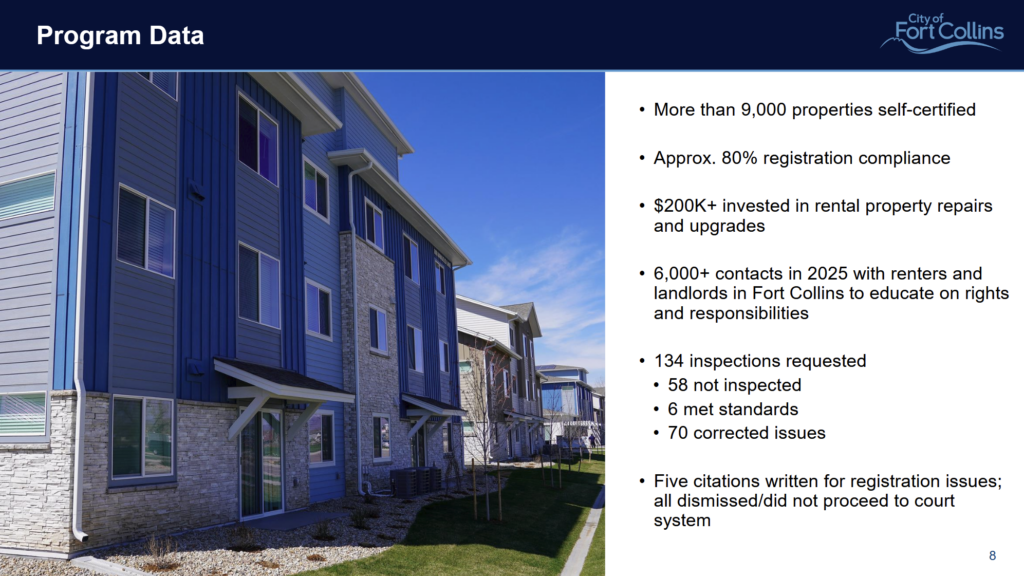
- More than 9,000 properties registered, which staff estimate is about 80% of eligible rentals. The estimate is based on older consultant data that staff plan to update.
- More than $200,000 in grants for repairs and upgrades.
- 134 inspection requests. In 58 cases, the owner fixed the issue before an inspection was needed. Of the inspected units, 70 required repairs and 6 met standards.
- Five citations for failing to register, none of which went to court.
Council questions
Pignataro said the program balances “safety with providing a roof over people’s heads.” She asked what happens to units flagged as illegal dwellings. Chief Building Official Marcus Coldiron offered a follow-up memo on the four specific cases. He said the usual goal is to bring those units up to code. Pignataro asked that the fee update include data on whether noncompliant rentals leave the market, sit vacant or “go underground.”
Francis agreed. She asked how the program interacts with last year’s land use code changes. Staff said they currently track operational measures, such as turnaround times and registration rates. Francis said that after two years, “it is time that we have program metrics as well.”
Hoeven asked how many rentals remain unregistered. Staff said that figure must be estimated from assessor and utility data, which is harder during the city’s switch to new FC Clear software. Hoeven added that a constituent considers the fees inequitable between small properties and 60-plus-unit complexes and asked to see staff’s options when fees are revisited late this year. Coldiron said citation fines can reach $3,000 per day but are set by a municipal judge, and most cases resolve before any fine. Staff said that if the city suspends a registration, a tenant’s current lease continues.
Potyondy relayed questions from a resident:
- Why does the city keep its own registry? Staff said county records often list LLCs rather than who manages a property.
- What keeps inspectors from overreaching? Staff said inspectors can enforce only minimum code requirements and are “educators first, enforcers second.”
Nelsen asked whether fees cover staff time. Staff said the program is designed to become cost-neutral and expects to get there in 2027.
Discussion Item: Accessory Dwelling Unit Grant
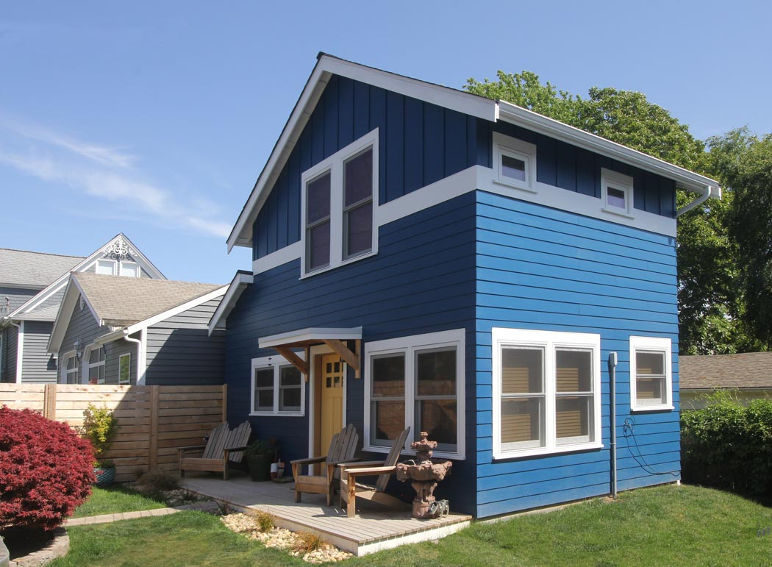
What it is: A $157,000 grant from the Colorado Department of Local Affairs (DOLA) to create at least two pre-approved designs for ADUs, which are smaller secondary homes on a residential lot. The grant also covers fee waivers for about four ADUs. The city’s $83,000 match comes from existing climate tax funds.
Recusal: Francis said her role at DOLA creates a conflict of interest, and she left the room. Pignataro presided.
Background from first reading: At first reading on July 21, Potyondy asked whether affordable housing money could replace the climate tax match. Staff’s written follow-up said the ballot language for those housing funds doesn’t allow that use, and that DOLA had already accepted the climate tax match.
Public comment: One speaker asked how an ADU differs from a duplex and who qualifies for waivers; another supported small, energy-efficient homes.
Council discussion:
- Potyondy said the written follow-up answered her questions and that she would support the grant.
- Nelsen asked City Planning Director Clay Frickey to explain the ADU-duplex distinction. Frickey said a second unit equal in size to the main home makes a duplex, while one 45% of the main home’s size or smaller is an ADU. He said most ADUs are detached and have their own utility meters, though sewer lines can be shared.
Vote: Nelsen moved to adopt the ordinance on second reading, Potyondy seconded, and it passed 5-0.
Other Business
No new ordinances or resolutions were proposed. On a motion by Pignataro, seconded by Nelsen, council voted 6-0 to hold two executive sessions: one on possible business incentives for three projects, and one on water storage projects.
Council Reports
- Potyondy attended a United Way back-to-school block party and the Turkish Festival, and wished Poudre School District students and staff a good first day.
- Hoeven did a ride-along with Poudre Fire Authority (PFA) and attended a Salud Family Health event with Conway. She will hold a listening session Saturday, August 22, 11 a.m.–1 p.m. at PFA Station 3.
- Francis thanked city employees and noted their appreciation event in City Park.
Adjournment
Francis ended the broadcast ahead of the closed sessions: “Good night, Fort Collins.”
Leave a Reply