
We’re playing catch up posting our council meeting recaps this summer. Please pardon our out-of-sequence article postings.
Fort Collins City Council held a work session on July 28, 2026, covering three discussion items: a new Real Estate Strategic Framework for the city’s 258 properties, a surveillance technology governance policy in development, and a proposed local licensing program for tobacco and other age-restricted products.
Work sessions differ from regular council meetings: there is no public comment, no consent calendar, and no votes. Instead, staff present work in progress and ask council for feedback and direction. Mayor Emily Francis presided, and Council Members Anne Nelsen, Chris Conway, Melanie Potyondy, Amy Hoeven, and Mayor Pro Tem Julie Pignataro all participated in the discussions.
Real Estate Strategic Framework
Assistant City Manager Denzel Maxwell and Senior Policy and Project Manager Sylvia Tatman-Burruss presented a framework meant to shift the city from reactive, one-off property decisions – someone calls and asks if the city wants to buy a parcel – toward strategic management of a portfolio that includes 258 unique properties across general fund facilities, parks, utilities, and historic buildings.
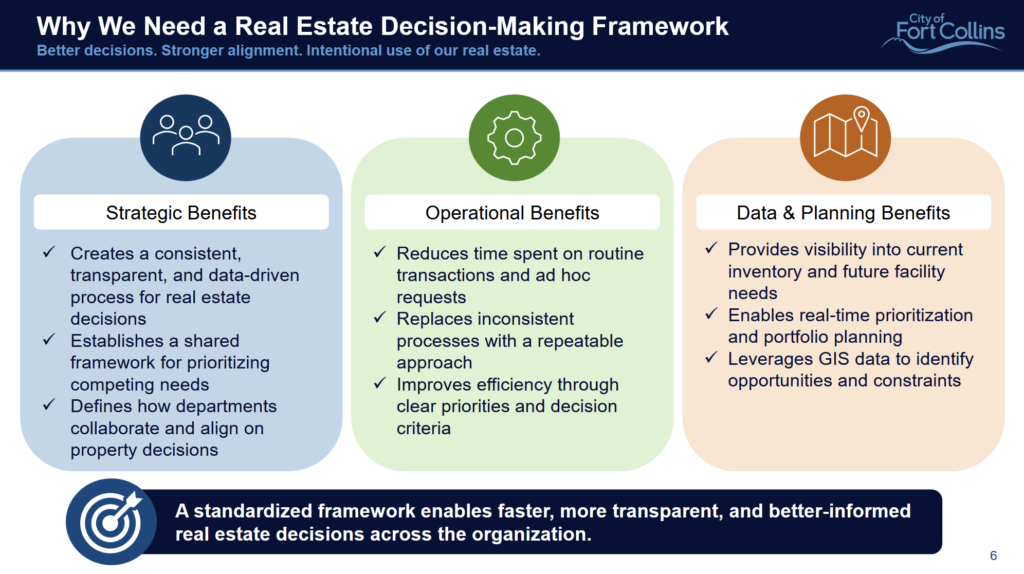
Staff walked through example properties, including the City Hall block at 300 Laporte Avenue (which could remain a municipal campus or become a mixed-use district with private partners), the customer service building at 281 North College Avenue, the historic trolley car barn at 330 North Howes Street, and the recently acquired 8.74-acre former Larimer County fleet site on East Vine Drive. Staff also floated a “reimagined” Civic Center Master Plan and asked whether council wanted to pursue it.
Council Member Nelsen gave the most detailed feedback. After confirming with City Attorney Carrie Daggett that nothing in the charter constrains long-term leases, she asked staff to evaluate ground leases as their own alternative – not just “keep” versus “sell” – so the city can preserve long-term appreciation on land it has held for decades. She also proposed value-sharing provisions as standard template language: contractual payments owed to the city when a defined public investment raises nearby land value, citing Copenhagen’s practice and New York’s Second Avenue subway, where surrounding landowners captured most of the publicly financed gain. She asked staff to convene Housing Catalyst, the Urban Renewal Authority, and the Downtown Development Authority to test the criteria on real parcels before they are finalized. Tatman-Burruss welcomed the ideas and said market-feasibility input from partners was already on staff’s mind.
Council Member Conway echoed Nelsen, emphasizing land valuations, ground leases as a possible dedicated funding stream for affordable housing, and diversifying city revenue away from recession-sensitive sales tax. Both he and Nelsen urged that any Civic Center vision extend Old Town’s street life rather than deaden it with government buildings that close at 5 p.m.
Council Member Potyondy supported the more strategic approach, favored renovating “humble” city buildings over demolition where they remain fit for purpose, was open to selling 281 North College, and called the trolley barn “criminally underused,” saying she would welcome a thoughtful public-private partnership to open it to the community. Council Member Hoeven asked for a clearer picture of future staffing and space needs and what the evaluation criteria are measured against. Mayor Pro Tem Pignataro asked who owns the process – staff said Real Estate Services will act as the citywide facilitator – and gave “an enthusiastic yes to mixed use for the Civic Center Master Plan.”
Mayor Francis supported a consistent, upfront approach to sale and lease decisions but raised concerns about the Civic Center Master Plan itself: it was not on her radar during priority-setting, funding was not included in the quarter-cent capital tax, and she questioned how much effort to invest now if construction funding may be 15 years away. She said she leaned toward letting the property-assessment framework lead rather than focusing on a master plan. City Manager Kelly DiMartino responded that staff would scale the planning effort – not a two-year master planning process – and would return with more detail on timeline; she noted a funding source for outside help that would not compete with other needs. Nelsen closed the item:
“We do not need a world-class city hall at this point. We need to take the resources that we have and get it to the people that need it most in our community.”
Surveillance Technology Governance Policy
Context: After community concern over the city’s use of Flock Safety license plate cameras, council asked staff to develop a citywide policy governing surveillance technology. Staff are drafting a framework first, with policy language to follow.
Assistant City Manager Rupa Venkatesh, Chief Information Officer Kevin Wilkins, and Senior Community Engagement Manager Heather Young presented a use-based framework: routine operational technology (utility meters, traffic sensors) would be out of scope, while any use that collects personally identifiable information or monitors the public would be covered. Wilkins stressed that lawfulness is the floor, not the ceiling, and that the policy must keep pace with vendors who add capabilities the city never asked for. The framework would not govern private cameras, other governments’ technology, or declared emergencies.

Sarah Olivier, Executive Director of Colorado Humanities, described the centerpiece of the engagement plan: four facilitated community conversations with the same hand-picked group of 25 residents, drawn from outreach to more than 50 organizations, running August through September with a summary report by early October. Residents not among the 25 can comment through an Our City project page, attend a public safety technology panel, or take a survey on the draft policy in late October and early November.
Council feedback was supportive across the board. Potyondy thanked staff for adding the Disability Advisory Board, which raised concerns about medical uses of surveillance, and confirmed interpretation services will be available. Hoeven said the plan “demonstrates that we really did hear our community members when we were discussing Flock” and asked where technical vetting of vendor contracts happens; Wilkins pointed to the city’s Technology Review Board, which Venkatesh noted includes the city’s equity officer. Pignataro asked staff to define “proportionate” (data collection must match the approved use case) and to make sure other boards – she named the Women and Gender Equity Board and Youth Advisory Board – can weigh in; staff will present at a September “Super Issues” meeting of all boards. Conway praised the move toward a civic-assembly-style representative sample and urged attention to “data minimalism” – rules for when data collected for one purpose can be shared across departments. Francis reminded viewers the policy covers only what the city organization controls, not private technology like camera-equipped glasses, and praised staff’s responsiveness. A draft policy will be posted in late October, with another work session November 10 and possible adoption December 1, 2026.
Tobacco Retail Licensing and Age-Restricted Products
Context: Tobacco retailers in Colorado need only a state license – unlike liquor and marijuana stores, which need local licenses too. Fort Collins is considering its own licensing program after years of frustration with state enforcement.
Marijuana Compliance Officer Jim Lenderts traced the issue to 2020, when angry parents began calling police asking how their kids got “marijuana.” Investigations pointed not to licensed marijuana stores but to smoke shops selling hemp products that tested around 5% THC – far above the 0.3% legal hemp limit. Staff presented striking numbers: 80.3% of Larimer County youth who tried to buy tobacco or vape products in a store were not turned away due to age; 23% of Fort Collins tobacco retailers had at least one sale-to-minor violation between 2023 and 2025; and local high school vaping rates rose from 2023 to 2025 while national rates fell. Lenderts described a store with three violations in a single year that the state declined to prosecute, and noted state rules let 18-year-olds sell products they cannot legally possess.
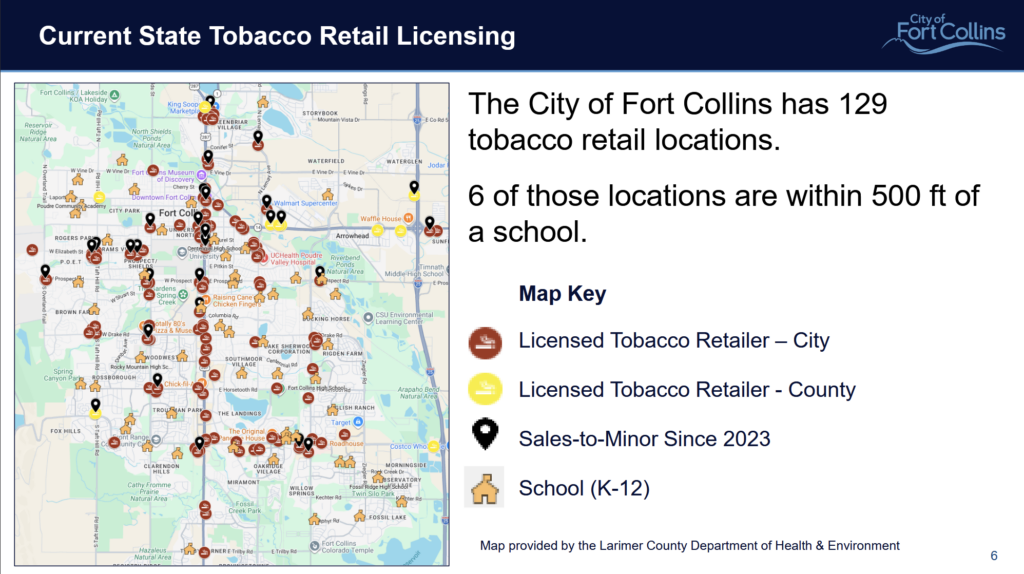
The recommended framework would require a city license for tobacco retailers, raise the minimum salesclerk age to 21, prohibit sales of paraphernalia and concealment containers to minors, fold state restrictions on kratom, intoxicating hemp, synthetic cannabinoids, and psilocybin-lookalike products into city code for local enforcement, and prohibit recreational sales of inhalant gases like nitrous oxide. Stores selling such items incidentally – staff named Jax and the Cupboard – would not need a license but could not sell gas products to anyone under 21. Penalties would escalate against owners, not just clerks; new stores would face roughly 1,000-foot distance requirements from schools, with existing businesses grandfathered. A $500 fee modeled on Aurora’s program would generate about $65,000 annually from the city’s 129 retailers.
Council support was unanimous and often emphatic. Potyondy, a school psychologist at Rocky Mountain High School, said:
“Vaping is not a Rocky problem. Vaping is an epidemic.”
She supported every proposed provision and urged staff to engage the Youth Advisory Board. Pignataro flagged that marijuana businesses already struggle with distance restrictions and asked staff not to let the new rules complicate future fixes; she and Lenderts agreed to hold off on a flavored-tobacco ban – adopted by 13 Colorado communities – in favor of consistency with flavored alcohol and marijuana, revisiting in a year or two. Nelsen probed whether gas stations could slip through the incidental-sales category; Lenderts answered, “No loopholes… I can name a gas station within 500 feet of every single high school.” Conway and Potyondy both asked to learn more about kratom regulation; Lenderts relayed that Larimer County Coroner Stephen Hanks reported six kratom overdose deaths in the county in the last 15 months, none of them minors. Francis went furthest: she would favor restricting kratom sales to smoke shops only – banning it from gas stations – and using zoning to limit where new smoke shops can open, and asked staff to bring both the regulations and the program design back in October.
Staff will engage affected businesses in August and September, return with a draft ordinance at an October work session, seek adoption in November–December, and begin the program in early 2027.
Announcements and Adjournment
Pignataro announced Kids in the Park at Twin Silo Park this Friday, 4 to 7 p.m., featuring the Touch a Truck event. Francis noted there is no council meeting next Tuesday because of Neighborhood Night Out and encouraged residents to find their local event – council members will be out that evening too. With that: “Good night, Fort Collins.”
Leave a Reply