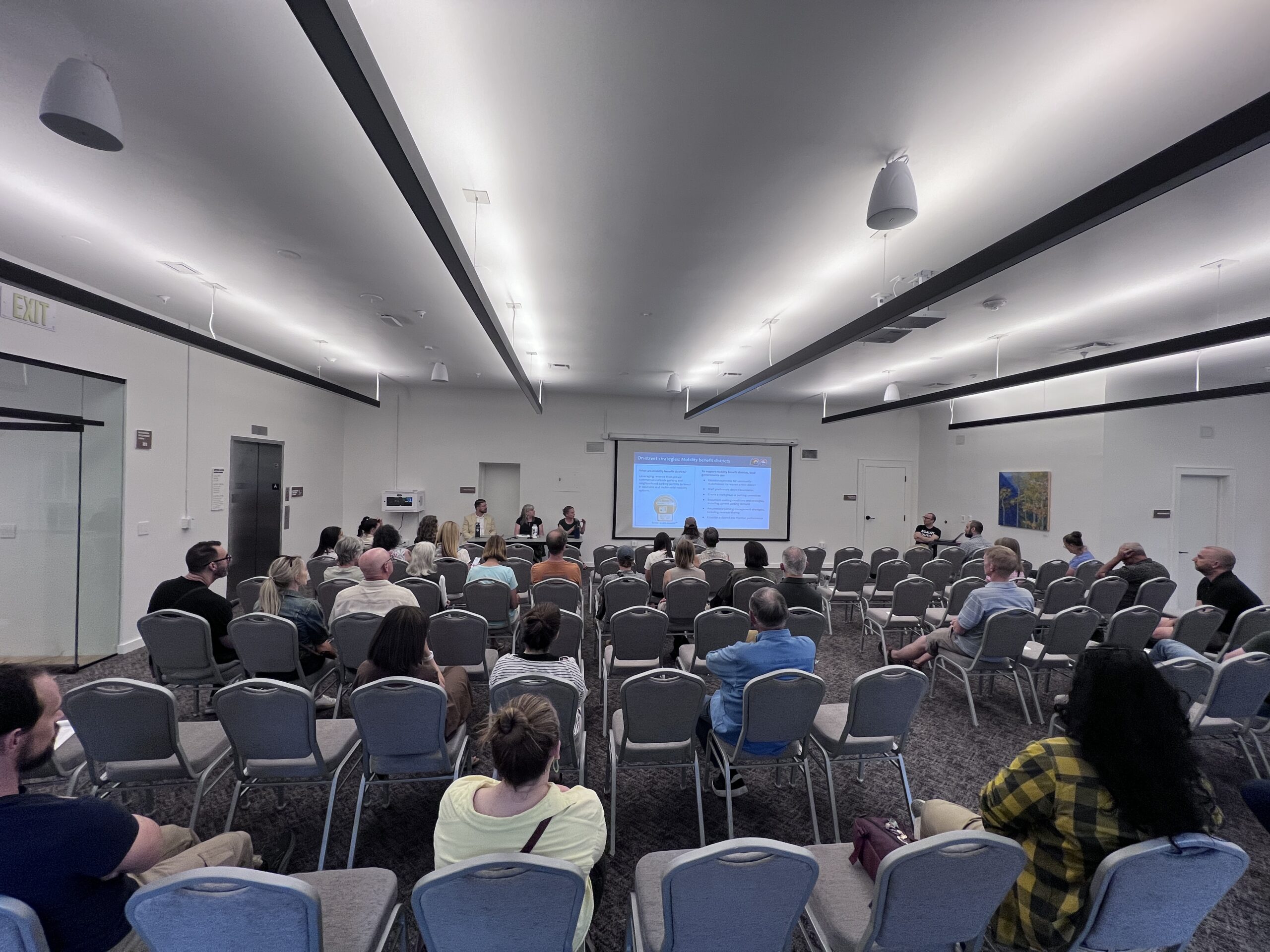
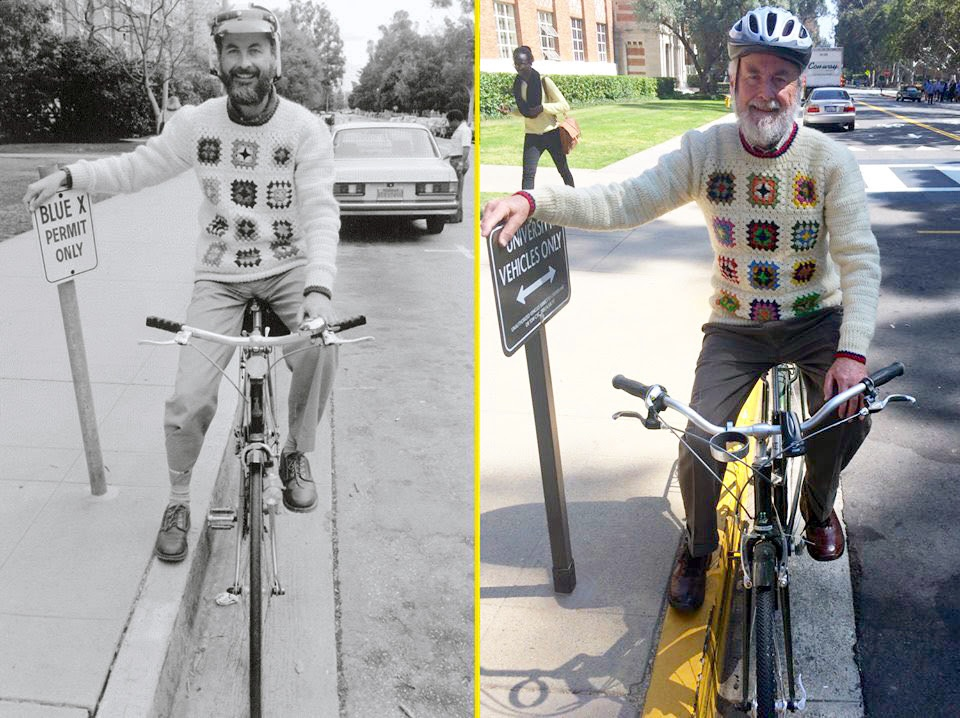
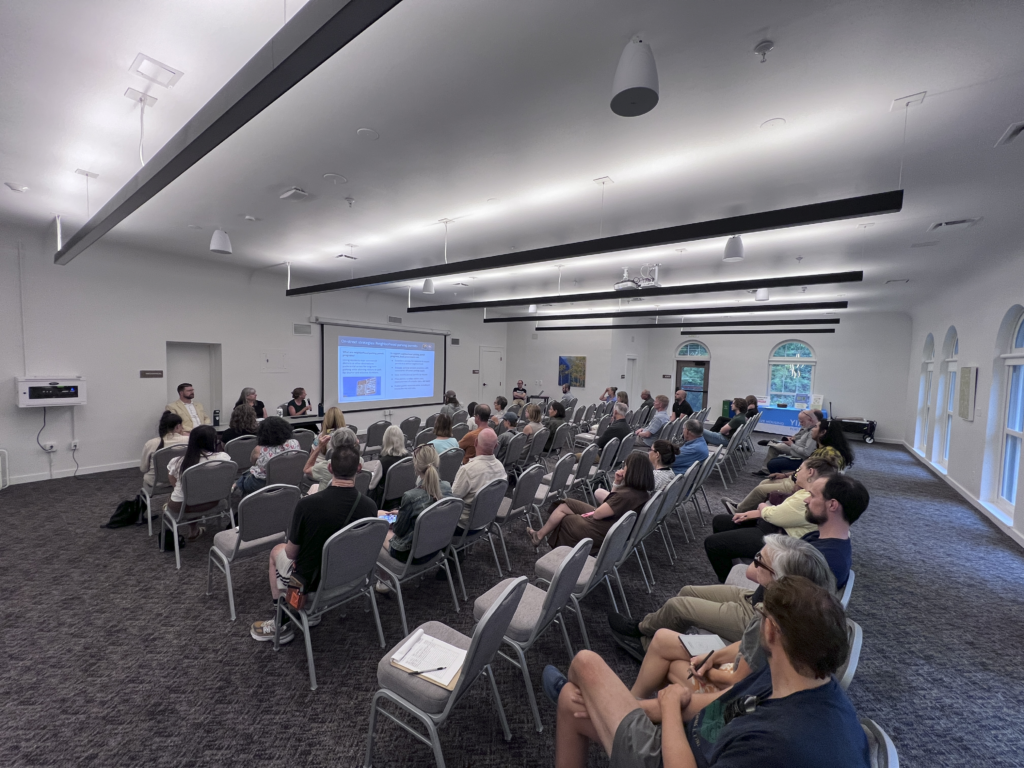
Last night, June 30th, Strong Towns Fort Collins and YIMBY Fort Collins co-hosted a gathering at Fort Collins’ Center for Creativity in Library Park to talk parking policy. We opened the night with a brief homage to Donald Shoup – aka Shoup Dogg, the father of modern parking reform – whose work underpins just about everything that followed. From there, three panelists took the topic at three different zoom levels: Kelly Blynn (email) on the statewide policy picture, Julie Pignataro (email) on Fort Collins’ own two-decade history with the issue, and Eric Keselburg (email) on the specific proposal headed to City Council later this year.
Kelly Blynn: Modern Strategies and Tools
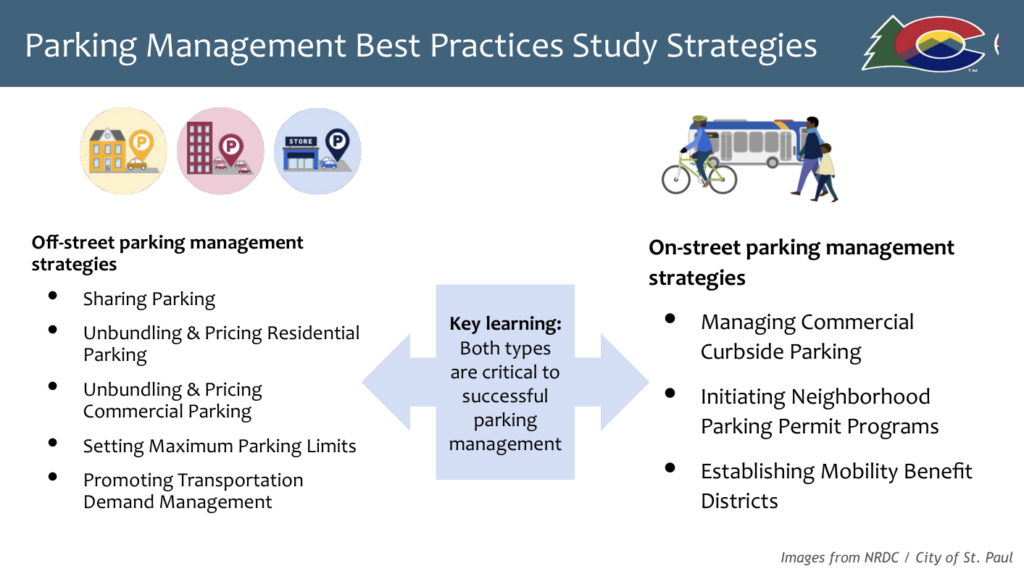
The night opened with Kelly Blynn, Senior Policy Advisor for Land Use and Transportation at the Colorado Energy Office, walking through the state’s new Best Practices in Parking Management Strategies for Colorado Communities report – the guide required by HB24-1304, the 2024 law that eliminated minimum parking requirements for multifamily and adaptive-reuse projects near transit.
Blynn framed the report around a core distinction: off-street strategies (what developers build – shared parking, unbundling, parking maximums, transportation demand management) and on-street strategies (how cities manage the curb – commercial curbside pricing, neighborhood permits, mobility benefit districts). Her key message was that the two have to be designed together; removing a mandate without managing the curb just relocates the problem.
A few specifics that stuck: the report recommends pricing curb parking toward an 85% occupancy target – Shoup’s rule of thumb for keeping a space open on every block without excess cruising – and it treats mobility benefit districts, which keep parking revenue in the neighborhood that generated it, as one of the more underused but powerful tools in the kit.
Slides available here. More info and full report available on Colorado.gov.
Julie Pignataro: 22 Years, Same Recommendation
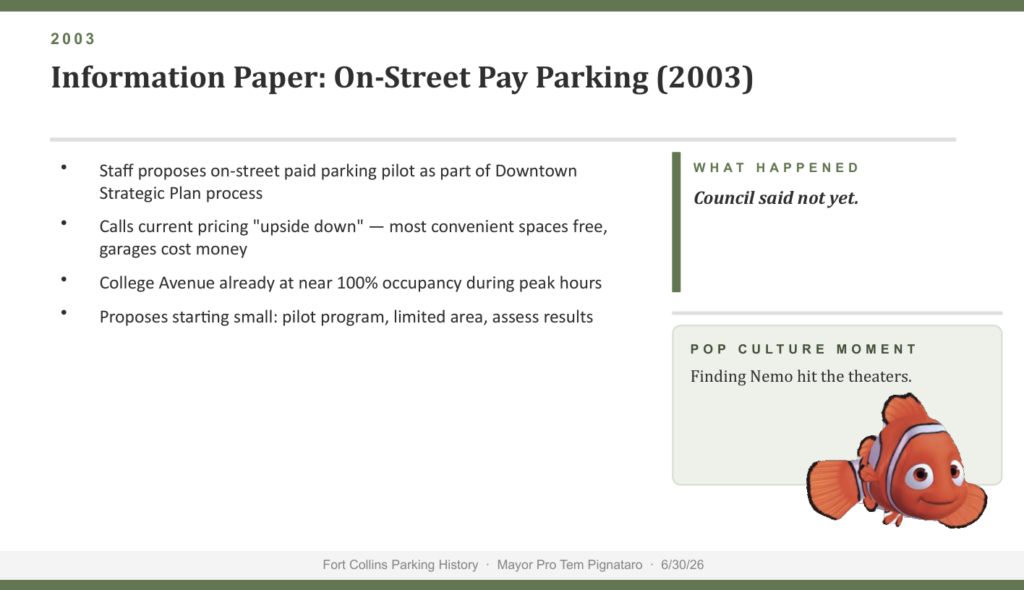
Next up was Julie Pignataro, current Mayor Pro Tem and councilmember for District 2, with a tour through 22 years of Fort Collins parking history – 2003 through today – set against a running gag of what movie or show was popular the year each report landed and went nowhere: an information paper in 2003 (Finding Nemo), the 2004 Downtown Strategic Plan (Lost), the 2013 Parking Plan (House of Cards), the 2014 TOD study (Pharrell’s “Happy”), the 2017 Downtown Plan (Wonder Woman), and now the 2025 Parking Study, landing alongside The Bear.
The pattern she traced was strikingly consistent: staff or an outside consultant recommends paid on-street parking as the primary strategy to fix the city’s “upside-down” pricing – free curbs, paid garages – and each time, Council either shelves it, asks for more data, or narrows it to enforcement-only. As she put it, the data has never changed and the recommendation has never changed.
She also gave some color on the most recent chapter: the previous Council was generally supportive of moving forward, but political considerations delayed action long enough that the decision landed in the current Council’s lap. That Council, in turn, has already pushed its own timeline back – from earlier in 2026 to a work session no sooner than August 2026 – continuing the same cycle she’d just walked the room through.
Slides available here.
Eric Keselburg: What’s Actually Being Proposed
The final speaker was Eric Keselburg, Senior Manager of Fort Collins Parking Services, who walked through the current proposal in detail – the data behind it and what his office hopes it will achieve.
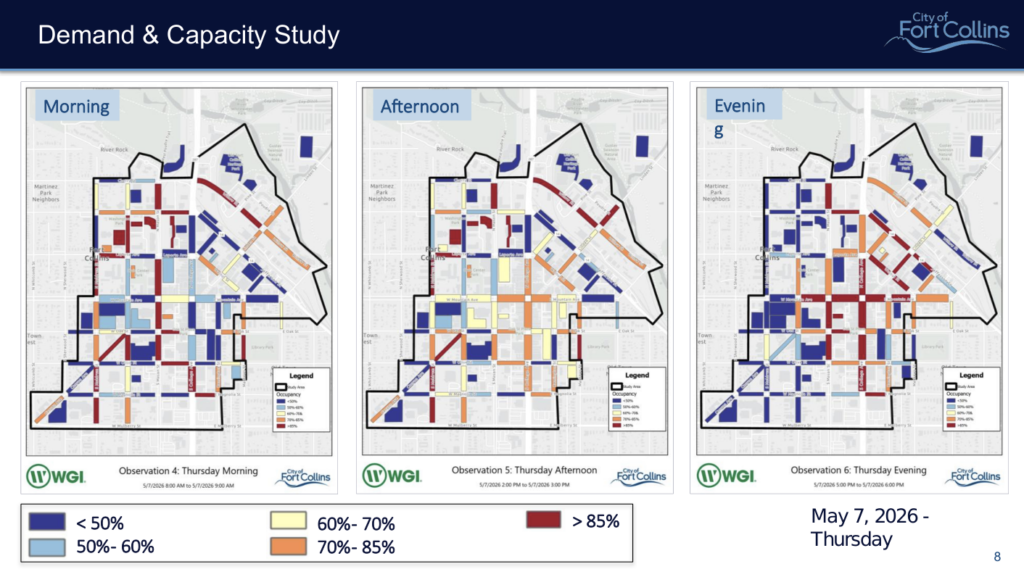
He shared occupancy data from a spring 2026 study showing several on-street blocks already running above the 85% threshold during evening hours, while off-street garages and lots sit comparatively underused – the same “upside-down” dynamic Pignataro’s history traced back two decades. The current recommendation: paid on-street parking across roughly 800 stalls in the core downtown area, with a fee schedule of $2.00/hour on-street (4-hour max), $1.50/hour in surface lots (no max), and $1.00/hour in parking garages with the first hour free (no max), operating Monday–Saturday. Revenue, he noted, would go toward deferred maintenance, technology upgrades, and – potentially – downtown amenities like holiday lighting and public art.
Slides available here.
Q&A
With the remaining time, we took a few audience questions, which led to some interesting discussion and ideas.
We (Strong Towns Fort Collins) asked directly about two things we see as central to Shoup’s approach: dynamic pricing and a dedicated parking or mobility benefit district. On dynamic pricing, Eric confirmed that the initial rollout will use the static rates in the current proposal – $2.00/hour on-street, and so on – for simplicity, but that rates can be adjusted post-implementation if the data calls for it, including lowered if occupancy or foot traffic drops too much once the meters go in – and that dynamic pricing is part of the long-term roadmap rather than being off the table.
On the benefit district question: while the proposal does call out uses for parking revenue beyond core operations and maintenance – technology upgrades, deferred garage repairs, and potentially amenities like holiday lighting and public art – all framed as being put back to work for the benefit of the paid parking district itself, there isn’t yet a formal proposal for a parking or mobility benefit district that would dedicate revenue to the district that generates it, with community governance over how it’s spent. That remains, in our view, the piece still missing from the picture.
Another audience member asked about downtown employees, who make up a meaningful share of the people currently parking on-street. Eric noted that discounted garage passes for employers would be available under the proposal. Kelly, who’d touched on this in her presentation, returned to it here – parking cash-out, where employers pay employees the cash value of a parking pass they don’t use, is one of the more common strategies cities pair with paid parking, and it gives employees who don’t drive a real incentive rather than just an unused benefit. The panel also noted that both time-limited and unrestricted free parking would remain available within a reasonable walking distance of the paid zone, so employees willing to walk a bit further wouldn’t be without options.
Both of those points – that pricing isn’t a one-way ratchet, and that the revenue stays local – seemed to land with the room, including people who seemed more skeptical at the beginning. Small detail, but it seemed to matter.
What’s Next
The next Council work session on the parking proposal is set for August 11th, 2026. Work sessions are open to the public to attend, though there’s no public comment period built in – still, it’s worth watching if you want to see where Council’s heads are at before any formal vote. We’re also working on a third article in our ongoing series on Fort Collins’ parking policy, following up on the two we’ve already published – stay tuned.
In the meantime, if you want a fun, deeply researched read on just how much parking quietly shapes our daily lives, we recommend Henry Grabar’s Paved Paradise: How Parking Explains the World. It’s a great companion to everything discussed last night.


Leave a Reply